Opposition accuses PM of selling out Trinidad to US military agenda
 4 Min Read
A US radar system and over 100 American marines in Tobago have raised alarms over Caribbean sovereignty and rising tensions with Venezuela.
-
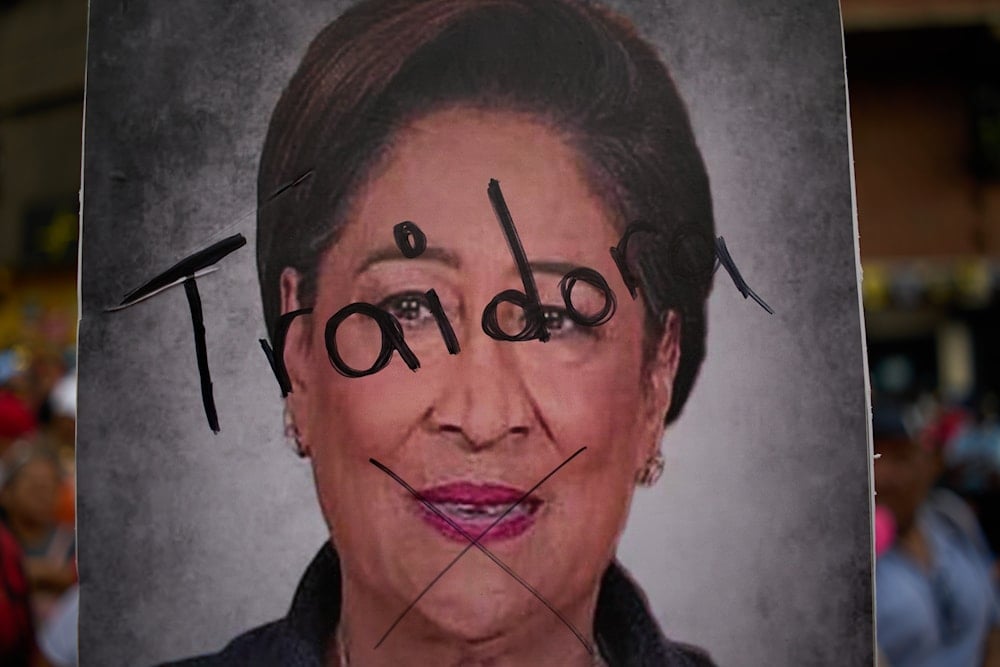
A poster of Trinidad and Tobago Prime Minister Kamla Persad-Bissessar hosts the Spanish word for "Traitor" on it during a government-organized march, in Caracas, Venezuela, Tuesday, Oct. 28, 2025 (AP)
The Trinidad and Tobago government is facing mounting scrutiny after confirming that a US military radar system and at least 100 American marines are currently stationed in the country, fuelling concerns that the Caribbean could be drawn into rising tensions between the US and Venezuela.
Prime Minister Kamla Persad-Bissessar initially sought to reassure the public following reports that a US C-17 transport aircraft had landed in the country, saying it was delivering personnel to assist with a road project and insisting no marines remained on the ground. However, videos and photographs circulating on social media later showed US Marines at a Tobago hotel, alongside images of a military-grade radar installation.
Pressed by reporters on Friday, Persad-Bissessar acknowledged the presence of the troops, as well as the installation of what is believed to be a long-range AN/TPS-80 G/ATOR radar system, manufactured by US defense contractor Northrop Grumman. She maintained the equipment was deployed strictly for counter–drug trafficking operations, arguing that the government had withheld information to avoid tipping off criminal groups.
The prime minister has denied allegations that the radar facility forms part of Washington’s pressure campaign against Venezuela, while Defense Minister Wayne Sturge insisted that “Trinidad and Tobago is not a launch pad for any military operations.”
Caribbean ancestors are all turning in their graves: Opposition figures
Opposition figures, however, have accused the government of misleading the public. Former national security minister Marvin Gonzales said Persad-Bissessar’s administration had “sold the soul of the nation for a mess of pottage,” warning that the move had betrayed the region’s longstanding principles. “Caribbean ancestors are all turning in their graves for what has befallen our beautiful Caribbean,” he said.
Echoing these concerns, David Abdulah, political leader of Trinidad’s Movement for Social Justice, accused the prime minister of being “complicit in the extrajudicial killings in the Caribbean Sea."
He added that “with the installation of a US military radar in Tobago, it is now directly involving the country in the US war plans. Our international reputation has been tarnished as the government unapologetically sides with the agenda of Washington.”
US escalates its anti-Venezuela campaign
This comes as the United States continues to escalate its campaign against Venezuela, with the alleged aim of curbing drug trafficking into the country.
On November 29, US President Donald Trump declared that the airspace over and around Venezuela is to be treated as completely closed, posting on Truth Social a message directed at airlines, pilots, drug traffickers, and human traffickers, urging them to consider the entire airspace above and surrounding Venezuela off-limits and warning that this restriction is to be enforced.
This follows remarks made by Trump, warning on November 27 that US operations against Venezuelan drug trafficking "by land" would begin very soon, claiming, "We've almost stopped — it's about 85% stopped by sea. The land is easier, but that's going to start very soon."
The closure declaration follows a substantial US military deployment to the Caribbean, the largest in decades. The USS Gerald R. Ford carrier strike group, including advanced fighter jets, warships, and over 15,000 personnel, entered the region in mid-November. Strategic B-52 bombers have also flown near Venezuelan territory, including a high-profile flight near Caracas on November 24.
These moves fall under Operation Southern Spear, a newly launched campaign targeting what Washington calls "narco-terrorist" threats in the Western Hemisphere. The US has already conducted over 20 maritime strikes on alleged drug trafficking vessels since September, killing at least 83 people.
Additionally, on November 24, the US designated the Cartel de los Soles as a "foreign terrorist organization." The US government alleges this "cartel" is led by Maduro and senior Venezuelan officials, though Venezuela rejected the designation as a "ridiculous fabrication".