
Water colonialism: How 'Israel' weaponizes the lifeblood of the Levant
-
 Rabih Abdallah
- Today 13:50
- 1 Shares
 8 Min Read
“Israel’s” domination of the Levant is built not only on land theft and military occupation, but on a regional system of hydro-colonialism that weaponizes rivers, aquifers, and water infrastructure to enforce dependence and control.
-

As long as water is colonized, life itself will remain under occupation. (Al Mayadeen English; Illustrated by Batoul Chamas)
Water is not just a natural resource in the Levant. It is the foundation of sovereignty, survival, and power. In this region, the deliberate control and redirection of water to entrench domination form the infrastructure of the Israeli occupation’s fantasies. "Israel's" colonialism is not only reflected in its domination of Palestinian society; it extends beyond that into a project of hydro-colonialism. To understand "Israel's" ambitions, and resist them, we must look not only at walls and settlements, but also at rivers, aquifers, and water infrastructure. Hydro-colonialism is the hidden architecture of domination. Water sovereignty for native communities is not a peripheral demand; it is a precondition for sovereignty and liberation.
From the aquifers of the West Bank to the snow-fed headwaters of Jabal al-Sheikh [Mount Hermon] and the rivers of Lebanon, "Israel" has built a colonial order that captures and weaponizes water. The case of water colonialism in the Levant demonstrates that scarcity is man-made, produced by systems of domination that "Israel", as a colonial project, epitomizes. In Palestine, water scarcity is shaped by Israeli policies that determine who drinks and who does not, who farms and who must abandon their land, and, most importantly, who is made dependent and who dictates the region’s future.
Apartheid by the tap
"Israel's" hydro-colonialism manifests as an instrument of apartheid in Palestine. In the West Bank, inequality is inscribed into the landscape: settlers enjoy irrigated gardens and swimming pools while Palestinian villages ration water by the bucket. Since 1967, "Israel" has asserted complete control over Palestinian water, requiring permits, almost never granted, for drilling wells, laying pipes, or repairing infrastructure.
A B’Tselem report reveals a brutal arithmetic of domination. Israeli settlers consume an average of 247 liters per person per day. Palestinians in the West Bank survive on less than 80 liters per day, and in some rural areas, consumption falls below 30 liters per person per day. This allocation is far below the 100 liters per day that the World Health Organization considers the minimum for basic health.
Controlling people’s lives through water is a colonial tactic adopted by the Israeli government, and it is not unique to "Israel". A similar dynamic persisted in South Africa even after the formal end of apartheid. During prolonged droughts, Black communities saw their water supply rationed while water parks in white urban neighborhoods continued operating as usual. What "Israel" exercises in Palestine is the epitome of colonial domination. Nowhere is water colonialism clearer than in Gaza.
Gaza, under siege for nearly two decades, is the most brutal face of "Israel's" water colonialism. According to UNICEF, nearly every drop of Gaza’s groundwater is now unfit for human consumption. The Israeli blockade has not only strangled fuel and goods; it has corroded the very arteries of life. "Israel" prohibits the repair of pipes and wells, then bombs whatever infrastructure remains. Families survive on trucked water rations, and desalination plants sputter whenever fuel is withheld. Gaza’s thirst is no accident. It is a system of deliberate, slow asphyxiation, where scarcity itself becomes a weapon of domination.
In occupied Palestine, apartheid by the tap, where Israelis enjoy water abundance while Palestinians are forced into engineered scarcity, makes clear that "Israel's" control over water is not just a symptom of occupation but one of its central mechanisms.
Colonialism Beyond Palestine: Jabal al-Sheikh, the Jordan River, the Litani, and the Wazzani
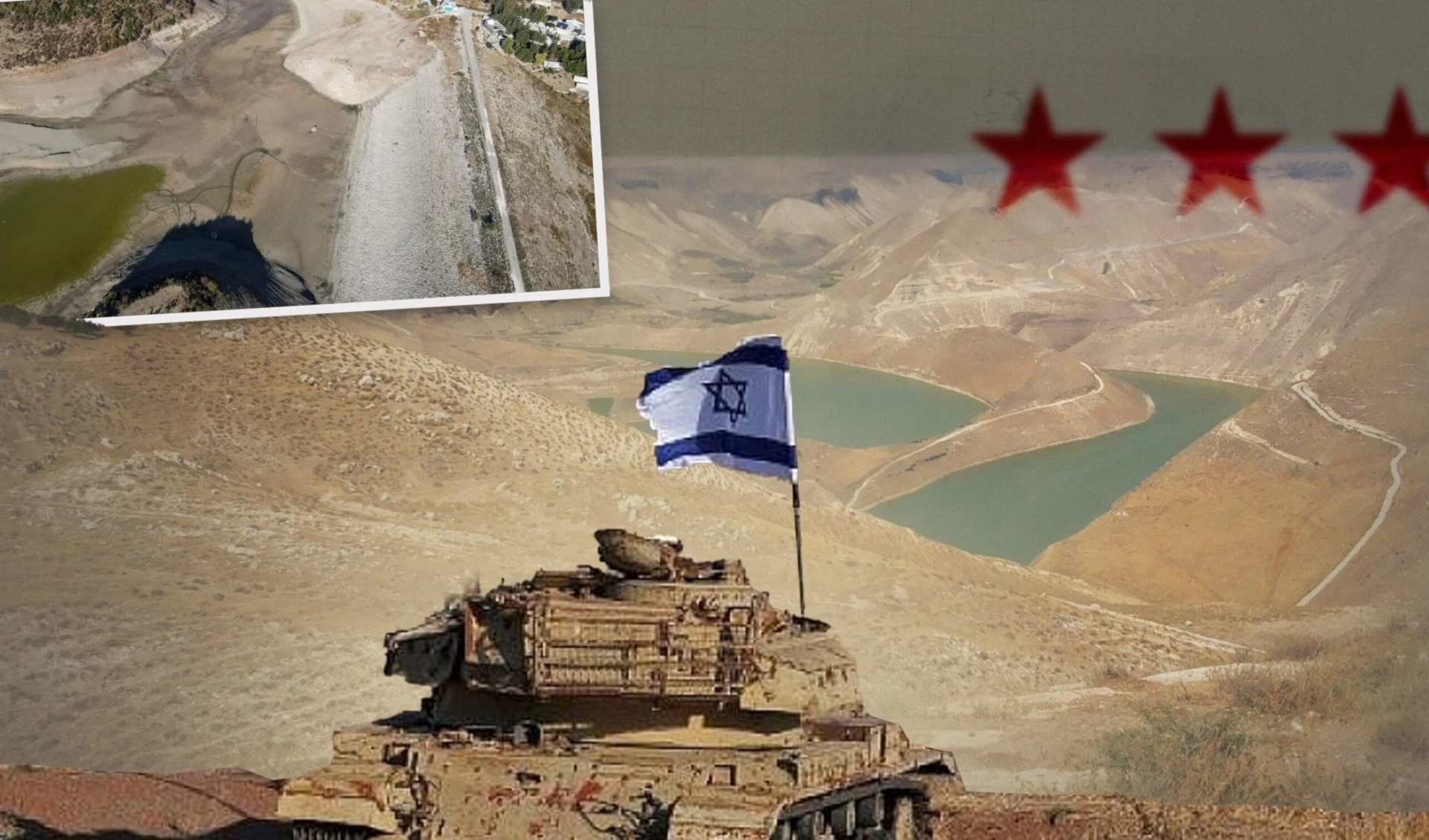
Hydro-colonialism does not end at the so-called "Green Line". It is a regional project that extends "Israel's" power far beyond occupied Palestine, reshaping watersheds and redefining political relations.
The Jordan River originates in the snows of Jabal al-Sheikh and the Yarmouk, shared between Jordan and the Israeli settler-colonial entity. Since the 1960s, "Israel" has diverted and dammed the river to feed its "National Water Carrier". Today, the paradox is glaring: Jordan, one of the most water-scarce countries on earth, is forced to buy water from Israel, pumped from their common river. Hydrological power has been transformed into political leverage.
Jabal al-Sheikh, described in Israeli military discourse as “the Eyes of the Nation,” is another emblem of colonial hydro-politics. Its snowmelt, originating largely in Lebanese and Syrian territory, flows south into the Jordan basin, sustaining agriculture, cities, and industry downstream. Yet neither Lebanon nor Syria benefits from this flow. Since occupying the Golan Heights in 1967, "Israel" has ensured that the headwaters of this vital system remain under its control. Here, colonialism is not only about territory, it is about seizing the very origins of life.
Lebanon’s rivers reveal the same story. "Israel's" longstanding ambition to divert the Litani River has shaped Zionist strategic thinking since the early years of the project, during which the proposed partition of “Israel” included the Litani within its borders. But the Litani is only part of the picture. The Wazzani springs, which feed the Hasbani River, have been a persistent flashpoint.
When South Lebanon attempted in 2002 to pump a minimal share of Wazzani water, less than what the 1955 Johnston Plan allocated, Israel threatened war. Hezbollah vowed to retaliate, and the crisis ended only after Western mediation. The pump was built, but in 2006 "Israel" bombed the Wazzani station during its war on Lebanon, crippling local supply. In the 2024 war, Israeli strikes again targeted the station, demonstrating "Israel's" hegemonic fury toward even the smallest attempt by Lebanon to exercise water sovereignty.
This is colonialism without borders. "Israel" recognizes no limits—geographical or political. It is an expansionist ideology that claims not only land but also rivers and springs that never cross into its territory.
Climate crisis as colonial opportunity
As the region warms at nearly twice the global average and droughts intensify, the colonial stakes of water control grow even higher. "Israel" markets itself as a “water superpower,” exporting desalination technology and selling water to Jordan and the Palestinian Authority. But beneath this narrative of innovation lies a reality of deliberate dependence: the same state that markets water abroad denies it at home to those under its occupation.
Palestinians, prohibited from building wells or modern irrigation systems, are structurally prevented from adapting to climate change. As aquifers dry and rainfall declines, farmers lose crops, families are displaced, and economic dependency deepens. Environmental stress becomes a tool of colonial control.
Meanwhile, Lebanon and Syria, weakened by war and economic crisis, lack the capacity to assert their water rights. Jordan remains trapped in unequal arrangements that ensure its reliance on Israeli water. Climate change, a planetary emergency, thus becomes an opportunity for "Israel" to entrench hydro-hegemony, turning ecological vulnerability into geopolitical power.
The struggle for life
The great error in mainstream narratives about water in the Levant is the assumption that scarcity is natural or the inevitable result of arid geography, overpopulation, or climate change. Scarcity here is engineered by the Israeli colonial project.
Scarcity is weaponized to sustain "Israel's" hydro-hegemony. Rivers do not dry by accident; they are diverted. Wells do not empty by chance; they are placed under military permit regimes. States do not become dependent by choice; they are rendered dependent through decades of deliberate hydrological domination.
Understanding hydro-colonialism allows us to grasp the deeper structures of the Zionist project, to look beyond the visible superstructures and into the underground infrastructures of colonialism.
Until the waters of the Levant run free, from the snows of Jabal al-Sheikh to the wells of Gaza, from the Litani to the Jordan, the region will remain captive to the Zionist project. As long as water is colonized, life itself will remain under occupation, demanding cultural, political, and armed resistance to reclaim sovereignty over our lives and resources.


