
Who is Reza Pahlavi, the 'war on Iran' flimflammer?
 8 Min Read
The Pahlavi dynasty is notorious in the Iranian psyche for failing to protect Iran’s territorial integrity and ceding major territories during its reign over Iran, but the unscrupulous “royal” swindling for a war against Iran is a new low.
-
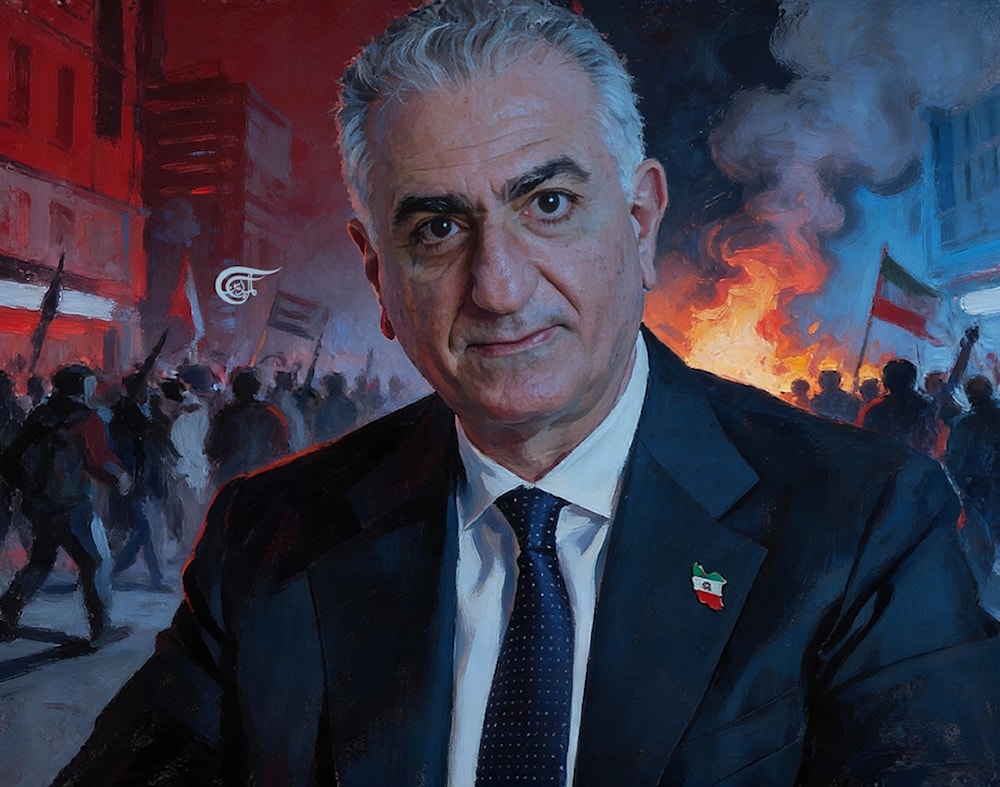
Reza Pahlavi fueled deadly unrest in Iran, backing foreign agendas (illustrated by Zeinab al-Hajj for Al Mayadeen English)
For over four decades, Reza Pahlavi, the son of the deposed Shah of Iran, and the self-appointed “Leader of the National Uprising,” has called on the Iranian people to overthrow the government and to put him back on the throne. Pahlavi considered himself “the guardian of the monarchy” in exile, but over the years, he received minimal attention, and only from Iranians in diaspora.
As an “opposition by profession,” Pahlavi had made the rounds to every Iranian adversary to seek support. In the 2000s, Pahlavi approached the American-Israel Public Affairs Committee (AIPAC)— a lobby group that exerts influence in the US to garner support for the Zionist regime’s nefarious actions in West Asia. When the diplomatic ties between Iran and Saudi Arabia were severed, Pahlavi courted Saudi Arabia.
Pahlavi, at some point, recognized that he had no prospect of becoming the “King of Iran” and lost his thirst for the throne. He publicly acknowledged, “I have said time and again that I am not running for any office… because honestly, my life has been for the past 40 years here in America; my children live here; my friends live here; every body that I know is here, so if I was to go back [to Iran], what do I go back to?”
In January 2023, a monarchist in Pahlavi’s inner circle launched an online campaign labeled “Reza Pahlavi is my Representative.” The campaign sought “to help the people of Iran to express their opinion.” Despite the overwhelming coverage by the foreign-state-funded Farsi media, the campaign could not garner more than 500,000 signatures from over 95 million Iranians inside and outside Iran. Many believe that even this insignificant number is not obtained but by bots.
The failed online coronation campaign was a turning point in Pahlavi’s political performance. In April 2023, Pahlavi paid his first official visit to Tel Aviv, where he met with the Zionist regime’s officials, including his soon-to-be handler, Gila Gamliel, the intelligence minister.
As Pahlavi was becoming a less desirable asset to the European intelligence and security apparatus, his desire to be vindicated as a relevant opposition figure was growing stronger. The Zionist regime had a moment of epiphany that Pahlavi’s flair for fanning a war against Iran could be put to work. His Tel-Aviv-based handlers saw this as an opportunity to employ Pahlavi as the flag bearer of the war against Iran.
Flag-bearer of war on Iran
During the US-Zionist blitz attack on Iran in June 2025, not only did Pahlavi fail to condemn the attack, but he also participated in the war propaganda in unison with Trump and Netanyahu. The Iranian Gen-Z responded from the streets of Tehran with the messages of “f*** you Netanyahu.”
By failing to condemn the attacks on Iran, Pahlavi quickly squandered the support he may have had among the Iranians in diaspora. The hope for the outcome of a US-Zionist attack on Iran was “UNCONDITIONAL SURRENDER". That never happened. The next phase started just six months later.
In December 2025, protests erupted due to an unusually high currency rate fluctuation in Iran. The protests continued for several days peacefully, but in a coordinated operation, on June 8 and 9, cells of Mossad mercenaries responded to Pahlavi’s call for “chanting slogans simultaneously at 8 PM” in Iran for the next two nights.
In some of the smallest and largest cities in Iran, cells of masked, dressed-in-black elements infiltrated the crowd of protesters and turned the protests into “urban warfare". These cells were armed with an array of weapons from flamethrowers and Molotov cocktails to machetes and shotguns. They would act quickly and in coordination to wreak havoc by attacking the police and civilians and burning buildings, banks, and mosques.
In the presence of the police and security forces, these terrorist cells would position themselves in the crowd of protesters and shoot at the security forces from within the crowd to maximize casualties. Although hundreds of security forces were shot from within the crowd, many of the victims were not even among the protesters or the security forces. Many also lost their lives because fire departments, ambulances, and medical centers were under attack.
In the face of a large-scale terrorist attack, Iran mobilized its counter-terrorism special forces and cut off access to international calls and the internet throughout the country. With the loss of contact and coordination, the mayhem dissipated quickly. Over the next few days, Iranian security forces arrested hundreds of ringleaders and rioters.
While heavily armed Kurdish terrorist groups were involved in armed clashes with the security forces in western provinces, a large number of Mossad assets who were arrested in Tehran and other larger cities were young elements, between the ages of 17 and 23. Many of the arrested elements, including minors and vulnerable individuals, were recruited and radicalized on social media platforms and groomed for terrorism.
After cheerleading the 12-day imposed US-Zionist war on Iran, Pahlavi instigated a 2-day “urban warfare” against Iran with the help of Mossad mercenaries on the ground. The bloody terrorist attack resulted in the loss of 2,427 lives. When asked by CBS News about his responsibility for the death toll, Pahlavi openly said, “This is a war, and war has casualties.”
With the mounting death toll, the anti-Iran Human Rights Industry and the US regime change NGOs quickly raised the alarm about the “brutal crackdown” on “peaceful protesters". An investigation found a coordinated network of Zionist astroturfers, masquerading as “Iranian people", pushing to shape the narrative about the Iranian protests and calling for “foreign help".
While Pahlavi was in command and control of the urban war from his royal war room in exile, an anti-Iran analyst on the Zionist regime’s Channel 14 was hoping and praying that the US would strike Iran. Wearing a sinister smile, the analyst salivated over the prospect of turning Iran into “one big shooting range,” just like Syria, which would be “a significant strategic achievement for Israel.”
For the Zionist regime, Pahlavi is only one tool in the toolbox that can be used to propel its expansionist schemes. With all major countries in the region under the US military control, Iran remains the only viable obstacle to the Zionist regime’s expansion into the so-called “Greater Israel”.
The Zionist regime sees Iran as its archenemy because, for decades, the Zionist occupation attempts in Lebanon, Syria, and Palestine were thwarted by the Home Guards with the support of Iran. The Zionist regime has carried out acts of sabotage, espionage, terrorism, and assassinations inside Iran to weaken the only hurdle to its expansionist ambitions.
As for Pahlavi, years of unheeded calls to action may have genuinely caused him anger and vindictiveness toward Iranians, and Pahlavi’s actions and ideology may be driven by a desire for revenge. Yasmine Pahlavi, the wife of Reza Pahlavi, once posted on Instagram that while her husband has not forgotten Iran, he is the one who should distrust the Iranian people and hold a grudge against them for causing pain to his family [referring to the Iranian revolution of 1979].
Pahlavi’s malevolence may be motivated by revenge, but his actions are also fueled by a desire to stay relevant as a “professional opposition” in the multi-billion-dollar “Iranian Opposition” industrial complex.
The Pahlavi dynasty is notorious in the Iranian psyche for failing to protect Iran’s territorial integrity and ceding major territories during its reign over Iran, but the unscrupulous “royal” swindling for a war against Iran is a new low, even for the cursed Pahlavi dynasty.


