
At the edge of the Strait: A superpower in a narrow sea
-
 Mahmood R. Rehman
- 3 May 2026 10:18
- 4 Shares
 7 Min Read
Mahmood Rehman, drawing on his maritime experience, argues that US naval dominance in Hormuz does not translate into control in confined waters. Washington is strategically trapped, facing Iran’s asymmetric strengths in a narrow and high-stakes maritime environment.
-
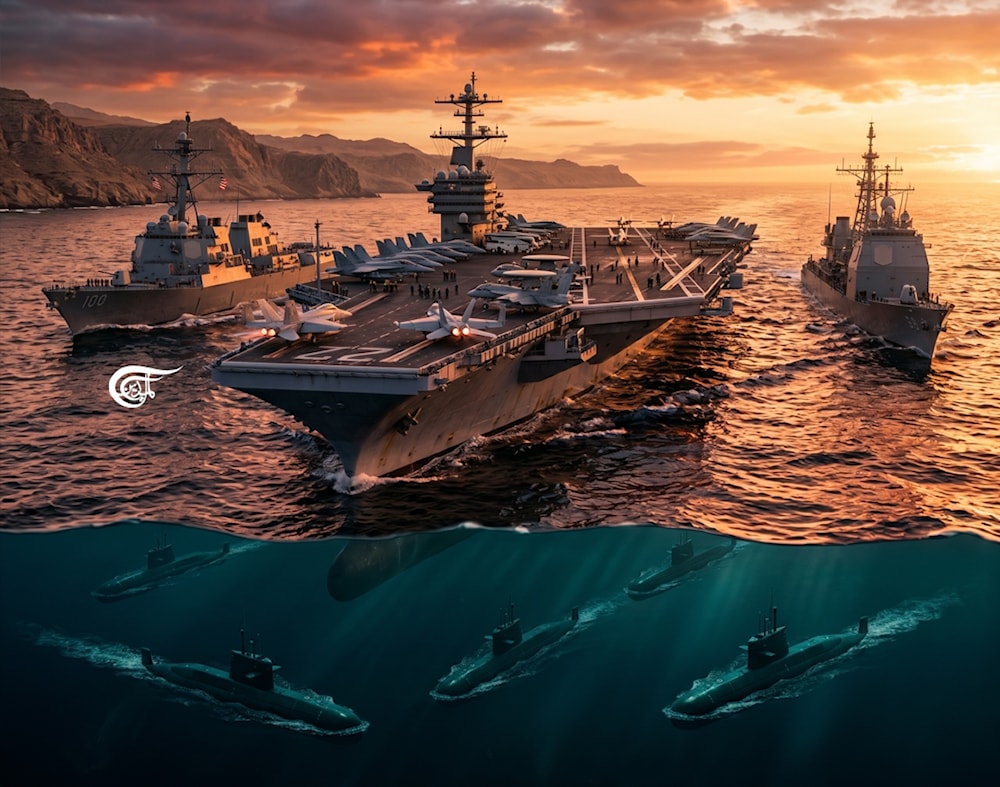
It is often in the narrowest waters that the greatest caution is required. (Al Mayadeen English; Illustrated by Zeinab el-Hajj)
I have spent a good part of my professional life at sea, and I say this without hesitation: there are few waterways in the world as unforgiving, as deceptive, and as strategically consequential as the Strait of Hormuz. It is not just a stretch of water; it is a pressure point of the global economy. When tension rises here, the entire world feels it—from fuel pumps in America to kitchen tables in South Asia.
What we are witnessing today is not merely a regional conflict. It is a strategic impasse in one of the most sensitive maritime corridors on earth. The United States has deployed significant naval power into the region. Carrier strike groups centred around the USS Dwight D. Eisenhower, USS Theodore Roosevelt, and USS Gerald R. Ford are operating alongside cruisers, destroyers, frigates and replenishment tankers. Along with them are nuclear-powered guided missile submarines of the Ohio-class submarine type, carrying formidable strike capability. With over two hundred and fifty aircraft embarked across these platforms, the sheer scale of deployment is impressive by any standard.
Yet, having commanded ships myself, I know that numbers and tonnage do not always translate into control, especially in confined, contested waters.
The stated objective appears straightforward: enforce a maritime blockade of Iranian ports and ensure unhindered passage through the Strait of Hormuz. But here lies the irony. The Strait, by most accounts, was already open before the escalation. What has changed is not the physical state of the waterway, but the political and military environment surrounding it.
Iran’s recent offer has placed Washington in a difficult position. It has indicated willingness to ensure the Strait remains open, on its own terms, provided the United States lifts the blockade and shows flexibility on the timing of nuclear negotiations. Accepting such an offer risks appearing to concede under pressure. Rejecting it prolongs a costly and increasingly unpopular confrontation.
And cost is now becoming the defining factor.
Fuel prices have risen. The ripple effect is visible in everyday commodities. The American public, which never truly supported this war, is beginning to feel the burden directly. Wars fought thousands of miles away eventually find their way into domestic politics, and this one is no exception. The narrative of a swift and decisive operation has long faded. What remains is a grinding reality.
There is also a growing perception (rightly or wrongly) that this was not entirely America’s war to begin with. Many point towards the long-standing position of Benjamin Netanyahu, who has, for decades, articulated a hardline stance against Iran. Previous US administrations, including those led by Barack Obama, Joe Biden, George W. Bush and Bill Clinton, exercised caution in this regard. They understood, perhaps better than most, that Iran is not an easy adversary.
And this is where, in my professional judgement, the conversation must turn towards Iran’s maritime capability, often underestimated, sometimes misunderstood, but very real.
Iran does not seek to match the United States ship for ship. Instead, it has built what we in naval terms would call an asymmetric maritime strategy. Its so-called “mosquito fleet” consists of numerous fast attack craft -- small, agile, heavily armed platforms that can swarm larger vessels. Operating from concealed bases along the coastline and from island positions, these units are difficult to detect and even harder to neutralize in large numbers.
Then there are the Ghadir-class submarines, small, quiet, and ideally suited for the shallow waters of the Gulf. These are not platforms designed for long blue-water patrols; they are designed for ambush. In confined waters, that makes all the difference.
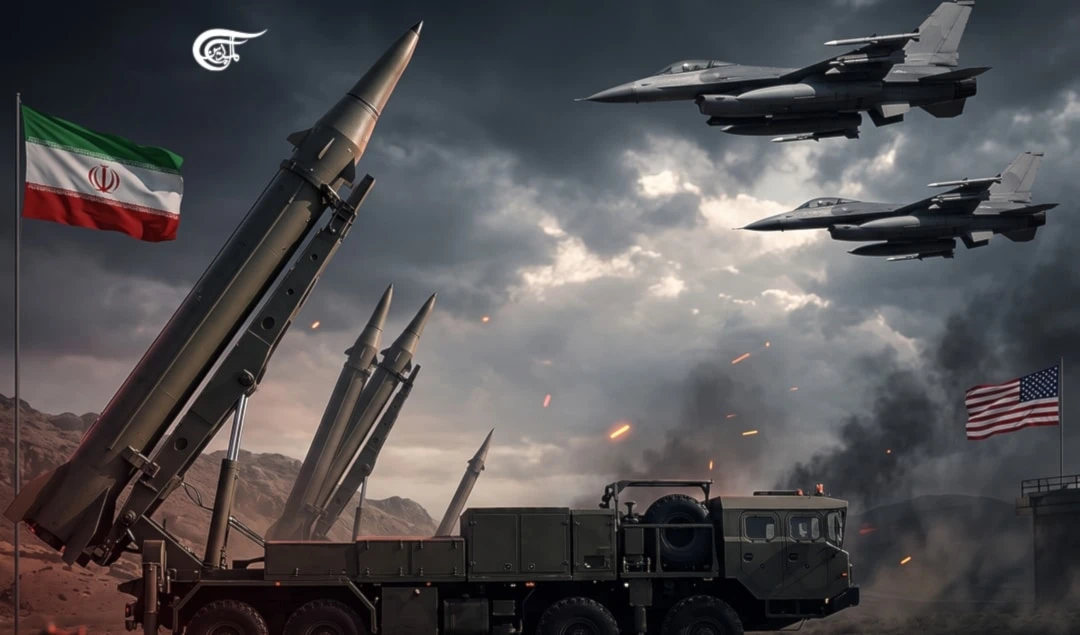
But perhaps the most serious threat comes from naval mines. Mines are the poor man’s weapon, but they are brutally effective. A relatively small number, deployed intelligently, can disrupt shipping lanes, halt commercial traffic, and force even the most advanced navy into slow, methodical clearance operations. And mine clearance, particularly under threat from drones, missiles and fast attack craft, is not a quick or easy task. It is painstaking, dangerous, and time-consuming.
I have seen operations in constrained waters. I know how quickly a tactical situation can become complicated. In the Strait of Hormuz, where geography itself favours the defender, the challenges multiply.
And this is where the United States finds itself today: powerful, present, but not entirely in control of the outcome.
There is no clear exit strategy. Escalation carries risks of wider conflict. De-escalation risks loss of face. It is, quite literally, a classic case of being caught between two difficult choices.
Adding to this complexity is the broader geopolitical picture. Statements from Russian President Vladimir Putin, particularly in his engagement with Iranian leadership, signal that Russia is watching closely and is not indifferent to the outcome. China, on the other hand, observes with strategic patience. A United States deeply engaged in the Gulf has fewer resources and less attention to devote to the Indo-Pacific. For Beijing, that is a development of interest.
Meanwhile, American allies are beginning to reassess. Commitments are being questioned. Expectations are being recalibrated. In international relations, perception often matters as much as reality.
From where I stand, this entire situation carries the unmistakable signature of a strategic miscalculation. Not in terms of capability (the United States has overwhelming capability), but in terms of expectation. This was never going to be a simple operation. Iran is not a theatre where outcomes can be dictated quickly.
Let me put it in simpler, more human terms.
There is an old story I once heard from my Pathan elders back in Peshawar. A man was walking along a riverbank when he spotted what looked like a blanket floating in the middle of the river. Ignoring the warnings of his friends, he jumped in to retrieve it. He swam hard and reached the object—only to realize that it was not a blanket at all, but a brown grizzly bear. The bear grabbed him instantly. His friends shouted from the shore, “Leave the blanket and come back!” The man shouted back, “I am leaving the blanket—but the blanket is not leaving me”. This saying suits USA so well.
That, to me, is where this conflict stands today.
The United States may well wish for a quick and honourable exit. But the situation it has entered into is not easily disengaged from. Iran, having endured and adapted, now seeks closure on its own terms. And so, Washington finds itself in a difficult position: proceed and risk deeper entanglement, or pull back and face the consequences.
Damned if it does, and damned if it does not.
In the end, the Strait of Hormuz will remain what it has always been, a narrow passage with very wide consequences. And as I have learned over the years at sea, it is often in the narrowest waters that the greatest caution is required.


