
From a yearning son to Sayyed Hassan: When absence becomes Yusuf
 4 Min Read
Mohammad Ali Nasrallah pens a heart-wrenching tribute to his father, Sayyed Hassan, tracing the sorrow of absence, the weight of loss, and the enduring memory of a love rooted in faith and sacrifice.
-
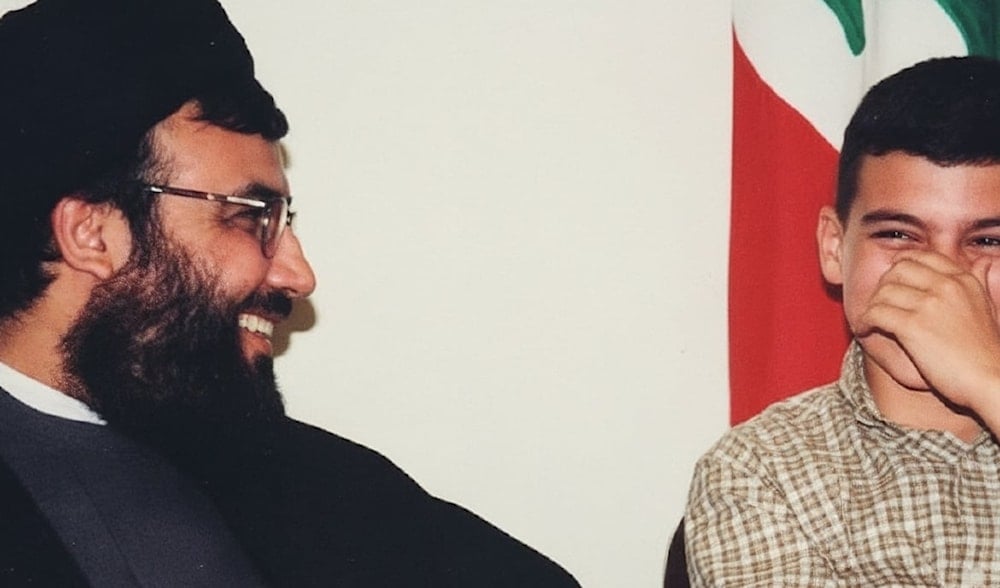
An undated image of martyr Sayyed Hassan Nasrallah and his son Mohammad Ali Nasrallah
When absence becomes [Prophet] Yusuf [Joseph] and the heart turns into a well...
History is a synonym for stories, and we are the children of the tale we ourselves write.
You, my father, had no vision I could interpret, nor did suns or moons bow before you; yet you were like Yusuf, choosing absence of your own will, withdrawing into the hermitage of duty, far from [his father, Prophet] Yaqoub [Jacob].
In this prophetic tale, we exchanged roles: you were its Joseph, serene in his destiny, and I was your Jacob, whose sight was eaten away by waiting. However, neither did absence dim your presence, nor the grave your generosity. O noble-souled, beautiful of countenance, send me a breeze carrying the scent of Yusuf from those distant lands to console me.
You lived in the heart of a nation exhausted by drought, and God grew the wheat of dignity within you, filling its granaries with the meanings of sacrifice. You taught us how to become a sword in its sheath, drawn only for the triumph of truth, and showed us that a true ruler does not wield the kingdom for himself but lays it gently in the hands of his people, even at the cost of his own soul.
O' greatest of stories, no darkness of any well could ever veil you from my heart. For 34 long years, my soul became a wandering caravan, collecting fragments of your virtues. I carried along a flask filled with the scent of your commandments, their wisdom lighting my path whenever I feel lost in this world.
O' master (Sayyed) of grace, how can anyone who drank from your cup ever thirst? How can a hand that once held yours ever lose its way?
O' master of gentleness, the faces of the faithful held you as you passed by, like a breeze, joking with the fighters and embracing them with a kindness they had never since forgotten.
You were a secret whose joy we tightly guarded, not out of shame, but out of care, lest a prying eye catch your scent among us, lest others know when the moon would rise among us.
You were both the vision and its interpretation, and I, grieving as I am, long for a dream in which to see you. O' valorous [Prophet] Ibrahim [Abraham], who lived the truth of devotion, and rose among his people a guardian of truth and dignity, entrusted with the sustenance of the hungry and the oppressed.
The chilled cup of worldly comfort never swayed you. Instead, you walked beside the fighters, bearing the searing weight of struggle, fearing for their lives more than your own.
O moon-faced one, who chose September for rest…did your light truly reach its full radiance in the sky of lovers, that they might be guided by you when their paths go astray?
Letters now bear the mark of farewell, yet here I meet you, between the lines and in the hidden folds of words, to find a father made of light, a shade beneath which I take refuge whenever the heat of longing overwhelms me.
Every time I tell this story, another line of sorrow etches itself into the fabric of my years, a wound no balm can soothe but reunion. If only the well had been my heart, O' father; if only the shirt that restored my sight were my present moment.
But loss is a wolf from which no soul escapes. And Yaqoub must wait, steadfast, eyes fixed on the horizon of the promise, until the Quranic verse is realized: "Among the believers are men who were true to their covenant with Allah; some of them have fulfilled their vow (by martyrdom), and some are still awaiting, and they have not changed in the least."
[Editorial note]
[A son’s farewell read through the story of Prophet Yusuf]
[The story of Prophet Yusuf begins with a well, a place of darkness, abandonment, and the illusion of loss. Cast away by his own brothers, Yusuf disappears from the life of Prophet Yaqoub, his father. Yet he is never beyond God’s care. His journey through exile and injustice becomes the very path that refines him and allows him to return to his family a nobleman.
Yaqoub, blinded by grief but not by doubt, clings to the certainty that “Yusuf is not dead,” trusting in a promise no one else could see. When Yusuf’s shirt is finally brought back, its scent restores sight and reunites hearts.
In Mohammad's letter to his martyred father, this narrative becomes a living metaphor: the father as a modern Yusuf, choosing the well of duty and disappearance for the sake of his people; the son as Yaqoub, whose eyes are dimmed by yearning yet sharpened by faith; and the memory of the father lingering as the “scent of the shirt," a presence strong enough to guide him even throughout the darkest stretch of the journey.]
*Translated by Rasha Reslan*


