
British Museum removes Palestine from display
 4 Min Read
The British Museum removes Palestine from its ancient West Asia displays after complaints over "anachronistic terminology and historical accuracy."
-
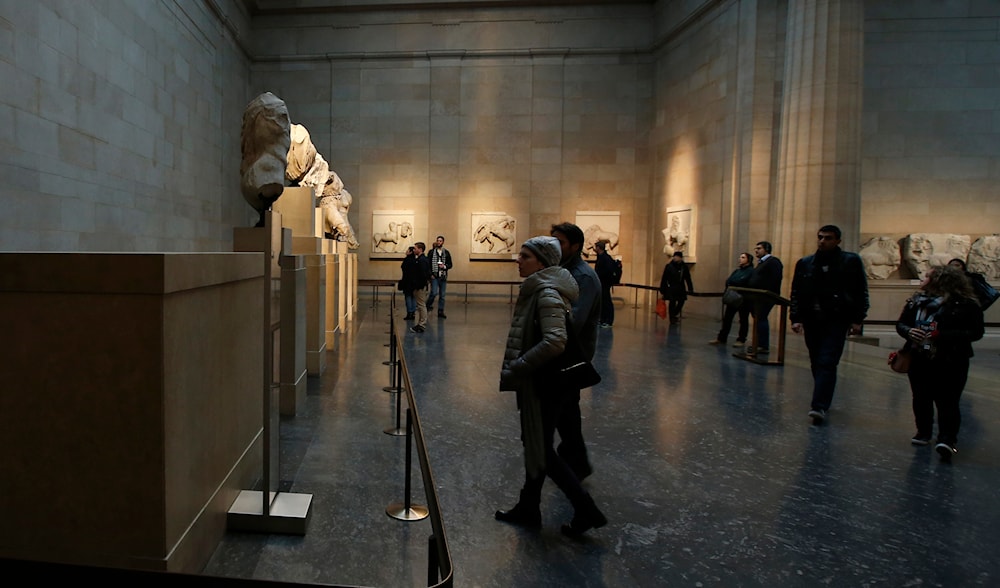
Visitors look at the empty plinth where a headless reclining male statue depicting the Greek river god Ilissos lay, until it was loaned out by the British Museum to the Hermitage in Russia, at the museum in London, on December 5, 2014. (AP)
The British Museum has removed the word Palestine from several displays about ancient West Asia following complaints that the term was being used anachronistically, a move that has sparked debate over historical narratives and modern political sensitivities.
Maps and information boards in galleries covering ancient Egypt and the Phoenicians had labeled the eastern coast of the Mediterranean as Palestine, while some peoples were described as being "of Palestinian descent." Some parties then argued that the museum was applying the term retroactively to regions and civilizations that existed before the word came into use.
Curators later said that the word was not "meaningful" as a historical geographic term in certain ancient contexts, garnering criticism for the move.
Read next: Does UK's recognition of Palestine atone for Balfour's sins?
The changes were made following audience research and concerns raised by UK Lawyers for Israel, an Israeli lobby group that has been implicated in anti-Palestinian and Islamophobic actions over the past years.
In a letter to Nicholas Cullinan, the museum’s director, the group wrote: "Applying a single name, Palestine, retrospectively to the entire region, across thousands of years, erases historical changes and creates a false impression of continuity."
The museum has since altered certain displays and confirmed that additional panels are under review.
Historical names of the southern Levant
The western Asian region has been known by several names throughout history. One of the earliest prominent terms is Canaan, referenced in ancient texts dating back to around 1500 BC. The area was often controlled by smaller powers, including the Philistines. A 1200 BC Egyptian inscription contains one of the earliest known mentions of a kingdom called Israel, though short-lived, and several centuries later, an Assyrian text refers to "Judah."
Greek sources later described the land of the Phoenicians, centered around what is now Lebanon. The historian Herodotus is widely believed to have made one of the earliest textual references to Palestine in the fifth century BC. The term was subsequently used during the Roman and Byzantine periods to denote a province in the region. Following the Muslim conquest in the 7th century, the area was Arabised.
Read next: Koufiyyeh's artistic dissent stirs Israeli trepidation
By the late 19th century, Palestine had become a commonly used geographic term for the southern Levant, widely used in academic, cartographic, and administrative contexts.
Changes to the Hyksos and Phoenician Panels
Concerns were raised specifically about the museum’s use of the term Palestine in displays covering the period from approximately 1700 to 1500 BC. An exhibition described the Hyksos people of the Nile Delta as being of "Palestinian descent." That wording has now been changed to read "Canaanite descent."
A map covering Egypt’s New Kingdom period had also described Egyptian forces as having "dominance in Palestine." Additionally, the Phoenician civilization was described as being based in Palestine. The museum said such panels are being reviewed on a case-by-case basis as part of its broader master plan for redisplay and reconstruction, with further revisions expected in the coming years.
A British Museum spokesman said: "For the Middle East galleries for maps showing ancient cultural regions, the term ‘Canaan’ is relevant for the southern Levant in the later second millennium BC," adding: "We use the UN terminology on maps that show modern boundaries, for example, Gaza, West Bank, Israel, Jordan, and refer to 'Palestinian' as a cultural or ethnographic identifier where appropriate."


