
'Israel' uses archaeology to expand control over Palestine's Sebastia
 6 Min Read
A 2,068-dunam expropriation order around Sebastia threatens Palestinian olive groves and livelihoods as UNESCO warns the historic site faces serious risks.
-
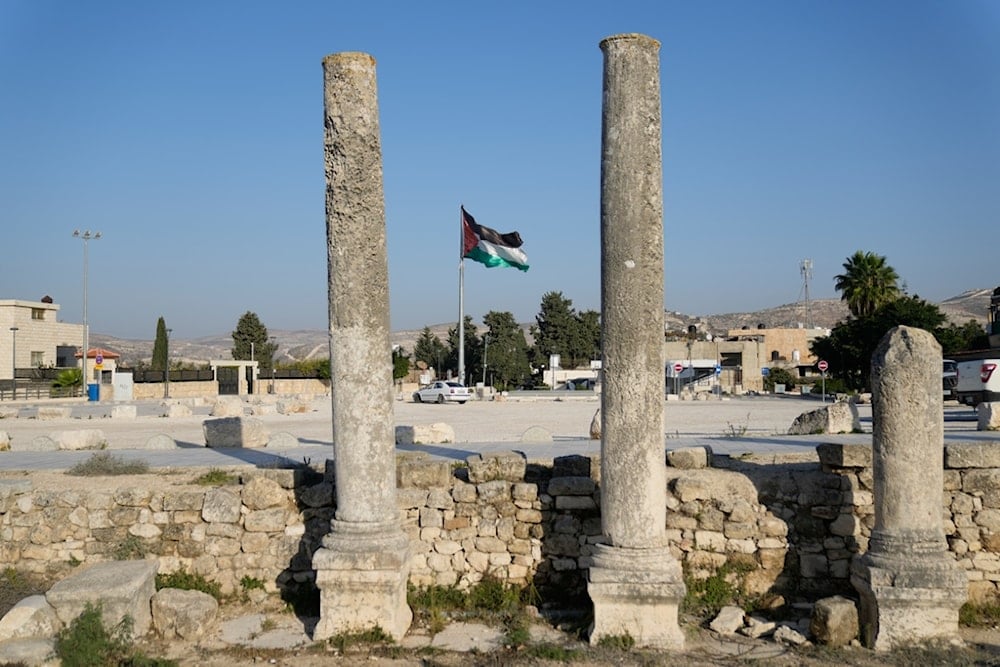
A Palestinian flag flies over the Roman historical site in the West Bank town of Sebastia, Thursday, Nov. 20, 2025. (AP Photo/Nasser Nasser)
“Israel” has ordered the expropriation of more than 2,000 dunams (200 hectares) of Palestinian land around Sebastia in the occupied West Bank, including agricultural land surrounding the town’s historic archaeological site, The Financial Times (FT) reports.
The February 2026 order has drawn opposition from Palestinian residents and heritage experts, who say the measure extends far beyond the archaeological site itself and threatens Palestinian land, livelihoods, and control over a historically significant area. Palestinian officials have stated that the move as part of broader settlement expansion and efforts to consolidate control over the occupied West Bank.
The residents of Sebastia have challenged the expropriation before “Israel’s” High Court, while heritage organization Emek Shaveh has provided an archaeological and legal opinion opposing the measure.
Read more: US Democrats push sanctions over Israeli E1 settlement project
Land seizure threatens Palestinian olive groves
For residents such as heritage researcher and local council member Zaid Azhari, the threatened loss is not limited to agricultural income.
Azhari's family has cultivated olive groves on the land for generations, with the proceeds helping finance his university education.
“I feel like families when they lose one of their children,” Azhari told FT. “It’s not just about losing financial income. It’s about being part of the land, belonging to the land. And that connection is being taken away.”
Sebastia Mayor Mohammed Azem said the expropriation order, together with land already confiscated, covers around 55% of the town’s territory. He said approximately 560 families own plots affected by the order, containing more than 6,000 olive trees.
FT reports that Israeli authorities have presented the expropriation as a temporary measure intended to preserve, restore, and safeguard Sebastia’s archaeological remains. The Israeli occupation has also accused the Palestinian Authority of neglecting the site.
Temporary measures by Israeli authorities are known to be anything but temporary; military buffer zones that the Israeli occupation often implements are usually used as a pretext for permanent settlement.
The archaeological complex contains remains from multiple historical periods, including the Iron Age, Hellenistic, Roman, Byzantine, medieval, and Ottoman eras. UNESCO states Sebastia is a multi-period site whose remains document successive civilizations dating back to the ninth century BCE.
Palestinian residents and archaeologists, however, reject the claim that the site requires the seizure of surrounding privately owned Palestinian land for its protection.
Alon Arad, head of Emek Shaveh, said the expropriation represents the use of archaeology and heritage in a broader political process.
“The order is not justified: not legally, not professionally, not ethically,” Arad told the news outlet. “This expropriation shows more than anything the weaponisation of heritage and archaeology, and the way they are being manifested into an annexation programme that has nothing to do with archaeology or heritage.”
The United Nations Independent International Commission of Inquiry has documented the expansion of Israeli administrative control over archaeology in the West Bank, noting that responsibility for archaeological sites was transferred in 2023 and that legislation has been advanced to allow the Israeli Antiquities Authority to operate directly in the occupied territory.
Read more: West Bank annexation: decades of settlements, control, and expansion
Heritage dispute extends beyond Sebastia
Sebastia is not the only Palestinian archaeological site affected by expanding Israeli occupation.
Land has also been stolen around Herodium and Nabi Samwil, while Israeli authorities have expanded the role of their archaeological administration in parts of the West Bank.
In August 2026, an Israeli government program involving approximately 113 million shekels ($37 million) was announced for the development and preservation of more than 70 archaeological and heritage sites in the occupied West Bank.
Heritage experts say the concern is not the preservation of archaeology itself, but who controls the land, how historical narratives are presented, and whether archaeological development is being used to facilitate permanent territorial control.
“When you cherry-pick only Zionist or Jewish sites and then invest a lot of money in them, you create the impression that the whole area is Jewish or exclusively Jewish, and you hide or destroy other types of history,” Arad told FT.
UNESCO places Sebastia on World Heritage in Danger list
The dispute gained an international dimension in July 2026, when UNESCO's World Heritage Committee inscribed Sebastia on the World Heritage List and simultaneously placed it on the List of World Heritage in Danger. UNESCO identified the land expropriation plans as a direct threat to the site's integrity, alongside other pressures resulting from the division and administration of the territory.
UNESCO's decision recognizes Sebastia's layered historical character, covering remains associated with successive civilizations rather than a single historical period.
The designation followed an earlier UNESCO warning in May 2025 calling on all parties to refrain from actions that could adversely affect Sebastia and stressing that archaeological activities must comply with international law and applicable heritage conventions.
Israeli Foreign Minister Gideon Sa'ar rejected UNESCO's decision at the time, arguing that international organizations could not alter what he described as Jewish historical ties to the land.
Palestinian livelihoods squeezed by restrictions
The expropriation order comes as Sebastia's economy faces mounting pressure. Tourism has sharply declined since the start of the war on Gaza in 2023, while settler attacks and restrictions have made it increasingly difficult for residents to reach agricultural land.
At the archaeological site, businesses that previously relied on visitors have struggled to remain open.
“The economic situation is zero. Absolute zero,” Nayef Akel, who owns a café overlooking the site's Roman remains told FT. “It used to be so busy. In 2015, 2016, it was really busy. But now I hope to see — I miss seeing — just one customer.”
For residents, the struggle over Sebastia is therefore simultaneously about land, livelihood, archaeology, and political control.
Azhari told FT that the growing restrictions have already transformed everyday life, stating that “the water resources are under Israeli control. Electricity is under Israeli control. The streets are under Israeli control. Borders already we don’t have. What else do we need the Israelis to have to say this is annexation?”
Read more: Elderly man, child injured, 8 detained in IOF raids in West Bank


