
No Stage for Genocide: Artists reject Israeli inclusion in Eurovision
 3 Min Read
Artists and activists gathered in Vienna for a protest concert opposing "Israel’s" participation in Eurovision 2026, voicing solidarity with Palestinians and criticism of the EBU.
-
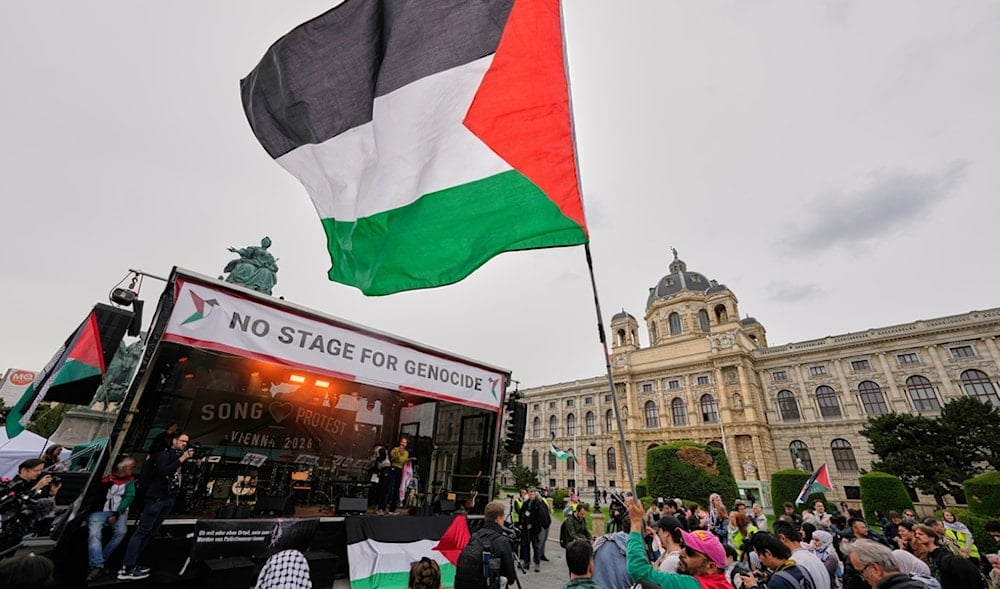
People attend a song protest concert against "Israel" at the Maria Theresien Square in the city center of Vienna, Austria, during the 70th Eurovision Song Contest week, Friday, May 15, 2026. (AP)
An alternative concert protesting "Israel’s" participation in the Eurovision Song Contest was held on Friday in Vienna, Austria’s capital.
Held at Maria-Theresien-Platz under the banner “Song Protest – No Stage for Genocide,” the event hosted international performers and activists to voice opposition to "Israel" taking part in Eurovision 2026 and to express solidarity with Palestine.
The concert featured musical performances and speeches centered on the Israeli-manufactured humanitarian crisis in Gaza, alongside repeated calls for support for the Palestinian people.
The event opened with a performance by the Palestinian diaspora choir Shatat, while attendees chanted slogans including “Free Palestine” and “Boycott Israel.”
'Culture and art voice of resistance, not genocide'
Palestinian musician Ahmed Eid performed during the event alongside Austrian-Brazilian singer Celia Mara, Italian group Banda POPolare dell’Emilia Rossa, and Austrian band Leftovers.
Several activists, journalists, and performers also delivered speeches criticizing the European Broadcasting Union (EBU) for allowing "Israel" to participate in the annual music competition.
Organizers said culture and art “should not serve as tools to normalize genocide, but as the voice of resistance.”
For instance, Austrian musician of Congolese origin, Patrick Bongola, criticized artists appearing on the same stage as a “genocidal state.” “It is our duty as artists to stand up and raise our voices,” Bongola told Anadolu.
Austrian activist Wilhelm Langthaler further criticized European governments supporting "Israel", affirming that demonstrations against its participation would continue, and Palestinian activist Kanaan Shaat condemned "Israel’s" inclusion in a peaceful cultural event amid the ongoing war on Gaza.
Eurovision turns political
The Eurovision Song Contest has faced mounting criticism and growing calls to exclude "Israel" over its war on Gaza, which has killed more than 72,000 Palestinians, injured over 172,000 others, and destroyed around 90% of Gaza’s civilian infrastructure.
For many, Eurovision is no longer a purely “non-political” celebration of music. Instead, it has become another stage where geopolitical realities are normalized, even as civilian suffering in Gaza continues to dominate global headlines.
This year, Ireland, Spain, Slovenia, the Netherlands, and Iceland are boycotting the event over "Israel’s" continued participation in it, marking the biggest crisis in the contest’s 70-year history.
Spain, one of the contest's longest-standing participants, announced it would withdraw and not broadcast the competition for the first time in its history. Spanish Prime Minister Pedro Sanchez said earlier this year that just as Russia was expelled after the Ukrainian war, "Israel" should also be removed.
The EBU has continued defending its decision by insisting Eurovision is a competition between broadcasters rather than governments. But the controversy has transformed the 2026 edition into one of the most politically explosive contests in Eurovision’s history, with protests, walkouts, and broadcaster rebellions overshadowing the event itself.


