
Washington National Opera to leave Trump-led Kennedy Center
 4 Min Read
The Washington National Opera is cutting ties with the Trump-led Kennedy Center, citing financial strains and donor loss after leadership changes.
-
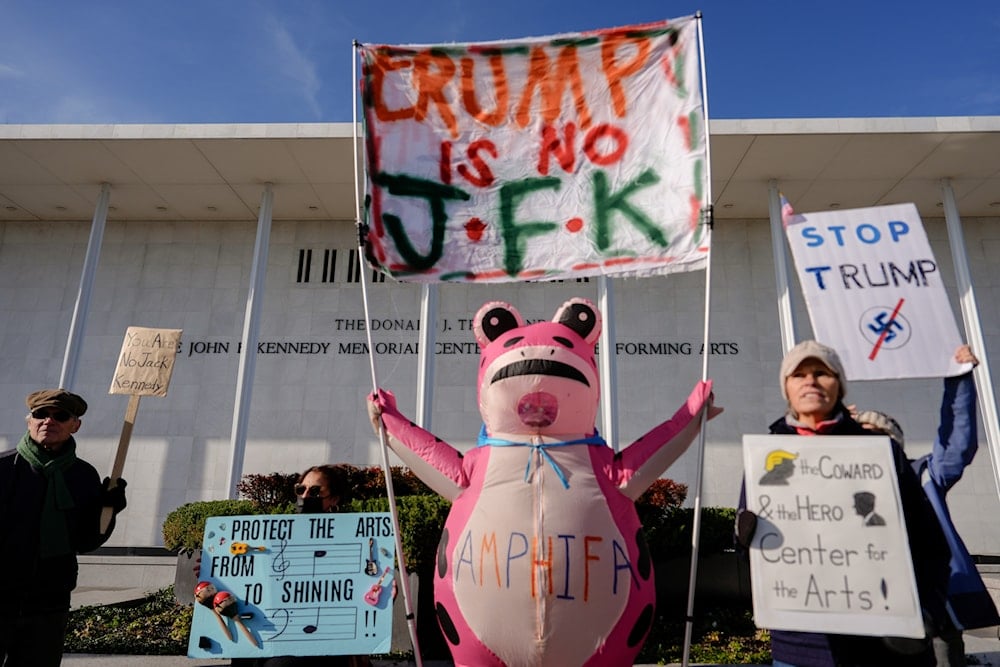
Demonstrators, including Nadine Siler, of Waldorf, Md., dressed in a pink frog costume, hold up signs at a designated protest point in front of the John F. Kennedy Memorial Center for the Performing Arts, a day after a Trump-appointed board voted to add President Donald Trump's name to the Kennedy Center on December 20, 2025, in Washington. (AP Photo/Julia Demaree Nikhinson)
The Washington National Opera will part ways with the Kennedy Center, both organizations confirmed on Friday, ending an affiliation that lasted more than five decades. The Washington National Opera's departure marks the latest in a series of withdrawals from the arts institution following its takeover by President Donald Trump and his allies.
In a statement, the opera said it is seeking an “amicable early termination” of its affiliation agreement and will return to operations as an independent nonprofit. The decision, it said, was prompted by structural changes at the Kennedy Center.
Artistic Director Francesca Zambello previously indicated the opera might leave the center, citing a collapse in box office revenue and “shattered” donor confidence. In November, she told The Guardian that the organization was facing significant financial strain following Trump’s involvement with the Kennedy Center.
A spokesperson for the Center acknowledged the split, describing it as a “difficult decision” driven by a financially unsustainable relationship. The spokesperson added that the move would allow the institution “to make responsible choices that support the financial stability and long-term future of the Trump Kennedy Center.”
According to the opera, the center’s new model, which requires productions to be fully funded in advance, is incompatible with standard opera operations. Additionally, centralized support services once provided by the Kennedy Center have been significantly reduced or removed.
Trump’s takeover and controversial renaming
Donald Trump named himself chairman of the Kennedy Center last year and appointed his allies to its board. In December, the board voted to rename the venue the Donald J. Trump and the John F. Kennedy Memorial Center for the Performing Arts, informally referred to as the Trump Kennedy Center.
The move sparked widespread criticism. Many arts groups and performers have since withdrawn from the center in protest. While Democrats have asserted that the renaming has no legal standing, given that the center’s name was established by Congress, members of the Kennedy family have condemned the decision, calling it an affront to President John F. Kennedy’s legacy.
The Washington National Opera's departure adds to growing tensions between the Kennedy Center and the broader artistic community. The institution, once seen as a nonpartisan hub for American performing arts, has faced increasing isolation following its rebranding and leadership changes.
Legal and historical objections resurface
President John F. Kennedy was assassinated in 1963, and Congress passed legislation the following year designating the center as a living memorial in his honor. His niece, Kerry Kennedy, has pledged to remove Trump’s name from the building once he leaves office. Former House historian Ray Smock and others have said any such change would require congressional approval.
The law governing the center explicitly bars its board of trustees from turning it into a memorial to anyone else or adding another individual’s name to the building’s exterior.
Trump, a Republican, has taken an unusually active role in an institution honoring an iconic Democratic president after largely sidelining it during his first term. Since returning to the office, he has pushed out senior leadership, reshaped the board while installing himself as its chair, and personally hosted this year’s Kennedy Center Honors, breaking with the long-standing tradition of presidents attending mainly as spectators.
These moves align with Trump’s broader campaign against what he describes as “woke” culture across federally supported cultural institutions.


