
$100 oil 'clear and present danger' as Hormuz tensions rise: Bloomberg
 3 Min Read
RBC Capital Markets warns that escalating tensions around the Strait of Hormuz, compounded by limited OPEC spare capacity and emerging shipping disruptions, could push oil toward $100 per barrel.
-
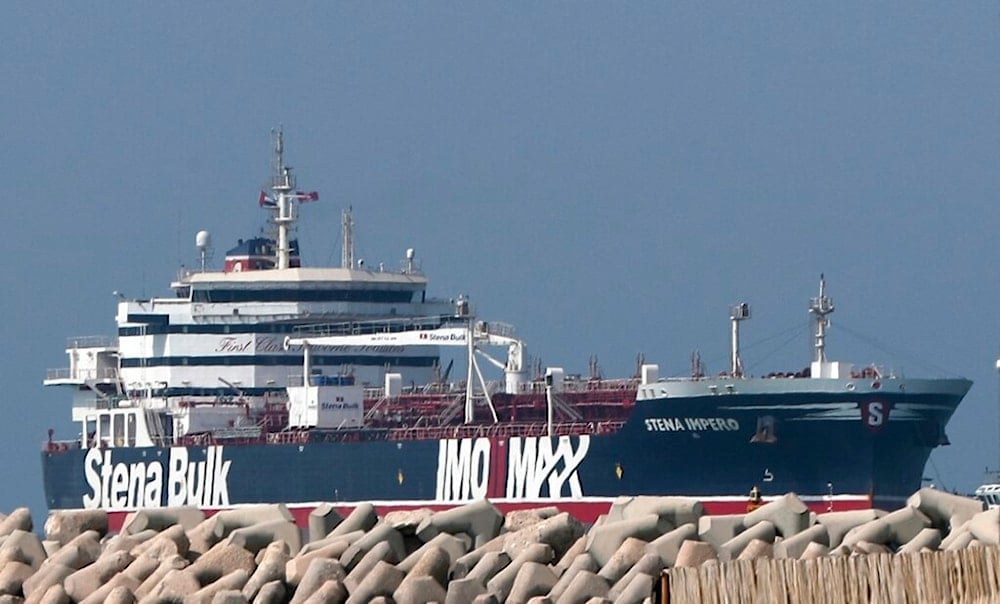
The British-flagged oil tanker Stena Impero is seen outside Port Rashid in Dubai, United Arab Emirates, Saturday, Sept. 28, 2019. (AP)
A surge toward $100-per-barrel oil would pose a “clear and present danger,” after regional leaders cautioned Washington about the economic and political fallout of sustained price spikes, Bloomberg warned, citing a research note from RBC Capital Markets.
While RBC described the $100 threshold as a risk scenario rather than a base case, the warning is landing as real-world shipping disruption builds in the Gulf. Reuters reported that major oil and gas companies, traders, and tanker operators have suspended shipments via the Strait of Hormuz, after vessels received warnings attributed to Iran’s IRGC that passage was not allowed.
The RBC note said that while it remains uncertain whether crude will hit triple-digit levels in the near term, the current confrontation is unfolding at a time when there are minimal “OPEC shock absorbers.” That constraint is now central to market thinking: Reuters reported OPEC+ is weighing a larger-than-expected output increase, but analysts say meaningful spare capacity is concentrated mainly in Saudi Arabia and the UAE, limiting how quickly the group can offset a major disruption.
Hormuz tensions shake markets
Market anxiety is increasingly centered on the Strait of Hormuz, the narrow waterway linking the Gulf with global markets. The chokepoint carries a major share of seaborne crude and is also a critical route for LNG exports from Gulf producers. The International Energy Agency has estimated roughly 20 million barrels a day transit Hormuz in typical conditions, noting that all LNG exports from Qatar and the UAE pass through the strait, around 20% of global LNG trade, with no alternative route for those volumes.
Beyond the headline risk of a formal closure, markets are now reacting to operational constraints: insurers reassessing war-risk premiums, shipowners slowing or pausing voyages, and naval warnings about safe transit. Reuters cited the EU’s Aspides mission describing VHF messages received by vessels, while the US Navy warned it could not guarantee safe navigation across the wider Gulf corridor. Greece also advised vessels to avoid the region’s key waterways.
Analysts describe current pricing as a “risk premium”, a surge driven by fear of escalation rather than confirmed supply losses. Reuters reported that oil rose to around $73 on fears of widening conflict and Hormuz disruption and cited RBC’s Helima Croft as warning that regional leaders have told Washington a war on Iran could push prices above $100, with other analysts offering similar scenarios if disruption persists.
Uneven exposure
The fallout would be uneven globally. EIA estimates that 84% of crude and condensate and 83% of LNG moving through Hormuz is destined for Asian markets, meaning the largest immediate exposure lies with major importers, such as China, India, Japan, and South Korea. At the same time, EIA data suggest the US is less directly reliant on Hormuz flows than in past decades, though it remains highly exposed to the global price impact that would feed inflation and transport costs worldwide.
If the confrontation proves brief, markets may still revert to fundamentals. But with shipping behavior already shifting and spare capacity constrained, a prolonged escalation would make sustained price pressure more plausible, and turn RBC’s warning into a broader macroeconomic problem.
Read more: Iran’s UN envoy: US, 'Israel' seeking to expand conflict


