
Rebuilding Gaza will cost $71.5bln, UNCTAD says
 5 Min Read
UNCTAD says rebuilding Gaza will cost $71.5 billion as 92% of businesses lie destroyed and "Israel" withholds billions in Palestinian revenues.
-
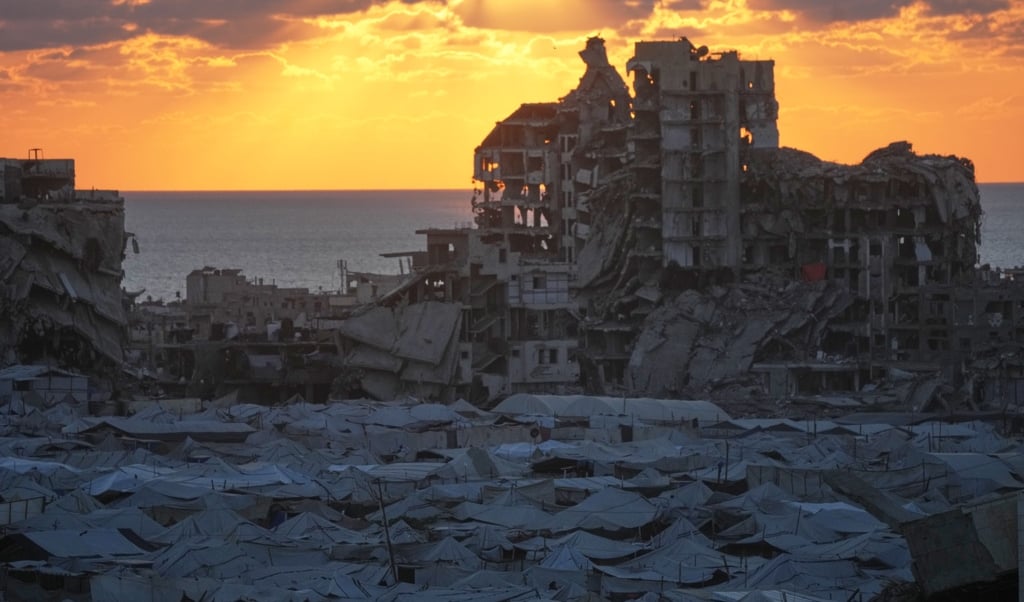
Tents sheltering displaced Palestinians are seen amid war-damaged buildings in Gaza City, Wednesday, Sept. 23, 2026 (AP/Jehad Alshrafi)
Rebuilding Gaza will cost an estimated $71.5 billion, a new report by UN Trade and Development (UNCTAD) has revealed, documenting an economy stripped of its productive base and a Palestinian Authority pushed to the edge of fiscal collapse by "Israel" withholding revenue.
The estimate comes from a joint damage and needs assessment by the World Bank, the European Union, and the United Nations, and appears in UNCTAD's latest report on its assistance to the Palestinian people, presented to the UN Trade and Development Board.
The assessment puts physical damage to Gaza's infrastructure at $35.2 billion and economic and social losses at a further $22.7 billion as of early 2026. UNCTAD cautions that total needs could rise as more destruction is recorded.
An economy reduced to a fraction of its former size
UNCTAD found that 92% of Gaza's economic establishments have been damaged or destroyed since October 2023. GDP per capita fell to $212 in 2025, only 17% of its 2022 level and equal to roughly 58 cents per person per day. Unemployment reached 78%, and more than nine in ten working-age residents had no job.
Production has nearly halted across Gaza's main sectors. Agricultural and industrial output each remained 94% below 2022 levels, while construction activity was down 99%. Gaza produced 17.4% of Palestinian GDP before October 2023 but accounted for less than 4% in 2025.
Rising prices have deepened the hardship. The report found Gaza's overall price level in 2025 was 274% higher than in 2022, with staples such as potatoes and cooking gas selling at several times their earlier cost.
Gaza's real GDP grew by 34.2% in 2025, but UNCTAD attributes this to a statistical rebound after an 83% contraction in 2024 rather than any real recovery. The hundreds of thousands of jobs lost since October 2023 have erased an estimated $2.8 billion in labor income.
Where reconstruction funds are needed
Housing is both the most heavily damaged sector and the largest reconstruction need. Figures from the final assessment put housing needs at about $16.2 billion, followed by agriculture and food systems at $10.5 billion, health at around $10 billion, and commerce and industry at roughly $9 billion. About $26.3 billion is needed within the first 18 months, with the remainder spread over roughly a decade.
UNCTAD notes that more than half of Gaza's hospitals and primary health clinics are no longer functioning. Less than 1.5% of the Strip's cropland remains both accessible and undamaged, leaving the population increasingly reliant on humanitarian food aid.
Rebuilding cannot begin until the rubble is cleared. The assessment estimates Gaza holds more than 68 million metric tons of debris, with removal and processing expected to cost over $1.7 billion, according to Investing.com.
Withheld revenues push the Palestinian government toward crisis
Under the Paris Protocol, "Israel" collects more than two-thirds of Palestinian fiscal revenue and is required to transfer it to the Palestinian Authority. UNCTAD says these transfers have been irregular and subject to repeated deductions, adding that "Israel" withheld clearance revenues in full from May 2025 through mid-2026.
Between January 2019 and March 2026, deductions and withheld funds exceeded an estimated $3.67 billion, calculated at the exchange rates in effect when each payment was due. That total equals 83% of all Palestinian net revenue in 2025.
The report puts the 2025 budget deficit at 13% of GDP when unpaid clearance revenues are excluded. Counting those funds as revenue owed to the government lowers the deficit to 6%, showing how much of the fiscal gap stems directly from 'Israeli' withholding.
Access will decide whether rebuilding happens
A reconstruction program on this scale requires vast quantities of cement, steel, heavy machinery, pipes, cables, and medical equipment to enter Gaza.
In an analysis of the reconstruction economy, Investing.com noted that turning estimated needs into actual building work depends on open border crossings, workable customs procedures, and the political arrangements governing the movement of goods. "Israel" controls every one of these.
Much of the market commentary has centered on which multinational equipment makers, engineering firms, and suppliers stand to win contracts. Yet the same analysis cautioned that the headline estimate reflects needs, not committed spending, and that reconstruction should ultimately be judged by whether it leaves behind a local economy able to generate jobs, production, and income.
UNCTAD's priorities for recovery
UNCTAD says recovery will require large-scale international financial and technical assistance. It argues that rebuilding productive capacity in agriculture, industry, construction, energy, and technology is essential if Gaza is to recover beyond the conditions that existed before October 2023.
The report sets out three immediate priorities: releasing the Palestinian revenues withheld by "Israel", protecting the banking system, and aligning reconstruction support with the documented scale of damage and economic losses.


