
'Israel' gets a taste of Gaza destruction: Pollution hits its water
 4 Min Read
"Israel's" destruction of Gaza’s water and sanitation infrastructure is contributing to Mediterranean pollution that has worsened an algae bloom disrupting Israeli desalination plants and straining water supplies.
-
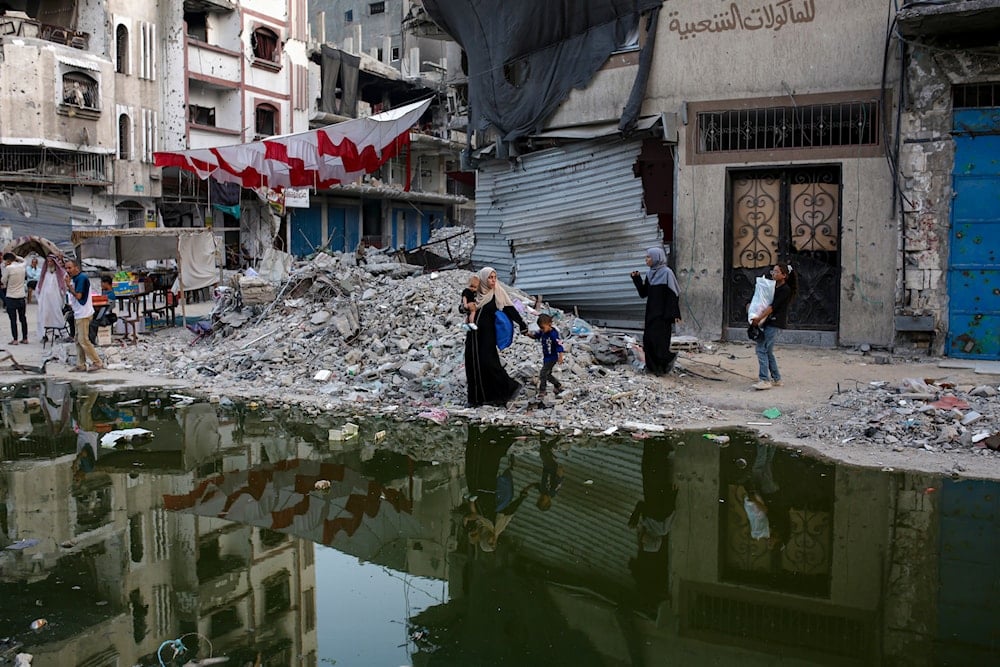
Palestinians displaced by the Israeli aggression on the Gaza Strip walk next to a dark streak of sewage flowing into the streets of the southern town of Khan Younis, Gaza Strip, Thursday, July 4, 2024 (AP)
The destruction of Gaza's water and sanitation infrastructure during the Israeli war on the Strip is now contributing to a pollution crisis affecting Israeli desalination facilities, with five of the six main plants forced to halt operations after an exceptional algae bloom clogged their systems, The Guardian reported Thursday.
The facilities were shut for several days and have since resumed operations at reduced capacity, leaving Israeli authorities confronting weeks of pressure on water supplies and urging reduced consumption.
The disruption has highlighted the cross-border environmental consequences of the devastation inflicted on Gaza's civilian infrastructure, where untreated wastewater is flowing into the Mediterranean on a massive scale after sewage treatment facilities were knocked out of service.
Gaza wastewater feeds worsening marine pollution
According to Omar Shatat, deputy executive director of Gaza's Coastal Municipalities Water Utility, all five wastewater treatment plants in the Strip are currently out of operation.
Around 45,000 cubic meters of untreated sewage are consequently being discharged into the Mediterranean every day, while another 15,000 cubic meters seep into the ground through pits and damaged networks, particularly around displacement camps in al-Mawasi.
Médecins Sans Frontières estimates that around 90% of Gaza's water and sanitation infrastructure has been destroyed since October 2023, including wells, reservoirs, pipelines, desalination units and wastewater facilities.
Pollution reaches Israeli water system
The destruction has left Palestinians facing severe shortages of safe water while sewage accumulates in residential areas and displacement camps.
UN humanitarian reporting earlier this month found that 91% of assessed households in Gaza were experiencing moderate-to-high water insecurity, while damaged infrastructure continued to constrain access to drinking and domestic water.
The environmental effects are increasingly being felt beyond Gaza.
A vast microalgae bloom, stretching for up to 100 kilometers along the Mediterranean coastline, clogged filtration systems serving Israeli desalination plants and forced five of the six main facilities offline.
Israeli NGO: Pollution does not stop at border
Israeli environmental organization Zalul said wastewater discharged from Gaza contains nitrogen and phosphorus capable of feeding microalgae and cyanobacteria and worsening blooms in coastal waters.
"Pollution does not recognise political borders," the organization said, adding that contamination originating in Gaza was contributing to the crisis affecting desalination facilities.
Separate reporting by The Washington Post cited Israeli environmental experts as saying the algae itself originated around Egypt's Nile Delta before moving northward, while Gaza's untreated sewage likely provided nutrients that intensified its growth.
Jack Gilron, a desalination specialist and professor emeritus at Ben-Gurion University's Zuckerberg Institute for Water Research, warned that wastewater entering the Mediterranean from Gaza posed risks to Israeli water-production infrastructure along the southern coastline.
The episode, he said, underscored the vulnerability of desalination plants that have become a central source of drinking water.
Destruction in Gaza reverberates across border
Israeli authorities have reduced water supplies in parts of the south and instructed farmers to suspend irrigation as desalination capacity remains constrained, raising concerns over agricultural production and food prices.
The contrast remains stark inside Gaza itself, where damaged distribution networks have forced much of the population to depend on trucked water, while contamination of the coastal aquifer has further restricted access to supplies fit for human consumption.
The wastewater crisis has also fueled concerns over infectious disease. EcoPeace Middle East's Palestine Director Nada Majdalani pointed to increasing hepatitis A cases in Gaza and warned that environmental and public-health consequences could not simply be contained behind political borders.
Zalul and EcoPeace have called on COGAT, the Israeli body responsible for coordinating civilian affairs involving Gaza, to facilitate the rehabilitation of the Strip's sewage infrastructure and allow wastewater treatment in areas under Israeli control.
The desalination disruption has therefore brought into sharper focus a consequence long warned of by environmental specialists: the destruction of essential infrastructure in the Gaza Strip is generating ecological and public-health repercussions that extend well beyond the territory itself.
Read more: Catholic clergy march to Vatican, demand end to Gaza genocide


