
Antarctic sea ice hits third-lowest winter peak on record
 5 Min Read
Antarctic sea ice reached its third-lowest winter maximum on record, renewing concerns over warming oceans, marine ecosystems and the stability of ice shelves.
-
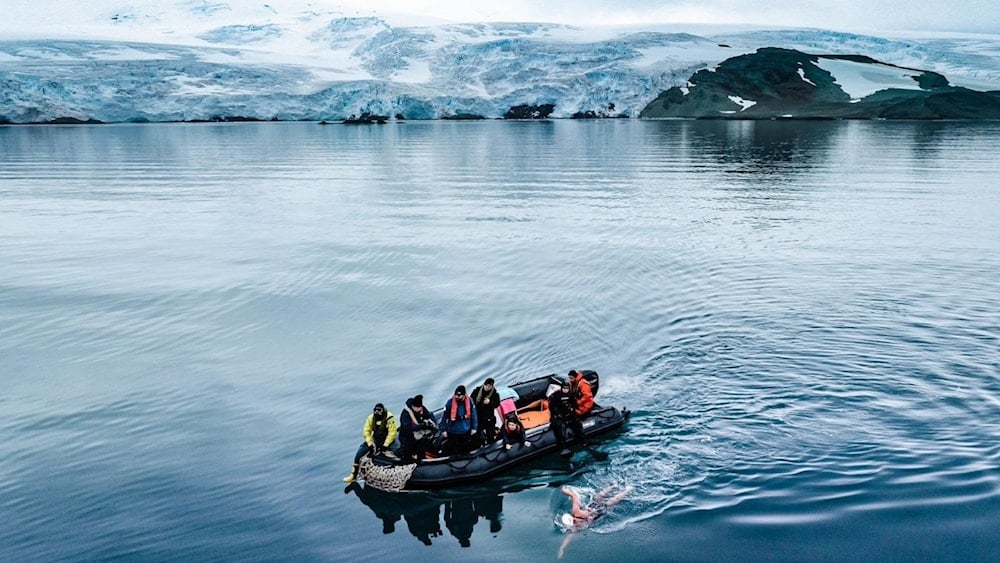
This photo, released by Barbara Hernandez of the Antarctic and Southern Ocean Coalition (ASOC) shows Chilean swimmer Barbara Hernandez swimming in the Antarctic Ocean off Greenwich Island, Antarctica, on Feb. 5, 2023. (AFP)
Antarctica's winter sea ice has reached its third-lowest maximum since satellite monitoring began in 1979, with scientists warning that repeated years of unusually low ice coverage indicate a changing Antarctic climate system.
Sea ice peaked on September 14 at 17.59 million square kilometers, around 1 million square kilometers below the long-term average maximum. That shortfall is roughly equivalent to twice the area of Spain.
The latest measurement means that the four lowest Antarctic winter sea-ice maxima on record have all occurred within the past four years, according to the source material.
Read more: Arctic ocean's acidity increasing 4 times faster: Report
Antarctic sea ice reaches another historic low
Antarctic sea ice undergoes a dramatic annual cycle. During the Southern Hemisphere summer, it can fall below 2 million square kilometers before expanding through the polar winter and normally reaching more than 17 million square kilometers in September.
Dr. Walt Meier, a senior scientist at the National Snow and Ice Data Center at the University of Colorado, said, per The Guardian, that scientists had delayed declaring the annual maximum because of the potential for further fluctuations.
However, after sea ice began declining from the September 14 level, Meier said he considered the maximum to have been reached.
The repeated low maxima have heightened scientific concern because the recent pattern differs from isolated years of unusual variability.
"The past four winters have had the lowest sea ice maximum on record – that’s a very clear indication of a system that has changed," Dr. Ariaan Purich, a Southern Ocean expert at Monash University, said, according to The Guardian. "This is not a one-off event any more. The sea ice is no longer covering the same extent of ocean that it used to."
Scientists point to a changing Antarctic system
Scientists have identified several factors behind the recent fluctuations, including changes in atmospheric circulation and the El Niño climate pattern in the tropical Pacific.
Purich said El Niño-related changes in winds likely contributed to reduced sea ice in parts of the Amundsen Sea.
Dr. Phil Reid of Australia's Bureau of Meteorology said El Niño can alter the movement of storm systems around Antarctica, potentially keeping them over particular regions and churning up sea ice.
But Reid cautioned that atmospheric variability alone does not explain the broader trend.
"The atmosphere will play around a bit, but in the end thermodynamics wins. If the water is too warm, you won’t have as much sea ice," he said.
Purich similarly warned that the significance of the latest figures extends beyond a single season.
"This is not a future problem. It’s a now problem," he added.
Warmer oceans deepen concerns
The loss of Antarctic sea ice does not directly raise global sea levels because floating sea ice already displaces seawater.
Its disappearance can nevertheless have wider consequences. Sea ice reflects incoming solar radiation, while open ocean absorbs more heat. As Antarctica emerges from its polar winter, reduced ice coverage could therefore allow the Southern Ocean to absorb additional solar energy.
The consequences could extend to the continent's ice shelves.
Sea ice can help shield ice shelves from waves and ocean extremes. Ice shelves, in turn, act as a brake on glaciers flowing toward the ocean. Accelerated loss of Antarctic land ice would contribute directly to global sea-level rise.
Recent Antarctic conditions have underscored the scale of the changes. In June, the Antarctic Peninsula experienced temperatures as much as 20°C above normal, while an area of open ocean roughly the size of France emerged along the continent's western coast.
Implications for marine life and ice shelves
Antarctic sea ice is also a crucial component of the Southern Ocean ecosystem.
Algae growing in and around the ice supports krill, which form a key part of the food web and provide sustenance for numerous Antarctic species.
Changes in the timing and extent of sea-ice formation can also affect species that depend on stable ice platforms to reproduce.
Emperor penguins are particularly vulnerable because they use sea ice for breeding and raising chicks. Previous periods of exceptionally low sea ice have been associated with major breeding failures in some colonies.
Dr. Will Hobbs, an Antarctic sea-ice expert at the University of Tasmania, said the ice had been declining "faster than usual" since its September peak.
"We could be looking at another low summer, and that’s when things get really worrying," he said, per The Guardian, pointing to concerns about potential effects on ice shelves. "How sensitive is the global climate system to this loss of sea ice? We are still working to put numbers on that. But the system is changing faster than we are understanding it."
Read more: Glacier melt due to climate change could erase 40% globally


