
Climate crisis could spark global financial collapse, experts warn
 5 Min Read
A new report warns that climate-driven shocks could overwhelm global markets, with policymakers and investors underestimating risks that may be impossible to recover from.
-
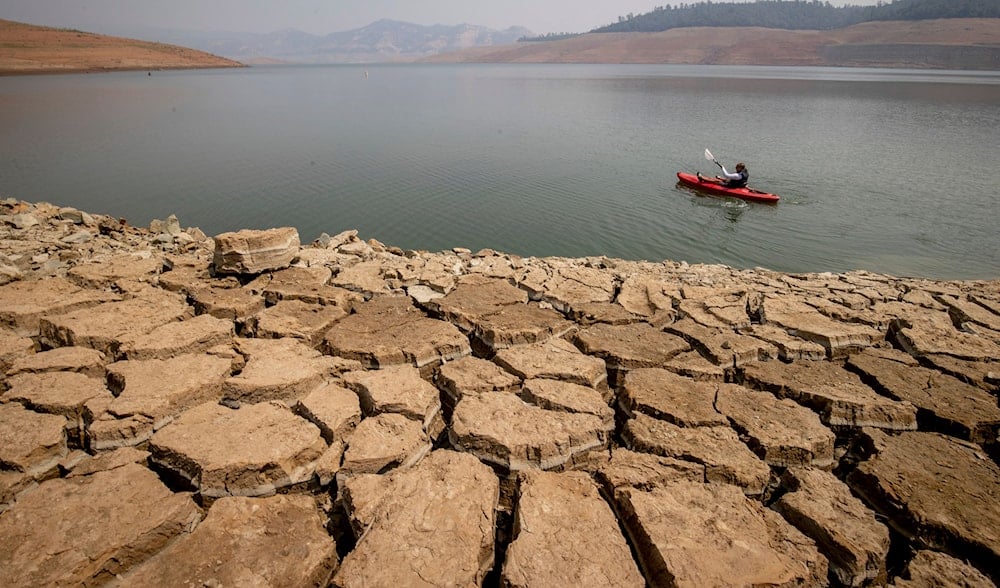
A kayaker paddles in Lake Oroville as water levels remain low due to continuing drought conditions in Oroville, Calif., Sunday, Aug. 22, 2021. (AP)
Faulty economic modelling risks severely underestimating the financial fallout of the accelerating climate crisis, potentially setting the stage for a global economic crash, researchers have warned, according to The Guardian.
They said the aftermath would be far more difficult to manage than the 2008 financial crisis, stressing that “we can’t bail out the Earth like we did the banks.”
As the planet moves rapidly toward 2°C of global heating, the likelihood of extreme weather disasters and abrupt climate tipping points is rising sharply. However, the economic models relied upon by governments and financial institutions fail to account for these risks, according to researchers.
Instead, the models project continued economic growth, modestly slowed by gradual increases in average temperatures. This approach, the researchers said, assumes future conditions will resemble the past, an assumption that no longer holds as fossil fuel emissions push the climate system into unprecedented territory.
Tipping points pose systemic global risks
Climate tipping points, such as a collapse of key Atlantic ocean currents or the Greenland ice sheet, would have sweeping global consequences. Some may already be close to being triggered, though the exact timing remains uncertain.
Researchers from the University of Exeter and the Carbon Tracker Initiative warned that simultaneous extreme weather events could devastate national economies, overwhelming existing financial systems.
The report argues that governments, regulators, and financial decision-makers must take high-impact, lower-probability risks far more seriously. Cutting carbon emissions to avoid irreversible damage, the authors said, is far less costly than attempting to cope with its consequences later.
“We’re not dealing with manageable economic adjustments,” said Dr. Jesse Abrams of the University of Exeter. “The climate scientists we surveyed were unambiguous: current economic models can’t capture what matters most – the cascading failures and compounding shocks that define climate risk in a warmer world – and could undermine the very foundations of economic growth.”
A misreading of financial risk
Abrams warned that policymakers and financial institutions are fundamentally misjudging the scale of the threat.
“For financial institutions and policymakers, it’s a fundamental misreading of the risks we face,” he said. “We are thinking about something like a 2008 [crash], but one we can’t recover from as well. Once we have ecosystem breakdown or climate breakdown, we can’t bail out the Earth like we did the banks.”
Mark Campanale, CEO of Carbon Tracker, said flawed economic advice has fueled dangerous complacency.
“The net result of flawed economic advice is widespread complacency amongst investors and policymakers. There’s a tendency in certain government departments to trivialise the impacts of climate on the economy so as to avoid making difficult choices today. This is a big problem, the consequences of delay are catastrophic,” Tracker said.
Hetal Patel of Phoenix Group, which manages around £300 billion in long-term investments, said misjudging climate risk has broader societal consequences.“Underestimating physical risk doesn’t just distort investment decisions; it underplays the real-world consequences that will ultimately affect society as a whole,” Patel said.
Severe economic losses projected
Actuaries warned in 2025 that catastrophic climate shocks could slash global GDP by as much as 50% between 2070 and 2090, far exceeding earlier estimates.
The new report draws on assessments from 68 climate scientists across the UK, the US, China, and nine other countries. One of the report’s key findings is that traditional economic models focus on average temperature changes, while societies and markets suffer most from extremes such as heatwaves, floods, and droughts.
The researchers also said GDP figures often obscure the true costs of climate damage by failing to account for deaths, illness, social disruption, and ecosystem degradation. In some cases, GDP may even rise following disasters due to reconstruction spending.
Call for faster shift away from fossil fuels
Rather than waiting for perfect risk models, the researchers urged policymakers and investors to prioritize worst-case scenarios and systemic vulnerabilities.
Campanale said investors have a fiduciary duty to accelerate the transition away from fossil fuels to avoid severe future losses.
The report criticized existing economic forecasts for presenting precise-looking but unrealistic estimates.
“Some are saying we’ll have a 10% GDP loss at between 3 °C and 4 °C degrees [of global heating], but the physical climate scientists are saying the economy and society will cease to function as we know it. That’s a big mismatch,” Abrams stressed.
Laurie Laybourn of the Strategic Climate Risks Initiative said current policy responses are dangerously inadequate.
“We are currently living through a paradigm shift in the speed, scale, and severity of risks driven by the climate-nature crisis. Yet many regulations and government actions are dangerously out of touch with reality,” Laybourn concluded.


