
Large swathes of southern Europe drying up, new analysis finds
 5 Min Read
Europe faces a growing freshwater crisis as climate change and groundwater depletion strain water supplies across the continent.
-
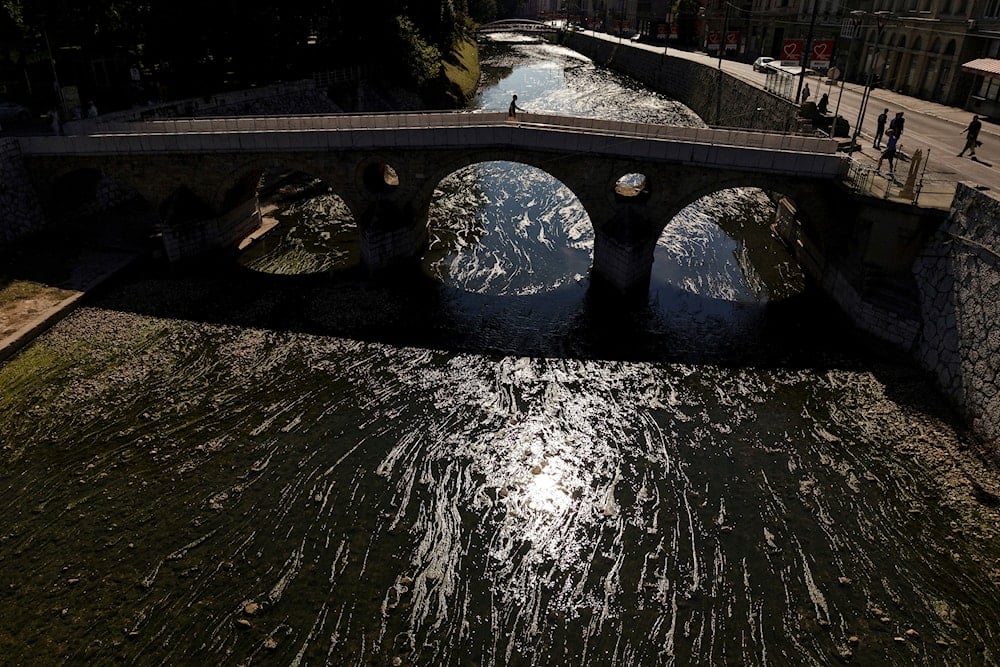
A person walks on a bridge over the Miljacka River, which is almost dried up with algae visible, amid a heat wave and drought in Sarajevo, Bosnia, Sunday, Aug. 10, 2025 (AP)
A new analysis of two decades of satellite data shows that Europe’s freshwater reserves are shrinking dramatically, with southern and central regions, from Spain and Italy to Poland and parts of the UK, experiencing significant declines.
Researchers at University College London (UCL), in collaboration with Watershed Investigations and The Guardian, examined satellite data from 2002 to 2024 that track changes in Earth’s gravitational field. Because water has weight, variations in groundwater, rivers, lakes, soil moisture, and glaciers are detectable, allowing satellites to effectively “weigh” the continent’s water stores.
The study highlights a stark geographic imbalance: northern and north-western Europe, including Scandinavia, parts of the UK, and Portugal, has generally become wetter, while southern and south-eastern areas, spanning parts of Spain, Italy, France, Switzerland, Germany, Romania, Ukraine, and even sections of the UK, are drying out.
'Wake-up call' for policymakers
Scientists say the data reflect the growing impacts of climate change. “When we compare the total terrestrial water storage data with climate datasets, the trends broadly correlate,” said Mohammad Shamsudduha, UCL professor of water crisis and risk reduction. He called the findings a “wake-up call” for policymakers still sceptical about cutting emissions, warning that the world is likely heading toward 2°C of warming above preindustrial levels.
Further analysis of groundwater by doctoral researcher Arifin confirmed the worrying trend, showing that even these more resilient reserves are being depleted, mirroring overall water storage losses across Europe.
The picture is mixed in the UK. “Overall, the west is getting wetter while the east is becoming drier, and that signal is getting stronger,” Shamsudduha said, adding that while total rainfall may remain stable or slightly increase, it is increasingly concentrated in heavy downpours, interspersed with longer dry spells, particularly during summer.
Although groundwater is generally more climate-resilient than surface water, intense summer rainfall often leads to runoff and flash flooding rather than replenishing aquifers, and winter recharge periods appear to be shortening, Shamsudduha noted. “In south-east England, where groundwater supplies about 70% of public water, these shifting rainfall patterns could pose serious challenges," he added.
Spring, Summer could bring severe restrictions
Between 2000 and 2022, the total volume of water drawn from surface and groundwater sources across the EU declined, according to European Environment Agency data. However, groundwater withdrawals rose by 6%, largely driven by public water supply (18%) and agricultural use (17%).
Groundwater remains a critical resource across the bloc. In 2022, it supplied 62% of public water needs and 33% of agricultural demand among member states. A European Commission spokesperson said the EU’s water resilience strategy “aims to help member states adapt their water resource management to climate change and to address man-made pressures.”
The strategy seeks to create a “water-smart economy” and is accompanied by a recommendation to improve water efficiency by “at least 10% by 2030.” With leakage rates ranging from 8% to 57% across member states, the commission emphasizes that reducing pipe losses and modernizing infrastructure will be essential.
Hannah Cloke, professor of hydrology at the University of Reading, warned of the immediate risks, noting that recent droughts and projections of below-average rainfall this winter could create severe shortages. “Next spring and summer, if we don’t get the rainfall we need, there will be severe consequences for us here in England. We will face severe water restrictions and that will make everybody’s life very difficult,” she said.
The Environment Agency has already urged preparations for drought conditions, potentially continuing into 2026 unless autumn and winter bring significant rain. Water Minister Emma Hardy highlighted government efforts, including plans for nine new reservoirs to enhance long-term water resilience.
Cloke cautioned, however, that long-term reservoir projects will not solve immediate shortages, calling for faster adoption of water reuse, reduced consumption, separation of drinking and recycled water, nature-based solutions, and smarter urban planning. “We’re just not doing these things fast enough to keep pace with these long-term trends,” she said.
Europe's dwindling reserves expected to affect Global South
Europe’s drying trend is expected to have “far-reaching” consequences, affecting food security, agriculture, and water-dependent ecosystems, particularly groundwater-fed habitats, according to Mohammad Shamsudduha. He warned that Spain’s dwindling water reserves could directly impact the UK, which relies on Spain and other European countries for fruit and produce.
Shamsudduha highlighted that climate impacts long associated with the global south, from South Asia to Africa and the Middle East, are now “much closer to home,” with Europe itself experiencing the effects of climate change. “We need to accept that climate change is real, it’s happening and it’s affecting us,” he said, calling for improved water management and openness to “new, even unconventional” measures, such as widespread rainwater harvesting in countries including the UK.
Drying hotspots are also emerging globally, spanning the Middle East, Asia, South America, the US west coast, and large areas of Canada, with Greenland, Iceland, and Svalbard showing significant water losses.
In Iran, the capital Tehran is approaching “day zero", when taps could run dry, prompting planned water rationing. President Masoud Pezeshkian warned that if rationing proves insufficient, evacuation of the city may become necessary.


