
Iran unveils cutting-edge plasma therapy systems
 3 Min Read
Iran unveils cutting-edge plasma therapy systems during the Iran Plasma Medicine Congress, highlighting AI-based wound treatment, plasma-based drug production, and technological self-sufficiency.
-
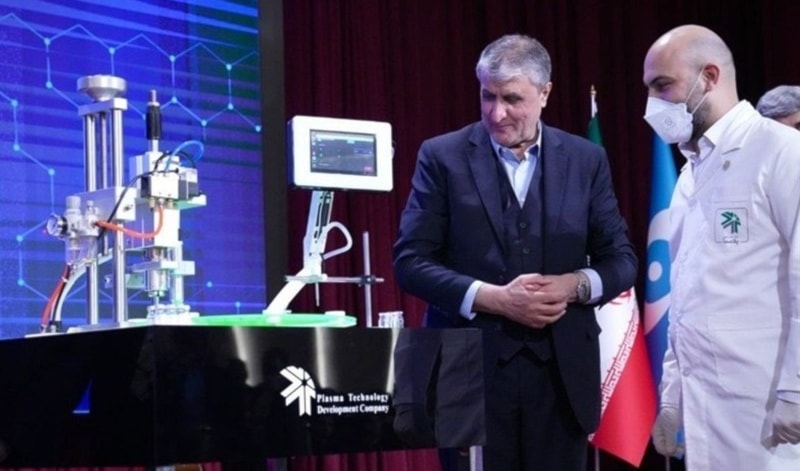
Mohammad Eslami, vice president and head of the Atomic Energy Organization of Iran, and a scientist during the second Iranian Congress of Plasma Medicine held at Shahid Rajaie Heart Hospital in Tehran (Tasnim)
Plasma therapy in Iran took a major step forward on Thursday with the unveiling of several advanced plasma-based medical technologies at the Second Iranian Congress of Plasma Medicine, held at Shahid Rajaie Heart Hospital in Tehran.
The systems were introduced in the presence of Mohammad Eslami, Vice President and head of the Atomic Energy Organization of Iran (AEOI), along with senior officials from the Vice Presidency for Science and Technology, the Ministry of Health, and Mahdieh Bakhtiari, CEO of the knowledge-based Plasma Technology Company.
Among the key innovations presented was a small-scale production line for plasma-activated media, which enables the synthesis of plasma-based drugs and supports clinical research. This development marks a significant milestone in Iran's medical technology advancements, positioning the country as a regional pioneer in plasma medicine.
A significant breakthrough was the successful use of plasma-synthesized drugs in the treatment of granulomatous mastitis, showing promising results in real-world clinical application.
Another major unveiling at the Iran plasma medicine congress was the new generation of AI-based plasma jets for wound care. These systems personalize treatment protocols for individual patients, improving precision and accessibility in clinical settings. According to officials, the devices are expected to significantly reduce treatment costs and broaden the availability of advanced plasma therapy in local clinics.
AEOI head emphasizes technological independence
Speaking at the event, AEOI head Mohammad Eslami stressed the importance of developing indigenous scientific capabilities and linking innovation to national independence.
“What matters to us is that the cycle of creativity and innovation is established in a sustainable process and that the transformation of science and knowledge into technology continues without interruption,” Eslami stated.
He emphasized that Iran will not yield to external pressure, asserting, “We have lived with dignity and were never under the domination of superpowers. We did not obey them, and their main problem is our refusal to hand over our interests to them.”
Overcoming foreign pressure and sabotage
Eslami also pointed to repeated hostile efforts targeting Iran’s nuclear and scientific infrastructure, including acts of sabotage, assassination, and psychological warfare.
“Despite industrial sabotage, assassinations, explosions, countless political, legal, and psychological obstructions, fabricated cases full of slander, infiltration, and bribery, and finally the military attack by two of them (the United States and the Zionist regime), they must understand that we are here and we will not back down,” he said.
He concluded by reaffirming Iran’s commitment to scientific progress, vowing, “We will continue our path of progress more determinedly than before, with God’s special grace and the efforts of our colleagues.”
The two-day congress runs from December 11 to 12 at the Heart Hotel of Shahid Rajaie Hospital and aims to showcase the growing role of plasma therapy in Iran in advancing medical science and patient care.
Read more: Iran-Russia deal expands cooperation in AI and cybersecurity


