
'Israel', US 'greatest threat' to regional, global security: Baghaei
 3 Min Read
Iran’s Foreign Ministry details talks with regional states, slams US actions, and highlights "Israel’s" repeated ceasefire violations in Lebanon and Gaza.
-
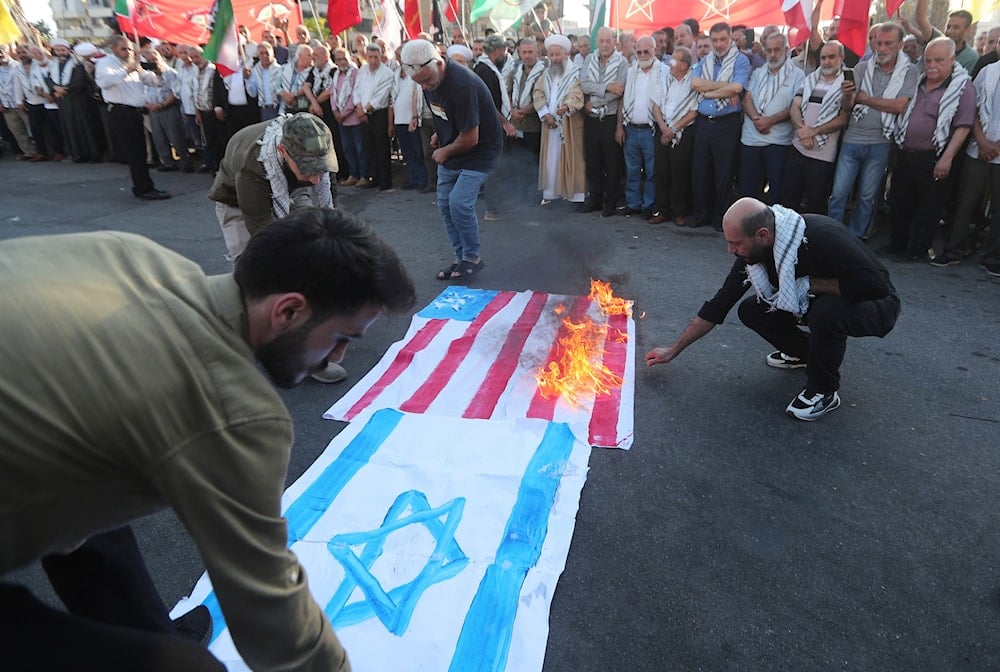
Palestinian protesters burn the Israeli and US flags during a protest against Israeli attacks on multiple cities across Iran, in the southern port city of Saida, Lebanon, Saturday, June 21, 2025 (AP)
Foreign Ministry spokesperson Esmaeil Baghaei highlighted recent diplomatic activities, noting that Iran hosted delegations from Turkey, Saudi Arabia, and South Korea over the past two days to hold discussions with the Foreign Minister, during his weekly press briefing on Monday.
Baghaei described the international scene as evolving rapidly, while identifying the Israeli entity as the primary threat in the region, pointing to ongoing violations in Lebanon, Syria, and other neighboring countries, where ceasefires are repeatedly breached.
According to Baghaei, the ceasefire in Lebanon has been violated hundreds of thousands of times, resulting in numerous civilian casualties, while Gaza has seen around 600 reported ceasefire violations.
He cited the UNIFIL's report of 10,000 violations in Lebanon alone, indicating that “there is practically no ceasefire.” He said that "Israel’s" actions undermine both the security and development of neighboring countries, placing greater responsibility on those charged with enforcing ceasefires and exposing the failures of parties that do not uphold their commitments.
US greatest threat to global security
Addressing US actions, Baghaei labeled US behavior as the "greatest threat" to global security, citing coercive measures against countries including Venezuela, Cuba, Nicaragua, Brazil, and Mexico.
He criticized Washington’s unprecedented decision to close another nation’s airspace, calling it a breach of international norms and aviation safety regulations, referencing US pressure on African countries, including objections to South Africa’s participation in the G20 summit.
Baghaei argued that full US support for the Israeli entity effectively makes the United States complicit in its actions, and suggested that the UN Security Council should address these measures as serious violations of international peace and security.
Australia proscription of IRGC lacks legal, factual grounds
On Australia’s recent proscription of the IRGC, Baghaei said Iran has officially clarified its position, stressing that Canberra’s claims lack legal or factual grounds and are part of a broader political agenda.
He added that misleading information previously provided to Australian authorities contributed to a reduction in diplomatic engagement, but even Australian officials, including regional police, confirmed that Iran was not involved in incidents targeting Jewish individuals. Baghaei described Australia’s move as a political gesture in favor of "Israel".
Regarding the Saudi Deputy Foreign Minister’s visit to Tehran, Baghaei confirmed it was part of a process initiated two years ago. He said discussions focused on bilateral relations and regional issues, including Palestine, Lebanon, and Syria, and emphasized that both countries remain committed to fostering stability in West Asia.
Concerning talks with the E3 countries, Baghaei reiterated that Iran’s stance is consistent: meaningful negotiations can only occur when all parties recognize each other’s rights and legitimate concerns. He stressed that Iran has not escalated tensions, while proposed European resolutions have created diplomatic deadlocks.
Dialogue with European states continues at a diplomatic level, including recent contacts such as a phone call with EU foreign policy chief Kaja Kallas, but Baghaei emphasized that these interactions do not automatically signal a resumption of formal negotiations.


