
'Israel' erasing Gaza war crime forensic evidence via rubble removal
 5 Min Read
The PFLP warns that Israeli rubble-removal operations in Gaza could destroy the remains of thousands of Palestinians and erase forensic evidence documenting war crimes.
-
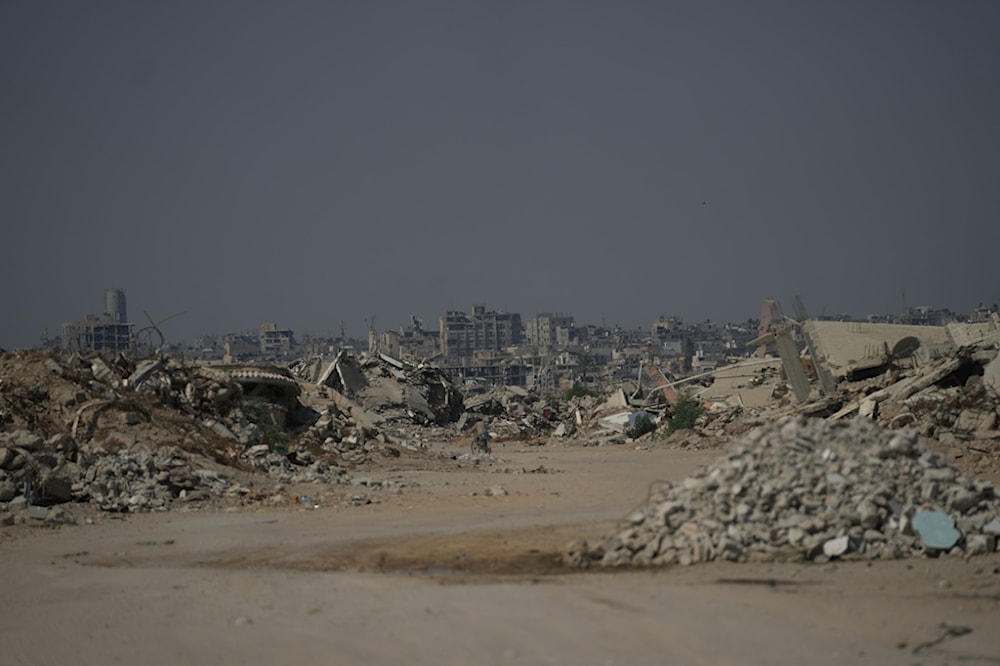
A Palestinian man rides his bicycle by the rubble of buildings that were destroyed during the war on Gaza, in Khan Younis, southern Gaza Strip, Friday, July 31, 2026 (AP)
The Israeli occupation is endangering the remains of thousands of Palestinians still buried beneath Gaza’s destruction, while potentially eliminating forensic evidence documenting crimes committed throughout the war, the Popular Front for the Liberation of Palestine (PFLP) warned on Sunday.
In a statement, the PFLP’s Office of Martyrs, Prisoners, and Wounded sounded the alarm over the occupation’s continued transfer of rubble from destroyed buildings across the Gaza Strip to what it describes as “military zones".
The office stressed that the debris being removed is not simply the remains of demolished infrastructure, but in many cases contains the bodies and fragmented remains of martyrs and missing Palestinians who have yet to be recovered.
It warned that transferring, crushing, or processing the rubble before specialized and independent teams are able to search and examine the sites risks destroying, mixing, and dispersing human remains, potentially making the identification of victims impossible.
Gaza rubble holds evidence of Israeli crimes
The PFLP further warned that the rubble contains material and forensic evidence that could prove crucial in documenting the circumstances in which Palestinians were killed, identifying the locations struck, and determining the weapons used by the Israeli occupation.
Removing the debris from its original location, the office said, could therefore erase evidence relevant to investigations into Israeli attacks and obstruct efforts to establish accountability.
“The rubble in Gaza is not merely war debris,” the statement stressed, noting that large sections of it effectively constitute burial sites containing the remains of martyrs alongside evidence of crimes committed against the Palestinian people.
The office demanded an immediate halt to rubble-removal operations at locations where bodies may still be present and called for forensic teams and personnel searching for missing Palestinians to be granted access to the affected sites.
It also called for independent international supervision to ensure that human remains and potential evidence are preserved and protected from destruction, disappearance, or tampering.
The PFLP additionally demanded an international investigation into the occupation’s transfer and handling of rubble and into the fate of the remains and evidence contained within it.
Thousands of families could be denied right to bury loved ones
The statement warned that continuing such operations could permanently deprive thousands of Palestinian families of their right to know what happened to their loved ones, retrieve their remains, and provide them with a dignified burial.
The office held the Israeli occupation fully responsible for any remains or evidence destroyed or lost as a result of bulldozing, crushing, or transferring rubble.
Civilian contractors enlisted in Gaza demolition campaign
The warning comes against the backdrop of the enormous demolition campaign carried out by Israeli occupation forces across the Gaza Strip, including through the use of civilian contractors operating bulldozers and excavators alongside military engineering units.
A 2025 investigation by Le Monde found dozens of online advertisements recruiting experienced civilian heavy-machinery operators for demolition work inside Gaza, suggesting that the scale of destruction had exceeded the capacity of Israeli military bulldozer units alone.
One advertisement reviewed by the French newspaper offered 6,000 shekels for less than ten hours of demolition work, with fuel costs reimbursed by the Israeli military.
Israeli journalist Hagai Amit of The Marker told Le Monde that in some cases contractors were paid according to the number of houses they demolished in a single day, pointing to the increasingly commercialized nature of the destruction.
The investigation also documented an expansive approach to demolitions in which Israeli forces treated buildings throughout the enclave as potential military threats under the pretext that they could conceal explosives, tunnel entrances, or Palestinian fighters.
In one account cited by Le Monde, an Israeli officer said that if one building among a group of houses was suspected of concealing a tunnel entrance, commanders could decide to demolish all of them.
Demolition raises questions over fate of evidence
Such practices have left entire areas of Gaza reduced to rubble, creating vast fields of debris where Palestinian bodies remain unrecovered and where fragments of weapons, blast patterns, personal belongings, and other material evidence may still be preserved.
The PFLP’s latest warning therefore raises questions not only over the fate of those still missing beneath the destruction, but also over what may be lost when the very rubble generated by the demolition campaign is crushed, mixed, or removed before independent examination can take place.
“We will not allow the truth to be buried beneath the rubble,” the statement affirmed.
“The remains of our martyrs are a trust, evidence of these crimes is a right belonging to our people, and justice does not disappear with the removal of the debris.”
Read more: Gaza death toll reaches 73,651 amid continued Israeli attacks


