
'Israel' issues massive displacement threat to Beirut Southern Suburb
 3 Min Read
The displacement threats target the neighborhoods of Bourj el-Barajneh, Hadath, Haret Hreik, and Chiyah, which house tens of thousands of civilians.
-
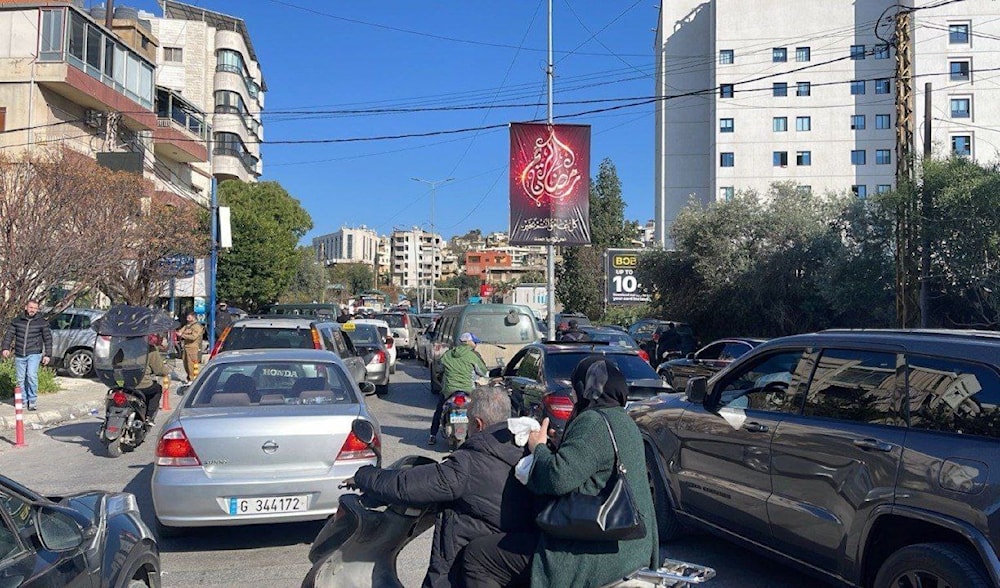
Heavy congestion in Beirut's souther suburb as civilians and families leave the area following large-scale Israeli threats, March 5, 2026 (Social media)
The Israeli occupation, in an unprecedented move, has issued a massive displacement threat against entire neighborhoods in Beirut's Southern Suburb. Previously issuing displacement warnings against specific buildings, the Israeli occupation has discarded this strategy and now threatens thousands of homes, businesses, medical facilities, schools, and civilians with bombardment.
The threats have specifically named the neighborhoods of Bourj el-Barajneh, Hadath, Haret Hreik, and Chiyah, which house tens of thousands of civilians, who were ordered to head east along the Beirut-Damascus highway, or north towards Matn or Beirut-Tripoli highways, respectively.
-
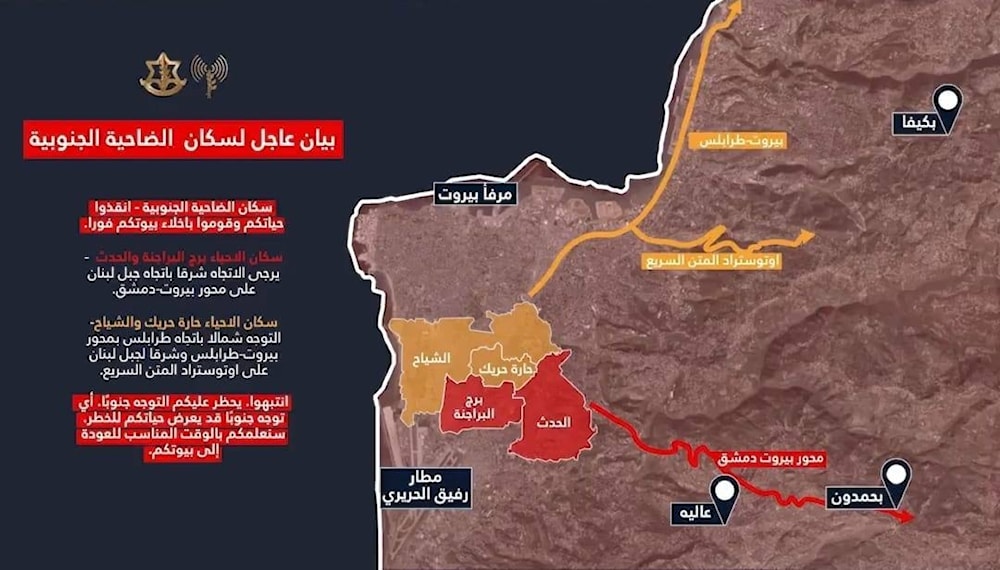
'Israel' issues massive displacement threat in Beirut Southern Suburb
This resulted in severe traffic congestion at the entrances to Beirut’s southern suburbs as residents began leaving their homes.
Heavy congestion reported across the Lebanese capital, Beirut, following Israeli evacuation threats against the city's heavily populated Southern Suburb. pic.twitter.com/GtwGnWA8AF
— Al Mayadeen English (@MayadeenEnglish) March 5, 2026
The Israeli threat eerily resembles those in Gaza, where hundreds of thousands and up to a million civilians were forced to flee their zones amid mass displacement plots.
Previous threats likely 'war crimes'
In the 2024 war on Lebanon, the Israeli occupation's "evacuation warnings," or forced displacement threats, were investigated and found to be "woefully inadequate, unnecessarily dangerous and likely illegal," as per Oxfam.
The so-called "evacuation warnings", targeting 25% of Lebanon's territories and forcing at least 1.4 million civilians out of their homes and towns, were either notices for the mass displacement of civilians or encompassed vague directives, the organization affirmed.
The report further found that the notices were impossible to comply with and triggered waves of mass displacement that failed to meet all IHL standards, which demand effective, clear, and specific warnings that give civilians sufficient time to safely leave, as well as a timeline for them to return home.
Out of the 3,334 Israeli airstrikes conducted over the examined timeframe, only 117 (3.5%) specific forced displacement notices were issued. On average, the notices were sent only 15-45 minutes before a strike, with the majority issued in the middle of the night between 10 pm and 4 am.
The aftermath of the evacuation notices was the displacement of millions of civilians and thousands of families into shelters or the streets, rendering them illegitimate and unsafe, and raising grave concerns for potential war crimes.
Comparing prior warnings to the current threat against entire neighborhoods, it is likely that the dangers of such conduct would be amplified.


