
'Israel'-Lebanon ceasefire extended 45 days amid unabated aggression
 5 Min Read
The US claims the extension was intended to "enable progress" in the talks, while also announcing plans to resume the political negotiation track on June 2 and 3.
-
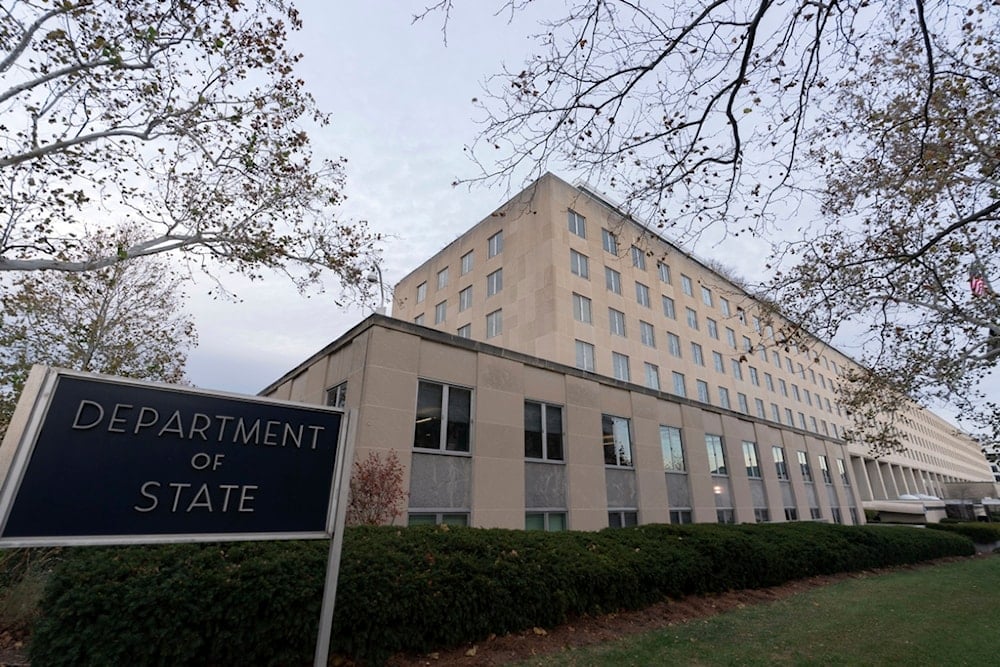
The US Department of State building is seen in Washington, Saturday, Dec. 7, 2024 (AP)
The US State Department announced that the ceasefire between Lebanon and the Israeli occupation is extended for an additional 45 days following the third round of direct negotiations held in Washington, amid continued Israeli aggression, airstrikes, assassinations, and incursions targeting southern Lebanon.
In an official statement released after two days of talks at the State Department headquarters, Washington said Lebanon and “Israel” had agreed on “a framework for negotiations to advance lasting peace between the two countries” and “full recognition of each other’s sovereignty and territorial integrity.”
Washington claimed the extension was intended to “enable progress” in the talks, while also announcing plans to resume the political negotiation track on June 2 and 3 and launch a parallel security track at the Pentagon on May 29 involving military delegations from both sides.
The State Department added that the Pentagon-hosted security track aims to improve “communication and coordination between Israel and Lebanon” under direct US facilitation, expressing hope that the negotiations would contribute to “strengthening a lasting peace” and “achieving a mutual recognition of each side’s sovereignty.”
The statement also accused Hezbollah of attempting to “derail this process” through its continued operations against the occupation, claiming the Resistance’s attacks were being carried out “without the consent or approval of the Government of Lebanon.”
Lebanese delegation: 'Meaningful diplomatic progress' achieved
For its part, the Lebanese delegation described the talks as having achieved “meaningful diplomatic progress for Lebanon,” welcoming the ceasefire extension and the launch of US-facilitated political and security tracks.
In a statement released following the negotiations at the State Department in Washington, the delegation said the extension would provide “critical breathing space” for Lebanese citizens and help advance “a political pathway toward lasting stability.”
The Lebanese delegation also stressed that its priority remains the “full restoration of state authority across all Lebanese territory,” while reaffirming its commitment to the return of displaced civilians, reconstruction efforts, and the recovery of Lebanese detainees and remains.
The statement added that Lebanon seeks a future in which sovereignty is upheld “solely by its Lebanese Armed Forces,” while calling for a phased implementation process supported by the United States to verify commitments made under the negotiations.
Washington's hidden agenda
The latest developments come despite the occupation’s ongoing violations of the ceasefire, including repeated strikes, demolitions, and attacks on Lebanese villages and civilians, fueling growing accusations inside Lebanon that the United States is using diplomacy as a cover to impose new political and security arrangements under military pressure.
Resistance figures and allied Lebanese officials have warned that the negotiations risk transforming ceasefire talks into a broader US-backed normalization track aimed at weakening Hezbollah and restructuring the balance of power in Lebanon in line with Israeli strategic interests.
Those concerns intensified after a White House spokesperson told Politico that President Donald Trump believes both sides “share a common goal of eradicating Hezbollah,” while Israeli Ambassador to Washington Yechiel Leiter openly stated that no lasting “peace” could be implemented without the “dismantlement of Hezbollah.”
Resistance rejects pressure
The remarks reinforced accusations by Resistance figures that Washington is no longer presenting itself as a neutral mediator, but rather as a direct partner in efforts aimed at politically and militarily weakening the Resistance under the cover of diplomacy and ceasefire negotiations.
The Loyalty to the Resistance bloc on Thursday accused the occupation of exploiting negotiations to advance its military and political objectives while continuing systematic aggression against southern Lebanon under direct American backing. Hezbollah officials and allied political figures have insisted that the Resistance remains fully prepared to confront any further escalation and reject any attempts to force concessions on Lebanon through intimidation and war.
Resistance sources also reaffirmed their rejection of any direct talks with the occupation, stressing that the future of any ceasefire would ultimately be determined by battlefield realities rather than American-sponsored diplomatic statements. The sources maintained that previous experiences with the occupation had demonstrated that “Israel” does not abide by agreements, insisting that the right to resist occupation and liberate Lebanese territory remains non-negotiable.
Security coordination
The Pentagon-hosted security track and the continuation of direct negotiations have further intensified concerns that Washington is attempting to institutionalize security coordination between Lebanon and the occupation under the guise of ceasefire management, while Israeli attacks and violations continue unabated.
The developments also come amid broader regional tensions, after Iran previously insisted that Lebanon be included in any wider ceasefire arrangement linked to the confrontation between the United States, the Israeli occupation, and the Axis of Resistance, stressing that aggression against Lebanon and the Resistance cannot be separated from the wider regional conflict.


