
100%: IOF solider describes a 'lust for destruction' in Gaza, Lebanon
 8 Min Read
An Israeli reservist details village demolitions in southern Lebanon, war crimes in Gaza, and a growing cycle of violence marked by soldiers bragging about killings and the destruction of entire villages.
-
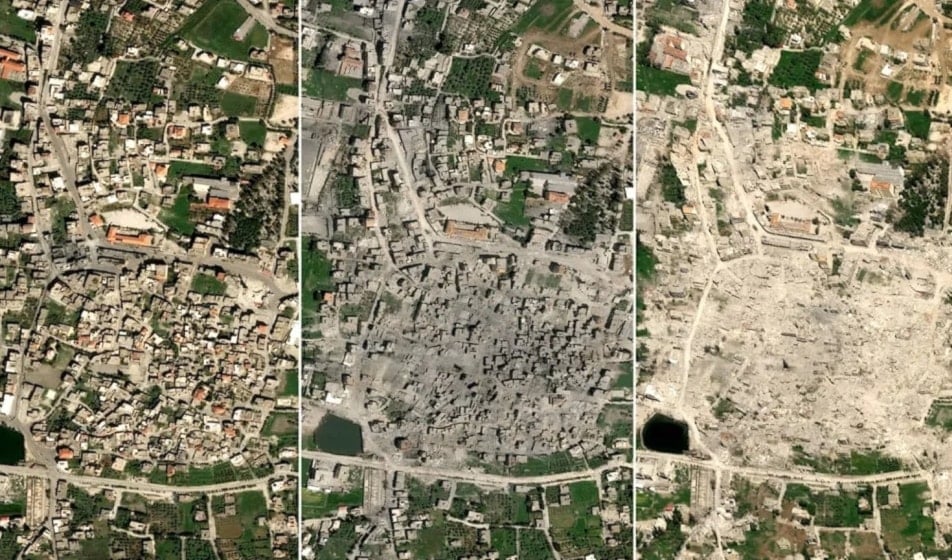
On April 14, satellite imagery shows the center of Bint Jbeil in southern Lebanon severly damaged, with grey debris patterns suggesting burning consistent with demolitions (Airbus)
An Israeli military reservist described the destruction of an entire Lebanese village as “a Nakba of 2026,” arguing that Israeli occupation forces have at times operated in both Lebanon and Gaza with a “sense of revenge.” In an interview published by Responsible Statecraft and conducted by a Palestinian journalist alongside Ariella Steinhorn, co-founder of a whistleblower advocacy organization, the reservist also suggested that homes could be classified as “terrorist infrastructure” based on relatively limited evidence, including the presence of hunting rifles and Hezbollah symbols. Both the journalist and the reservist were granted anonymity as a condition of publication.
The account comes from a recently discharged Israeli reservist whose testimony raises further questions about ongoing US backing for Israeli aggression on the region. It also highlights concerns surrounding proposed legislation that would deepen military cooperation between the United States and "Israel".
The soldier, a veteran of several Israeli wars over the past decades, discussed multiple deployments in Lebanon since 2023, including Israel’s ongoing aggression and occupation in southern Lebanon. He also served in Gaza following the 2024 invasion of Rafah.
Responsible Statecraft verified both the reservist’s identity and details of his deployments. The Israeli Embassy in Washington did not respond to a request for comment, as per the report.
The reservist used the phrase “Nakba of 2026” to describe the destruction of the southern Lebanese border village of Aitaroun. Satellite imagery from late April 2026 showed that nearly every structure in the village had been reduced to rubble.
Explaining the military justification behind the demolitions, he said, “The orders are very clear, to destroy. We got a map of all the homes that were considered terror infrastructure. ... Every home that was used by Hezbollah, it could be used as a hiding place, it could be used as a place where they put ammunition, it could be used as a gathering point, every home like that was destroyed.”
At the same time, the reservist indicated that the threshold for classifying buildings as "terrorist infrastructure" could be broad, particularly regarding weapons found inside homes.
“Every home almost has shotguns and rifles that may be hunting rifles. That’s in every home, literally. ... I probably was in 15, 20 homes I guess, I didn’t count exactly. I would say maybe three of them had actually the big arms, the PK [machine gun] and the kalash [the Kalashnikov assault rifle] and explosives. The rest, it was very clear they were Shia, because there were pictures of [former Hezbollah leader Hassan] Nasrallah, pictures of [former Supreme Leader of Iran Ruhollah] Khomeini, and then you saw the rifles and other weapons. ... If you find evidence — even a hunter's weapon — under international law, if it comes with a terrorist organization flag, that is a terrorist outpost. Check the law,” he alleged.
The Israeli occupation forces have previously released photographs of hunting rifles it said justified the destruction of civilian infrastructure in southern Lebanon.
When confronted with criticizm that such demolitions amounted to collective punishment, the reservist said that "Hezbollah’s visible presence throughout the village made the town itself part of the group’s infrastructure."
“We entered Aitaroun, all the streets of Aitaroun had Hezbollah flags. The town hall had a huge Hezbollah flag. So you could say, this entire town is used as infrastructure for terror,” he declared.
Accounts from Gaza
The Israeli occupation soldier also described experiences from Gaza, where he served during the summer of 2024 as a driver for a medical unit stationed in the Netzarim corridor, the route established by the Israeli forces that divided the territory between north and south.
During that deployment, he recalled a fellow soldier who boasted about actions that he believed amounted to a war crime.
“When we came to our post in Netzarim, he was already there. He was bragging about how he keeps doing more and more duty because he almost enjoys it. That’s his life now. And it’s very strange. Most of us, we don’t like doing duty. ... Once we were home for the weekend and we came back, and he bragged about killing people who tried to cross and it was very disgusting, okay? And we insisted that that guy doesn’t stay with our unit anymore. ... I heard from people who were there at the time that he wasn’t just making it up, that there was an incident. ... He said, ‘three people were trying to cross and I shot them.’ It was traumatizing for us to hear it. ... I know he was then taken somewhere else, I don’t know if he was charged,” he recalled.
According to the Israeli soldier, personnel shortages within the IOF contributed to situations in which individuals like this remained in service. While he claimed that most soldiers were motivated by a desire to "secure the return of hostages taken on October 7", he acknowledged that other motivations were also present.
“When we went into Gaza the first time and we saw entire areas wiped out ... I’m not going to lie, I think a lot of Israelis felt that sense of revenge, meaning, this is what happens after October 7. ... I can tell you there was a sense of satisfaction. Including myself by the way, and I hate to say it out loud,” he further stressed.
Discussing the destruction of villages in southern Lebanon, he expressed a similar view of the motivations behind some military actions.
"A lust for destruction"
When Steinhorn referred to an earlier comment in which he described some troops as having a “lust for destruction,” the reservist replied: “100%.”
The remarks are notable because the reservist broadly supports both military campaigns. He identified himself as a right-wing Israeli who has “voted right his entire life.”
Throughout the interview, he frequently defended and explained the military’s large-scale demolition of homes, even while describing aspects of the destruction as troubling. He said those concerns ultimately motivated him to speak publicly about what he witnessed.
Growing testimony from Israeli occupation forces
The interview joins a growing body of testimony from Israeli occupation forces who have reported witnessing or participating in conduct they believe may constitute war crimes in Gaza and elsewhere.
Earlier in the Gaza aggression, soldiers speaking to +972 Magazine described practices that could potentially violate international law, including permissive rules of engagement allowing troops to shoot Palestinians who approached Israeli positions.
Similar accounts have appeared in Haaretz, where soldiers who served in the Netzarim corridor described what they called a “kill zone” in which “anyone who enters is shot,” including children. Other soldiers told the newspaper about the psychological and moral consequences they experienced after participating in the Israeli genocide in Gaza.
"An army of vikings"
More recently, five soldiers interviewed by Haaretz described widespread destruction and looting during operations in Lebanon. According to those accounts, “the IDF has become like an army of Vikings,” while one soldier said that in southern Lebanon “our mission was one thing – to leave no structure standing, to destroy everything.”
Testimony gathered by the veterans’ organization Breaking the Silence similarly reported that troops were instructed to fire on anyone entering certain areas of Gaza and that some soldiers were motivated by a desire for retaliation against a population they viewed as collectively responsible for October 7.
One soldier told the Guardian, “A lot of us went there, I went there, because they killed us and now we’re going to kill them.’
“And I found out that we’re not only killing them – we’re killing them, we’re killing their wives, their children, their cats, their dogs. We’re destroying their houses and pissing on their graves,” he added.
Concerns about an "endless cycle"
The reservist concluded by expressing concern that Israeli soldiers, their opponents, and civilians trapped amid the war are all caught in a continuing cycle of violence.
Reflecting on the destruction in Aitaroun, he said, “The people of Aitaroun, they‘re going to come home to a town that doesn’t exist anymore. ... Is this going to put an end to this cycle, or is this just starting a way, way worse cycle?”


