
Aggressors expected swift Iran conquest, now realize mistake: Lavrov
 4 Min Read
Russia’s FM calls for an immediate ceasefire and negotiations as the US–Israeli war on Iran intensifies, warning of civilian casualties and regional instability.
-
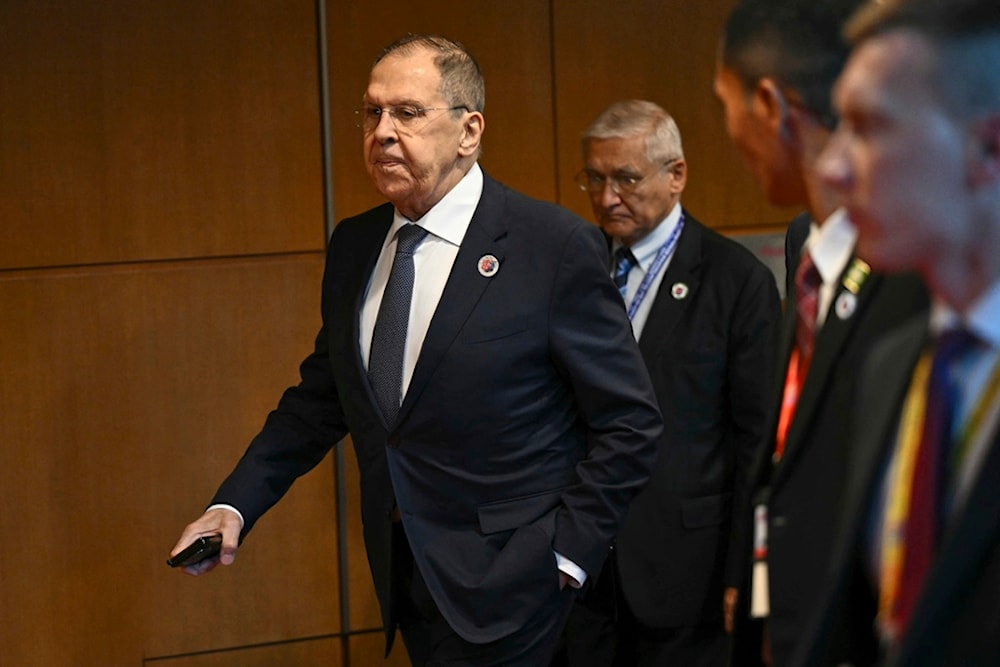
Russia's Foreign Minister Sergey Lavrov, left, departs after a meeting at the 58th ASEAN Foreign Ministers' meeting and related meetings at the Convention Centre in Kuala Lumpur on July 10, 2025 (Pool Photo via AP)
Russia has called for an immediate cessation of hostilities in West Asia and the launch of negotiations as the US-Israeli war on Iran continues to escalate.
Speaking at a press conference on Monday during talks in Moscow with Kenyan Foreign Minister Musalia Mudavadi, Russian Foreign Minister Sergey Lavrov stressed that diplomacy must urgently replace military confrontation.
“It is necessary to stop the fighting and sit down at the negotiating table if the credibility of the negotiations still remains,” Lavrov said.
The Russian diplomat warned that the continuation of hostilities risks widening the war across the region while further endangering civilian populations.
Read more: Iran arrests 500 for spying for 'Israel,' US
Moscow warns attacks on Iran miscalculated
Lavrov also indicated that the aggressing countries had expected a swift outcome, but their expectations have proven unrealistic.
According to the Russian foreign minister, the states that planned the attack believed they could defeat Iran within a day. However, he suggested that those calculations are now being reassessed as the war continues.
The remarks reflect Moscow’s growing concern over the trajectory of the confrontation and the possibility of a broader regional escalation.
Lavrov added that the consequences of the war remain difficult to predict, underscoring the urgency of halting the fighting before it spirals further.
Read more: The long shadow of the Strait of Hormuz closure
Russia urges protection of civilian infrastructure
During the meeting, Lavrov stressed that protecting civilian infrastructure must become an immediate priority as the war intensifies.
“And as the most urgent step, it is necessary to ensure that all participants stop actions that damage civilian infrastructure and lead to civilian casualties, both in the Arab countries of the Gulf and in Iran,” Lavrov said.
His remarks highlighted the risk that continued strikes could inflict damage far beyond military targets, potentially affecting vital infrastructure and civilian populations throughout the region.
The Russian foreign minister emphasized that preventing further civilian harm should be a central objective in any effort to de-escalate the war.
Russia offers to facilitate diplomatic settlement
Moscow has also signaled its readiness to assist diplomatic efforts aimed at ending the confrontation.
Lavrov said Russia would be prepared to help facilitate negotiations between the parties involved if such mediation were requested.
The Russian foreign minister noted that Moscow possesses the diplomatic capabilities necessary to contribute to a political settlement.
The statement reflects Russia’s broader push to position diplomacy as the only viable path toward resolving the escalating conflict.
Read more: Araghchi: Hormuz open, closed only to Iran's enemies
Moscow raises conflict at UN Security Council
Lavrov also warned that the situation shows no immediate signs of improvement.
“We shared our assessments of the situation in the Middle East, including in relation to the US and Israeli armed aggression against Iran, and the deep crisis in which the Palestinian issue finds itself,” Lavrov said.
“There is no sign of a breakthrough yet, and we want to bring this to the attention of the UN Security Council.”
His remarks signal Moscow’s intention to raise the issue at the United Nations, framing the crisis as part of a broader regional breakdown that also includes the unresolved Palestinian issue.
Lavrov stated that "there has been no breakthrough" regarding the Palestine issue amid increasing tensions across the region, adding, "We want to draw the attention of the UN Security Council to this."
The Russian foreign minister said that following the joint US-Israeli attack on Iran, everyone "happily forgot" about the Palestinian issue, adding that the UN should hold responsibility for its decisions, saying, "I think it is necessary for everyone here, including, probably, all the countries of the region, Arab countries, to realize their responsibility. And we will be ready to support such an approach actively so that the UN is responsible for its decisions."


