
Algiers hosts conference for African drive to criminalize colonialism
 5 Min Read
African leaders meeting in Algiers press for global recognition of colonial crimes, a legal definition of colonialism as a crime, and reparations for historic injustices.
-
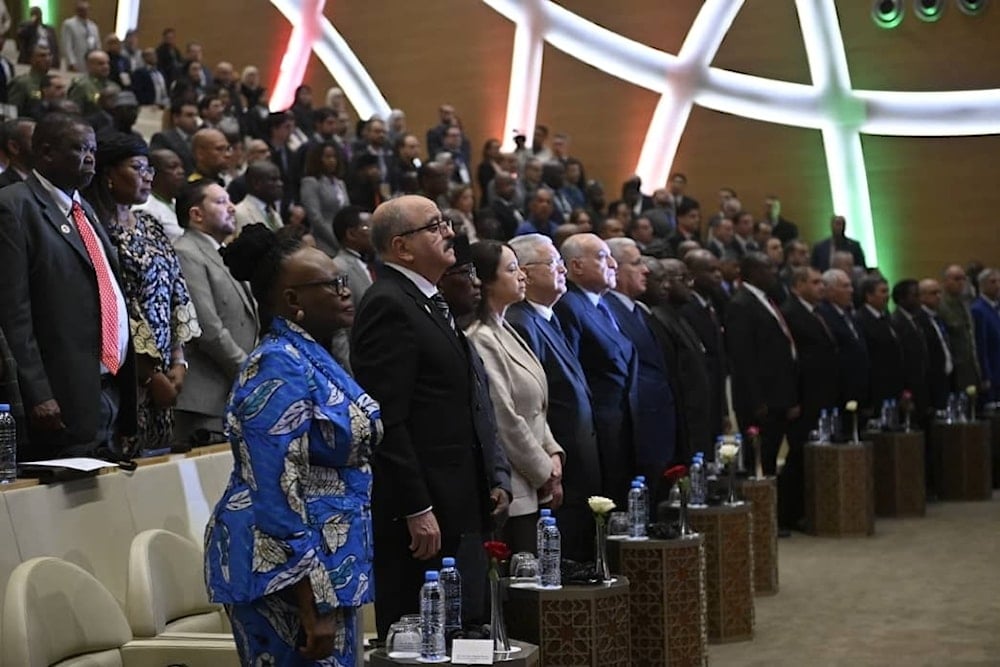
African leaders participate in the International Conference on Criminalizing Colonialism in Africa, as seen in this photo published on November 30, 2025, at the International Conference Center, Algiers, Algeria (X/@Algeria_MFA)
African leaders convening in Algiers have renewed a continent-wide push to formally recognize colonial-era crimes, define colonization as a crime against humanity, and secure reparations for the historic plunder and violence inflicted on African peoples.
The conference, held in the Algerian capital, builds on an African Union (AU) resolution adopted earlier this year that calls for justice and reparative mechanisms to address the enduring political, economic, and social consequences of colonial rule.
Algeria: Case study of colonial violence
Algerian Foreign Minister Ahmed Attaf said Algeria’s own history under French occupation made the country an essential venue for the gathering. He stressed that restitution must be seen as a legal obligation, not a gesture of goodwill.
“Restitution is neither a gift nor a favour,” he said, stressing that Africa is “entitled to demand the official and explicit recognition of the crimes committed against its peoples during the colonial period,” which continue to impose “a heavy price in terms of exclusion, marginalisation and backwardness.”
Between 1954 and 1962, Algeria fought one of the bloodiest anti-colonial wars for liberation. Hundreds of thousands were killed as French forces carried out systematic torture, disappearances, forced settlements, and scorched-earth counterinsurgency operations in an attempt to maintain control in North Africa.
Attaf said Algeria’s ordeal remained “a rare model, almost without equivalent in history” and should serve as a reference point for the global conversation on colonial crimes and justice.
AU seeks legal definition of colonialism as a crime
A central focus of the conference was to advance the AU’s February proposal to craft a unified African position on reparations and formally establish colonialism as a crime against humanity under international law. While slavery, torture, and apartheid are explicitly outlawed by global conventions, colonialism itself remains undefined in key legal instruments, including the United Nations Charter.
African leaders argue that this legal gap has helped shield former colonial powers from accountability, even as the legacies of extraction, forced labour, territorial dispossession, and political subjugation continue to shape the continent’s economic and social landscape.
Some economists estimate the cumulative cost of colonial exploitation in Africa in the trillions of dollars, given the vast profits extracted from gold, diamonds, rubber, and other natural resources.
Read more: Ruling on Belgium’s colonialism in Africa paves way for wider justice
Returning stolen heritage
The push for reparations also includes the return of cultural artifacts seized during the colonial era and still held in European museums. Many remain unrestituted despite decades of demands.
Mohamed Arezki Ferrad, a member of Algeria’s parliament, told the Associated Press that compensation must go beyond symbolic gestures, noting the continued absence of Algeria’s looted heritage, including the famed 16th-century cannon “Baba Merzoug”, which France keeps in Brest.
Western Sahara framed as 'Africa’s last colony'
Attaf also linked the AU’s anti-colonial agenda to ongoing international disputes, pointing to Western Sahara, a former Spanish colony claimed by Morocco, as an unfinished decolonization file. He reiterated Algeria’s support for the Sahrawi people, praising their struggle “to assert their legitimate and legal right to self-determination,” in line with the UN decolonization doctrine.
His remarks came as more AU member states shift toward supporting Morocco’s autonomy plan, a trend Algeria views as undermining the continental consensus. Morocco's Autonomy Plan, first presented to the United Nations in 2007, is a proposal to grant a measure of self-governance to the Western Sahara territory under Moroccan sovereignty. The plan allows its inhabitants to manage their own affairs through local legislative, executive, and judicial bodies. In late October 2025, the UN Security Council passed a resolution that welcomed the Moroccan proposal as a basis for negotiation, suggesting that genuine autonomy "could represent a most feasible outcome."
Both Algeria and the Polisario Front, the independence movement representing the Sahrawi people, have consistently rejected Morocco's autonomy plan. The Polisario Front maintains it is the sole legitimate representative of the Sahrawi people and advocates for a referendum that includes the option of full independence, not just autonomy under Moroccan sovereignty.
Global momentum from Africa to the Caribbean
The movement for colonial reparations is gaining traction beyond Africa. Earlier this month, The Guardian reported that the Caribbean Community (CARICOM) is escalating its campaign for reparative justice, with a regional delegation preparing to visit the UK to demand formal apologies and financial redress for slavery and colonialism.
Caribbean leaders argue that centuries of forced labour and racial exploitation created generational disadvantages that former colonial powers must now help correct.
As Attaf noted, the global push for recognition, restitution, and justice is no longer marginal, and Africa is seeking to lead from the front.
Read more: Algeria imposes trade curbs on France over Sahara recognition


