
Amnesty calls out RSF war crimes as fighting in Sudan spreads
 6 Min Read
Amnesty accuses RSF of committing war crimes in Darfur’s Zamzam camp as fighting escalates in El Fasher and Babnousa, deepening Sudan’s humanitarian crisis.
-
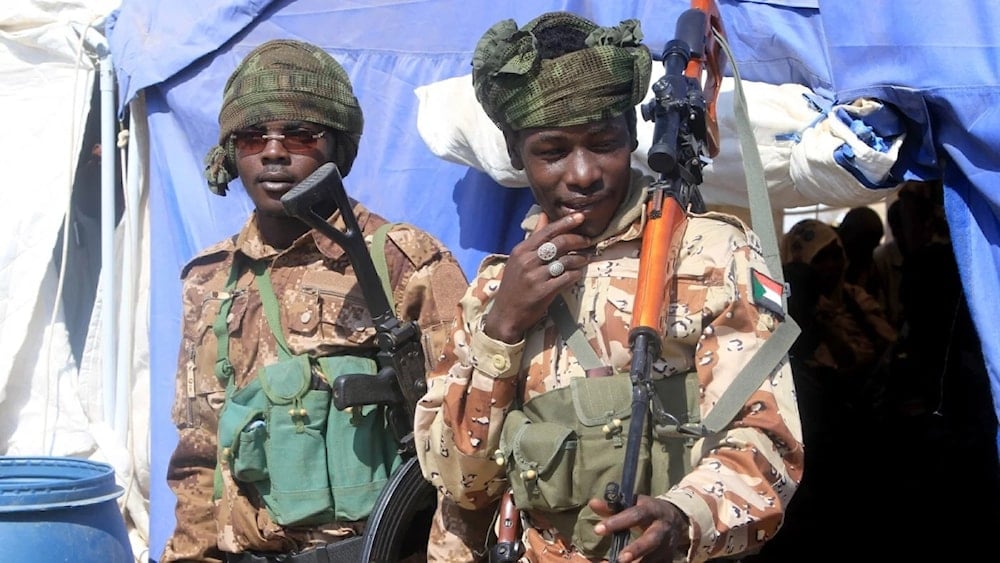
Security at the al-Afad camp for displaced people in the town of al-Dabba, northern Sudan, on November 26, 2025 (AFP)
Amnesty International has called for an investigation into potential war crimes after the Rapid Support Forces (RSF) carried out a large-scale assault on Zamzam, the largest camp for internally displaced persons (IDPs) in North Darfur, Sudan, in April 2025. According to a report released on Wednesday, the attack involved deliberate killings of civilians, hostage-taking, and the pillaging and destruction of mosques, schools, and health clinics.
The report, titled “A refuge destroyed: RSF violations in Darfur’s Zamzam camp for internally displaced persons,” documents how RSF forces struck the camp between April 11 and 13, 2025, deploying explosive weapons and firing indiscriminately in densely populated residential areas.
The assault forced approximately 400,000 people to flee between April 13 and 14 alone and was part of a broader military campaign launched by the RSF in May 2024 aimed at capturing El Fasher, the capital of North Darfur State. The RSF reportedly claimed control of El Fasher on October 26, during which eyewitnesses reported executions of unarmed men and the sexual assault of women and girls.
Agnès Callamard, Amnesty International’s Secretary General, described the assault as “horrific and deliberate,” highlighting that civilians were attacked, killed, and robbed of essential belongings while left without access to justice.
Targeted campaign against camps
She emphasized that the assault was not an isolated incident but part of a sustained campaign targeting IDP camps and villages. Callamard also criticized international actors, stating that some, including the United Arab Emirates, had actively fueled the conflict by supplying weapons to the RSF.
Amnesty International’s report is based on field research conducted between June and August 2025, which included interviews with 29 survivors, relatives of victims, journalists, conflict analysts, and medical personnel, alongside the verification of videos, photographs, and satellite imagery.
Survivors recounted shells striking homes, streets, and even a mosque during a wedding ceremony, while satellite images from April 16 showed new craters consistent with widespread use of explosive weapons. The organization documented 47 civilians deliberately killed by RSF fighters in homes, clinics, and places of worship, which may constitute the war crime of murder under international law.
Sudan Doctors Network expresses concern over situation in Babnousa
In a statement released on Wednesday, the Sudan Doctors Network said Babnousa had witnessed intense fighting, noting that the violence now threatens families who had previously sought refuge at the Sudanese army’s 22nd Infantry Division headquarters after Rapid Support Forces (RSF) troops advanced into the town.
The group stressed the urgent need to ensure the safety, protection, and relocation of civilians to secure areas without exposing them to harm or arbitrary detention, including accusations related to having relatives in the army. It called for the establishment of safe corridors to evacuate trapped families and to deliver humanitarian assistance.
The organization also urged the international community to step in, provide support, and pressure the RSF to facilitate the evacuation of civilians from areas near active clashes.
The statement comes after the Sudanese army announced on Tuesday evening that its forces had repelled a new RSF attack on Babnousa, just one day after the paramilitary group claimed it had taken control of the town and seized the 22nd Infantry Division headquarters.
RSF claims it seized Babnousa, SAF denies seizure
The Rapid Support Forces (RSF) announced on December 2 that they had seized “full control” of the strategic town of Babnousa in West Kordofan, even as international efforts continued to push for a political and humanitarian truce without achieving a breakthrough yet.
In its statement, the RSF said its fighters had “liberated the Babnousa area in West Kordofan,” characterizing it as one of the latest fronts in the conflict, and asserted that their advance followed their forces repelling what they described as a “surprise attack” by the Sudanese Armed Forces (SAF), which they accused of carrying out a “clear violation of the humanitarian truce”.
The SAF rejected the RSF’s claims as another example of what it called a wider effort to “mislead international, regional, and local public opinion,” saying in its statement that RSF units have continued launching daily attacks on Babnousa using artillery and drones even after publicly declaring a unilateral ceasefire without showing any signs of adhering to it.
The army added that the truce declared by RSF commander Mohammed Hamdan Dagalo, known as Hemedti, amounted to nothing more than a “political and media maneuver” aimed at concealing the group’s battlefield movements and deflecting attention from what it described as “ongoing Emirati support” that continues to drive the conflict forward.
Reuters documents kidnappings for ransom by RSF
Survivors and aid workers have reported that the Rapid Support Forces (RSF) and allied militias, which besieged and overran El Fasher, the capital of North Darfur, in late October 2025, are systematically detaining residents for ransom, killing or beating those unable to pay, according to accounts collected by Reuters.
While the exact number of people held in and around El Fasher remains unclear, witnesses suggest that large groups are confined in a cluster of villages within roughly 80 km (50 miles) of the city, with others reportedly returned to El Fasher under the RSF’s demands for payments ranging from thousands of dollars. Survivors told Reuters that ransoms ranged from 5 million ($1,400) to 60 million ($17,000) Sudanese pounds, sums considered vast in the impoverished region.
Reuters interviewed 33 former captives and 10 aid workers and researchers, gathering previously unreported details on the scale of the detentions, the conditions faced by captives, and the locations where they were held. Many of those unable to meet ransom demands, according to 11 survivors, were either shot at close range or executed in groups, while others were severely beaten. A Reuters reporter also observed survivors who had fled across the border into Chad bearing injuries consistent with beatings and gunshots, though these accounts could not be fully verified.
Mohamed Ismail, who spoke from Tawila, a town near El Fasher under the control of neutral forces, described the RSF’s methods: “They give you three or four days, and if you don't transfer the money, they kill you.” Ismail, who left El Fasher as the RSF captured the city on October 26, said he was later captured in the village of Um Jalbakh along with 23 other men.


