
Ansar Allah's advance exposes US, Saudi strategic loss: The Guardian
 5 Min Read
Ansar Allah’s capture of Mokha marks a major setback for Saudi-backed forces and raises new strategic concerns for Washington and Riyadh, The Guardian reports.
-
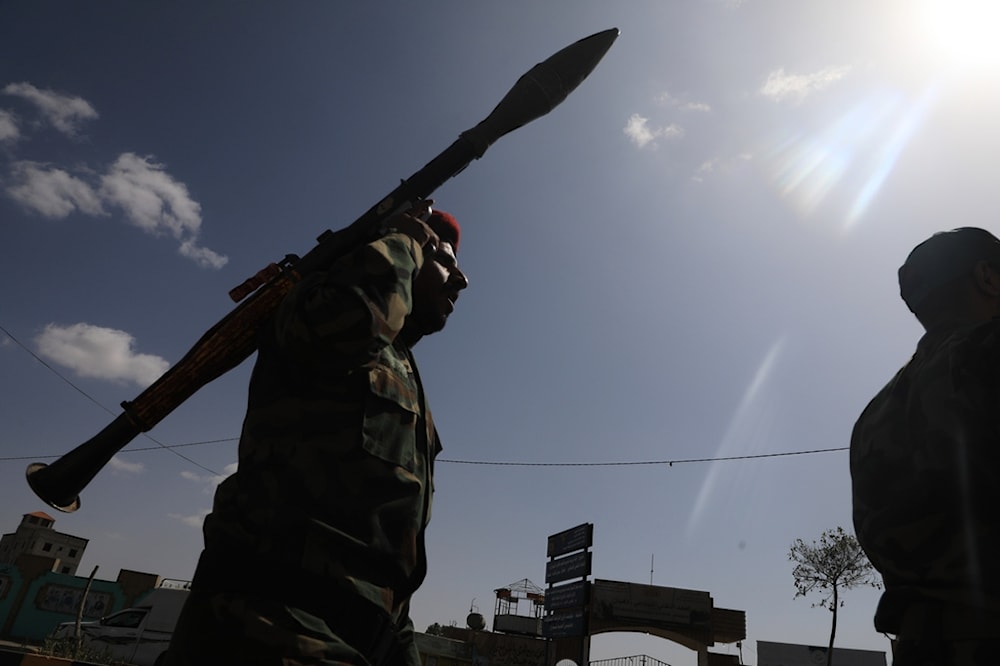
Yemen's Ansar Allah march during a mobilization campaign in Sanaa, Yemen, Thursday, Sept. 10, 2026. (AP Photo)
Ansar Allah’s capture of the strategic Red Sea port of Mokha marks a major setback for the Saudi-backed Yemeni government and threatens to create a wider strategic dilemma for both Saudi Arabia and the United States, The Guardian reported Thursday.
The advance is part of a broader push by Ansar Allah to seize more of Yemen’s Red Sea coastline. According to The Guardian, If the group succeeds in consolidating control over the coast, it could bring Iran and its allies closer to influence over two critical maritime chokepoints on opposite sides of the Arabian Peninsula: the Bab al-Mandeb at the southern entrance to the Red Sea and the Strait of Hormuz in the Gulf. The Guardian described such an outcome as a “strategic disaster” for Saudi Arabia and the US.
The development comes as Washington and Tehran remain locked in a wider confrontation over control of the Strait of Hormuz. The expansion of fighting in Yemen therefore risks opening a second front in the war, with Ansar Allah seeking to increase pressure on Saudi Arabia and the US by threatening another major maritime route.
According to Al Mayadeen's bureau director in Yemen, the Yemeni Armed Forces have prepared operational scenarios capable of striking deep into the Saudi interior should the war be prolonged.
— Al Mayadeen English (@MayadeenEnglish) September 10, 2026
Addressing ongoing battlefield developments along the Red Sea coastline, the bureau… pic.twitter.com/lGROgsf7T5
Saudi Arabia faces a widening strategic dilemma
Saudi Arabia has responded to the advance with an intensive air campaign, launching as many as 40 attacks against Ansar Allah targets on Thursday. Yet the airstrikes have not prevented the group from making ground advances along the coast.
The Saudi-backed forces have suffered significant setbacks, with Yemeni government commander Major General Tareq Saleh acknowledging that his forces carried out a strategic withdrawal south of Mokha to regroup.
Ansar Allah has also claimed control of Hays and the Khalid ibn al-Walid military camp, while an estimate linked to the group said its forces had captured more than 6,000 square kilometers of territory.
The Guardian reported that Saudi Arabia's position has become particularly vulnerable because the kingdom increasingly relies on the Red Sea as a trade and energy route after shipping through the Strait of Hormuz was severely disrupted during the US war on Iran.
That leaves Riyadh facing a difficult choice: escalate militarily to halt Ansar Allah’s advance, potentially deepening its involvement in a war it has sought to move away from, or risk allowing Ansar Allah to gain greater influence over the Red Sea.
Dhaifullah al-Shami, a member of Ansar Allah's Political Bureau, warned that the movement's military capabilities remain largely unvetted in the current phase of operations, revealing that the main body of their strategic arsenal has not yet been deployed against Saudi troop… pic.twitter.com/B4JqHqYHkE
— Al Mayadeen English (@MayadeenEnglish) September 10, 2026
A new pressure point for Washington
For Washington, the stakes extend beyond Yemen itself.
The Guardian reported that Ansar Allah’s push south of Hodeidah is intended to pressure Saudi Arabia and the US into lifting the US blockade on Iranian oil tankers in the Gulf. The strategy would effectively connect the war over Hormuz with the struggle over the Red Sea, increasing pressure on US efforts to maintain maritime access and energy flows across the region.
The escalation has already affected global energy markets, with oil prices rising above $100 a barrel after trading closer to $80 for weeks.
The strategic concern is therefore not limited to whether Saudi-backed forces can retake territory. Control of the Red Sea coast could allow Ansar Allah to threaten maritime traffic approaching the Bab al-Mandeb while Iran continues to challenge US efforts to reopen the Strait of Hormuz.
Saudi-backed forces struggle to contain the advance
The deterioration also exposes divisions within the Saudi-backed Yemeni camp. The United Arab Emirates withdrew financial and military support for southern forces at the beginning of the year, while those forces have refused to fight outside their own region, as per The Guardian.
The Royal United Services Institute said the situation was spiraling, as the internationally recognized Yemeni government opened new fronts in an effort to place greater pressure on Ansar Allah.
ACLED analyst Sherwan Hindreen Ali said a reduction in hostilities appeared unlikely, arguing that both sides were escalating in an effort to inflict enough damage to force the other into a compromise.
He added that fighting was likely to remain concentrated around Hodeidah and Taizz because both sides have an interest in controlling territory that could determine effective control of the Bab al-Mandeb Strait.
With Ansar Allah advancing along the Red Sea while the confrontation over Hormuz continues, the Yemeni battlefield is increasingly becoming part of a broader struggle over the region’s maritime arteries.
For Saudi Arabia and the US, the loss of additional Red Sea territory would therefore represent more than a battlefield setback. It could fundamentally complicate efforts to secure the two waterways that connect the Gulf, the Red Sea, and global energy markets.
Read more: Ansar Allah gains on west coast could choke Eilat port: Israeli media


