
Araghchi from Iraq: Hormuz will remain under Iranian administration
 4 Min Read
Iran's FM Araghchi held a joint press conference with Iraqi counterpart Fuad Hussein in Baghdad, addressing the Strait of Hormuz, regional developments, and the funeral procession of Sayyed Ali Khamenei.
-
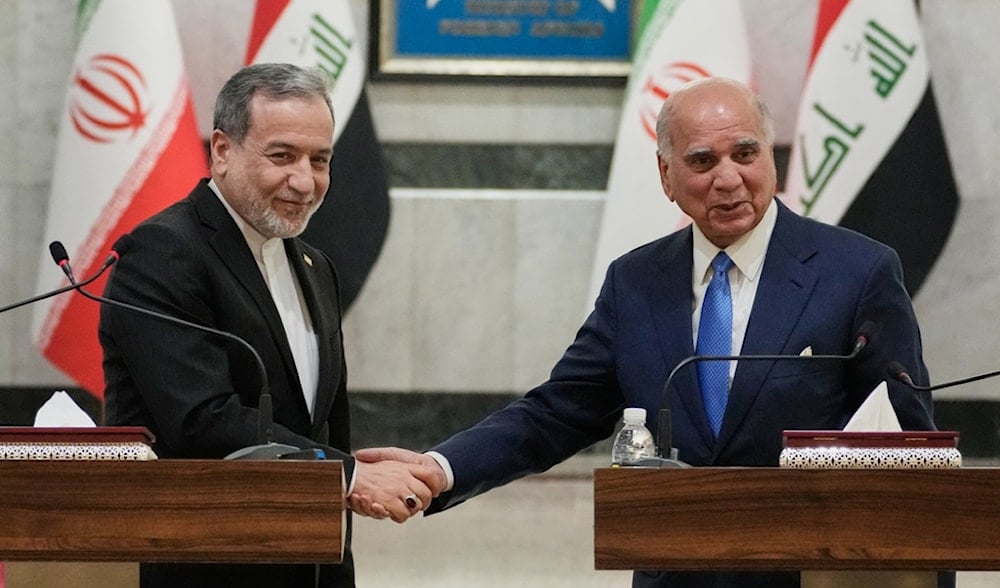
Iraqi Foreign Minister Fouad Hussein, right, shakes hands with Iranian counterpart Abbas Araghchi, during his visit to Baghdad, Iraq, Sunday, June 28, 2026. (AP Photo/Hadi Mizban)
Iranian Foreign Minister Abbas Araghchi arrived in Baghdad on Sunday, where he held a joint press conference with his Iraqi counterpart Fuad Hussein covering bilateral relations, regional developments, the Strait of Hormuz, and the Israeli aggression on Lebanon.
Araghchi said his visit aimed to strengthen relations between Iran and Iraq, noting that the talks also touched on the funeral ceremonies held in Iraq for the Martyred Leader Sayyed Ali Khamenei.
"The strategic relationship between the Islamic Republic of Iran and Iraq is of great value, and we are determined, God willing, to continue and strengthen this relationship," Araghchi said.
Iraqi Foreign Minister Fuad Hussein and Iranian Foreign Minister Abbas Araghchi held a joint press conference in #Baghdad, where the former called for the implementation of the #US-Iran memorandum of understanding.
— Al Mayadeen English (@MayadeenEnglish) June 28, 2026
Hussein stressed that it is necessary to reopen the Strait of… pic.twitter.com/11hZLhsR4j
Any interference in Hormuz will delay reopening
Araghchi stressed that the Strait of Hormuz falls under Iranian administration, affirming that conditions in the waterway would return to how they were before the war. "Any intervention by any party other than Iran in administering the strait will delay its reopening and raise tensions in the region," he said.
"Under the memorandum of understanding, the Strait of Hormuz will return to its pre-war operating capacity within 30 days under the management adopted by Iran and after the obstacles are removed by the Islamic Republic of Iran," he added.
Araghchi pointed to the previous two nights of incidents in the Strait as evidence of this risk. "As we witnessed over the past two nights, incidents in the Strait of Hormuz have already contributed to rising tensions and confrontations," he said, calling on all parties to respect the memorandum rather than allow it to be diverted from its intended course.
Looking beyond the immediate crisis, Araghchi said the new circumstances facing the region required all regional states to reconsider Gulf security collectively. "I believe that, with the new circumstances that have emerged, the security of the Persian Gulf and the security of the region must be reconsidered by all the countries of the region. We must reach a new framework that includes all the countries of the region and excludes the presence or interference of any country from outside the region," he explained.
Washington must restrain the Zionist entity in Lebanon
Araghchi also called on the United States to rein in "Israel" as it continues its aggression against Lebanon. "According to Article One of the memorandum of understanding, the war must come to an end on all fronts, including in Lebanon. We regret that the Israeli regime continues its attacks," he highlighted.
"It is the responsibility of the United States, in accordance with the commitments it accepted under the memorandum of understanding, to ensure that these attacks by the Israeli regime are brought to an end and to allow the cessation of the war to be fully implemented there as well, including the withdrawal from the occupied territories," Araghchi added.
Iraq's priority is ending the state of war
For his part, Iraqi Foreign Minister Fuad Hussein called for implementing the understandings reached between the United States and Iran in a way that leads to the reopening of the Strait of Hormuz and the lifting of the blockade on Iran.
Hussein said Iraq opposed the war on Iran because war leads to the destruction of the entire region, not just one country. He added that Baghdad stands ready to host any initiative aimed at discussing regional security and developing economic relations.
"Regional security must be built by the people of the region themselves," Hussein stressed, noting that Iraq maintains good relations with both the United States and Iran, and that its overriding priority is to bring the state of war to an end.
View this post on Instagram


