
Araghchi to Macron: ‘Get your story straight’ on Iran nuclear deal
 4 Min Read
Iran’s foreign minister says Macron contradicts his 2018 pledge to stay in the JCPOA after Macron said France always opposed any nuclear activity in Iran.
-
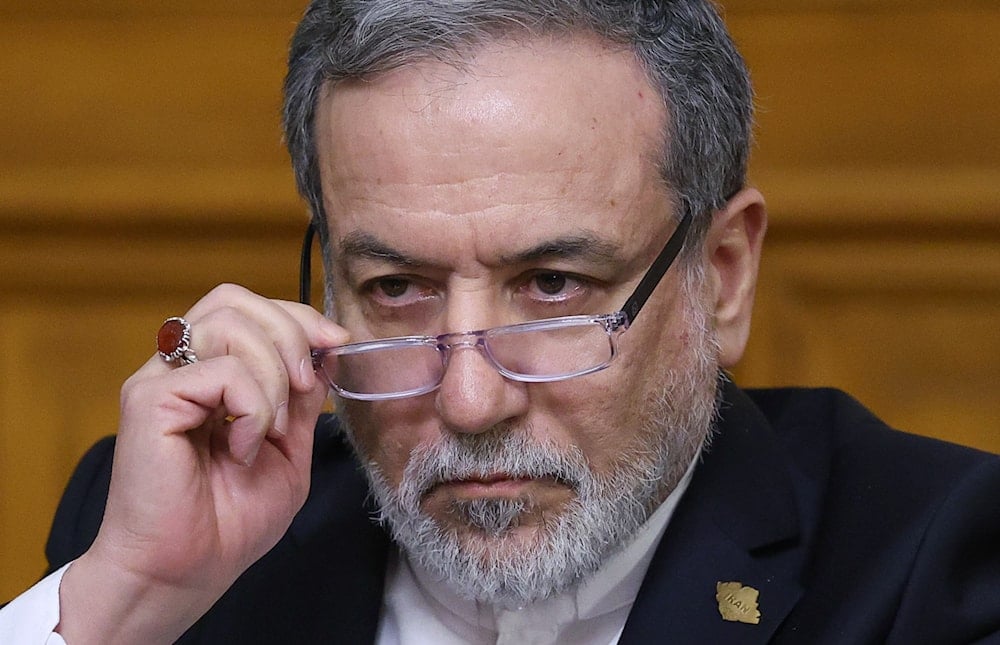
Iranian Foreign Minister Abbas Araghchi looks on during a joint news conference with Russian Foreign Minister Sergey Lavrov at Zinaida Morozova's Mansion in Moscow, on December 17, 2025. (Pool Photo via AP)
Iranian Foreign Minister Abbas Araghchi said French President Emmanuel Macron contradicted his own past position on Iran’s nuclear program, citing Macron’s 2018 speech to the US Congress.
“Just before POTUS exited the Iran Nuclear Deal in 2018, Mr. Macron insisted before the U.S. Congress that ‘France won’t leave the JCPOA, because we signed it,’” Araghchi wrote on X.
“Today, he claims he always opposed ‘any form of nuclear activity’ in Iran. Get your story straight, Mr. President.” He attached a screenshot of the passage from the speech.
Just before POTUS exited the Iran Nuclear Deal in 2018, Mr. Macron insisted before the U.S. Congress that "France won't leave the JCPOA, because we signed it." Today, he claims he always opposed "any form of nuclear activity" in Iran. Get your story straight, Mr. President. https://t.co/wtitKJ1Pzt
— Seyed Abbas Araghchi (@araghchi) October 22, 2026
Araghchi was responding to remarks Macron made at a press briefing on Wednesday. Macron claimed that France had said from the first day of the current war that it was “not our war,” that France did not take the decision, and that peace and stability in the region were its priority.
He added that France had been clear that it is “resolutely against any form of nuclear activity in Iran.”
What Macron said in 2018
Macron addressed a joint session of Congress on April 24, 2018, weeks before US President Donald Trump unilaterally pulled the United States out of the 2015 agreement.
“There is an existing framework, called the JCPOA, to control the nuclear activity of Iran,” he said at the time.
“We signed it, both the United States and France,” the French president explained, adding, “That is why France will not leave the JCPOA, because we signed it.”
During that visit, he proposed a broader deal that would restrict Iranian nuclear activity beyond the agreement’s 2025 expiry, address Iran’s ballistic missiles and regional role, and cover the concerns of the Trump administration. The deal itself restricted Iran’s program and did not prohibit nuclear activity.
When Trump withdrew in May 2018, Macron called the decision a “mistake” and said Europe should stay in the agreement.
France and the end of the deal
In August 2025, France, Britain, and Germany (the E3) triggered the UN "snapback" mechanism to restore previous sanctions on Iran over nuclear non-compliance. While the E3, the US, and the EU consider the restrictions reinstated, the UN Security Council never officially endorsed the outcome due to failed votes and structural disagreements.
Iran, Russia, and China rejected the snapback as invalid, arguing the Europeans lacked standing. Consequently, Iran declared all UN nuclear restrictions expired in October 2025 and proclaimed its IAEA file closed.
Tensions escalated further following US and Israeli aggression on Iranian nuclear sites in June 2025.
While France demands full inspector access and immediate negotiations, Iran has banned IAEA inspectors from the bombed facilities and terminated its recent IAEA cooperation agreement. With inspectors restricted only to the Bushehr plant, the IAEA has referred Iran's case back to the UN Security Council, where Russia and China hold veto power.
France and the war
Iran emphasizes that France’s wartime stance contradicts its public messaging, pointing to a leaked private text Macron sent Trump on January 19, 2026.
In the message, which Trump shared on Truth Social, Macron wrote, “We can do great things on Iran,” while also questioning Trump's actions on Greenland.
When the US-Israeli aggression against Iran began on February 28, Macron publicly stated France was “neither informed nor involved” and urged diplomacy over strikes. However, Euronews reported that France deployed eight warships, two helicopter carriers, and the nuclear-powered Charles de Gaulle to the region by March.
Macron later told Iranian President Pezeshkian that a new security framework must permanently prevent Iran from acquiring nuclear weapons.
On October 18, 2026, Iranian spokesman Baghaei publicly invoked the leaked January text, underlining that Macron is aligning with a “campaign of aggression and atrocities.”


