
Australia signs $1.8bn radar export deal with Canada
 3 Min Read
Australia has signed a $1.8 billion deal to supply Canada with advanced over-the-horizon radar technology, marking the largest defense export agreement in Australian history.
-
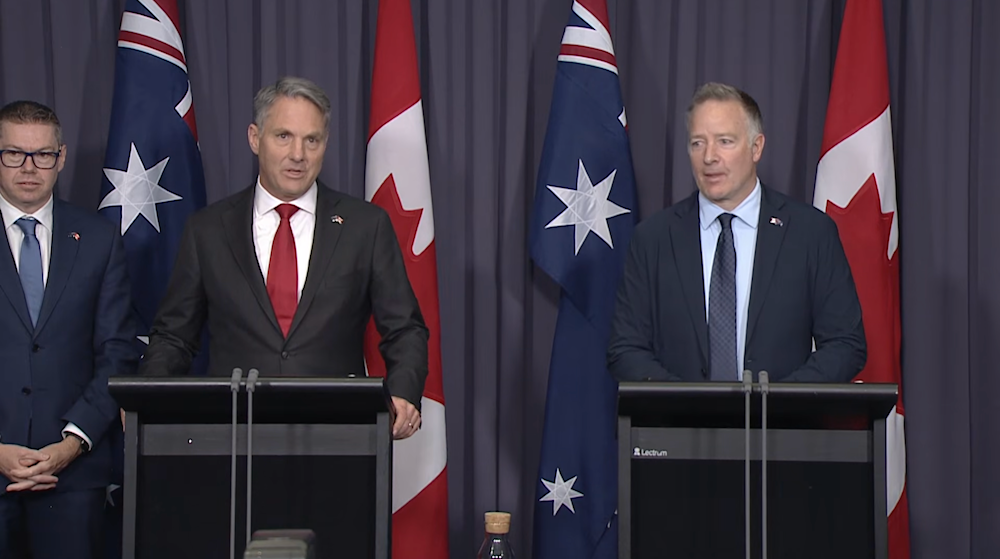
Screenshot of Australian Defence Minister Richard Marles (left) during a press briefing with Canada’s Secretary of State for Defence Procurement Stephen Fuhr (right) in Canberra, Australia, on June 22, 2026. (YouTube/9 News Australia)
Australia has signed a record Aus$2.5 billion ($1.8 billion) agreement to supply Canada with advanced over-the-horizon radar technology, marking the largest defense export deal in Canberra's history.
The agreement represents the first international sale of Australia's long-range radar system, which is designed to provide early warning capabilities and enhance surveillance across vast territories.
Australian Defense Minister Richard Marles described the contract as a landmark moment for the country's defense industry.
"It is far and away the largest defense export that we have ever done," Marles told reporters following the signing ceremony.
He said the agreement adds a new strategic dimension to relations between Australia and Canada, countries that have long maintained close political and military ties.
Read more: US to assist Australia in missile manufacturing and export
Advanced radar system to bolster Arctic surveillance
The radar technology uses high-frequency electromagnetic waves that are reflected off the ionosphere, enabling operators to detect aircraft, ships, and other objects at distances beyond the Earth's curvature.
According to Australian officials, the system forms the backbone of the country's northern surveillance network and provides monitoring capabilities at ranges between 1,000 and 3,000 kilometers.
BAE Systems Australia is expected to begin deliveries on July 1 as part of the first phase of a broader bilateral project.
Marles said Canada intends to use the technology to strengthen monitoring capabilities across the Arctic, a region that has gained growing strategic significance amid increased military competition and geopolitical interest, especially amid Trump's threats to annex Greenland.
“Just like Australia, Canada has large areas to surveil,” he said. “Canada will use this to engage in surveillance over the Arctic.”
Canberra deepens strategic ties with Ottawa
The agreement includes the construction of an initial radar site and lays the foundation for future cooperation on long-range surveillance systems.
Canadian Secretary of State for Defence Procurement Stephen Fuhr described the project as an important component of Ottawa's efforts to strengthen national security and Arctic monitoring capabilities.
“This capability will significantly enhance Canada's Arctic domain awareness, detect and track air and maritime threats with much greater range, strengthen NORAD by providing earlier warning and improving continental defense, and reinforce Canada's Arctic sovereignty,” Fuhr said.
The deal comes as Canada seeks to modernize its defense infrastructure and expand security partnerships amid evolving geopolitical conditions.
Fuhr emphasized that Ottawa would continue defense cooperation with the United States, while also diversifying strategic partnerships.
“We are reacting to our new realities and rewiring ourselves out to meet the moment,” he said.
Deal expected to create jobs in both countries
Australian officials said the agreement will support approximately 300 highly skilled technical jobs across the country's defense and technology sectors.
Canadian authorities, meanwhile, estimate the project will generate nearly 2,300 jobs annually over the next five years.
The deal is expected to strengthen industrial cooperation between the two countries while expanding Australia's presence in the global defense export market.
For Canberra, the agreement also highlights efforts to transform domestic defense technologies into internationally competitive exports amid growing demand for advanced surveillance and early-warning systems.


