
Australian activists prepare to sail to Gaza despite immense risks
 4 Min Read
One participant who says she was sexually assaulted by Israeli forces during a previous voyage says she will sail yet again as part of a 100-boat flotilla aiming to break "Israel's" naval blockade on Gaza.
-
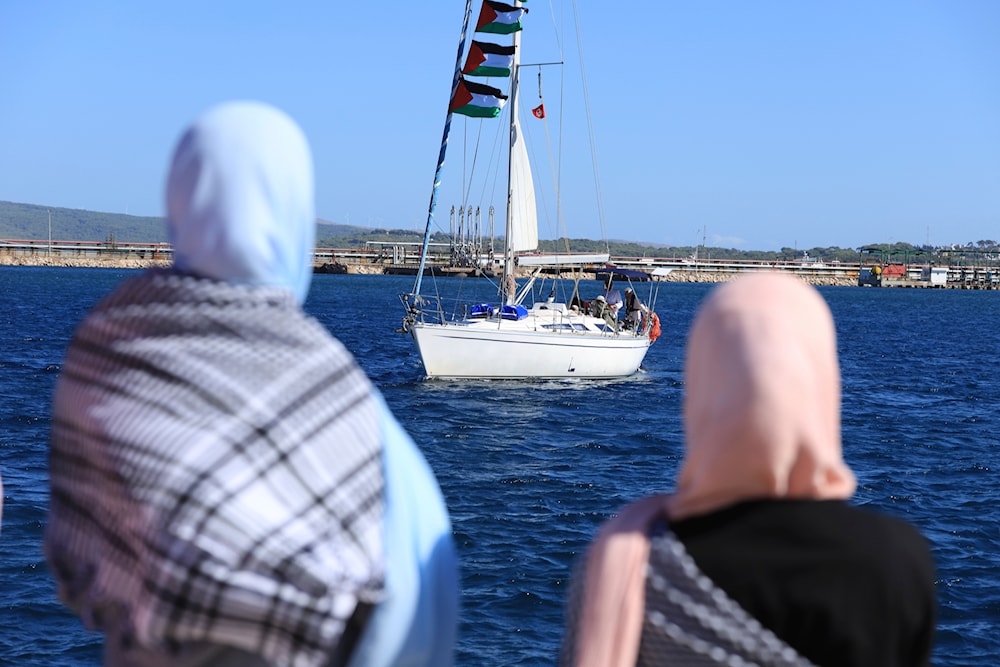
Supporters watch as a boat that is part of the Global Sumud Flotilla departs to Gaza to deliver aid amidst Israel's blockade on the Palestinian territory, in the Tunisian port of Bizerte, Saturday, Sept. 13, 2025 (AP)
Australian activists are preparing to set sail for Gaza as part of a 100-boat flotilla aiming to break "Israel's" naval blockade and deliver food, medical supplies, and volunteers to the Palestinian people.
Juliet Lamont, a New South Wales film-maker and co-head of the Australian delegation for the Global Sumud flotilla, spent six days in an Israeli prison in October after the vessel she was travelling on was hijacked by Israeli forces. She says she was sexually assaulted, deprived of medication, humiliated, and subjected to physical violence while held captive.
"I just wonder if I will be punished for coming back, for daring to return," she said from a European port whose exact location is being kept secret by organizers. "It's a mixture of being completely terrified, but then being so centred in my acknowledgment of the Palestinian suffering that I have to go back."
Added dangers amid regional war
This time around, there are added dangers. The ongoing US-Israeli aggression on Iran and its subsequent regional consequences have heightened safety risks for the mission.
"Of course, the geopolitical escalation with Iran, Israel and the US means that the flotilla might experience a heightened risk," Lamont said.
Simon Jones, Australia's delegation co-head, says the latest war has galvanized some participants and shaken others. "There's a realisation that things are not getting any better for anybody in Gaza. At the same time, some people feel the risk of sailing is too much."
Lamont will be one of about 2,000 flotilla members, with a single cargo ship potentially able to carry 1,000 caregivers, teachers, and construction workers, each "drilled" in non-violence. About 15 Australians are planning to sail.
"The level of our captains and first mates is amazing. We're going to have strong boats and a really strong team of non-violent humanitarians," Lamont added. "It's a military operation but without the guns."
Preparing for the worst
Lamont is preparing for potential harsh treatment by Israeli personnel by weaning herself off the blood pressure medication she was denied when detained in October. At the time, she feared she was at risk of having a stroke.
All participants have undergone detailed security training before flying to Europe. A common piece of advice is to throw mobile phones overboard rather than surrendering them to Israeli forces. Before departure, divers will check hulls for explosives, and each vessel will be searched for drugs, guns, or contraband that could have been planted.
Lamont will again be travelling with her two daughters, split across three vessels. Her daughter, Isla Lamont, 25, was on board the Alma when it was attacked by drones during the last attempt to reach Palestine.
A fighter's chance
The trip can be completed in 11 days. In October, Lamont could see the coastline of Gaza before their vessel was intercepted.
"That was 49 boats. This time, our flotilla is two times that size. They're going to have a really hard time intercepting that many boats," she said. "We've got an absolute fighter's chance of reaching the shore."
The flotilla is scheduled to leave Barcelona in mid-April before joining other boats en route to Gaza. But the mission remains at the mercy of ever-changing regional geopolitics.
For Lamont and the other activists, the choice is clear: despite the risks, despite the trauma, despite the ongoing regional war, they are going back. Gaza, they maintain, cannot wait.
Read more: 'Gaza, Marseille is with you,' French boats join global aid flotilla


