
Baghaei: Iran's two-day Hormuz proposal remains most rational option
 5 Min Read
Tehran says Washington must address the message sent by American voters and abandon its pressure campaign.
-
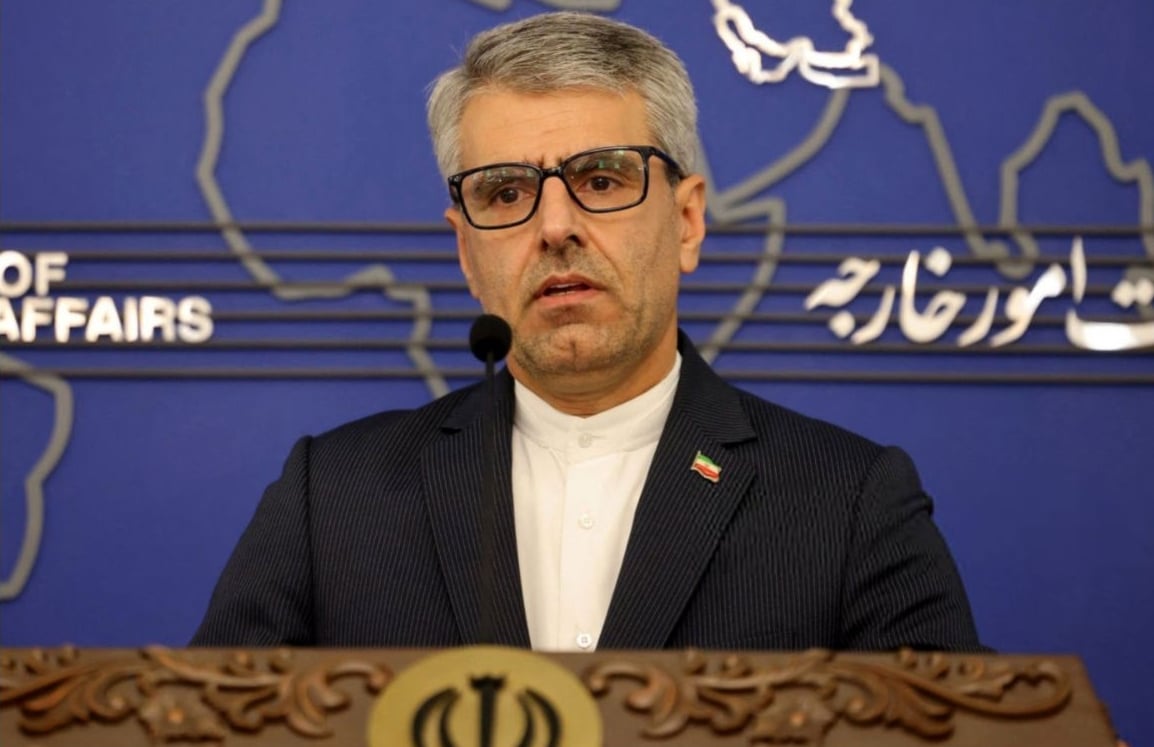
Iranian Foreign Ministry spokesperson Esmaeil Baghaei speaking during the weekly press conference in Tehran, photo shared by IRIB on Monday, November 9, 2026 (IRIB News Agency)
Tehran's proposal to reopen the Strait of Hormuz within two days remains the most rational option for restoring security to the strategic waterway and the Gulf region, Iranian Foreign Ministry spokesperson Esmaeil Baghaei said, stressing that Iran's demands are non-negotiable.
Speaking at his weekly press conference in Tehran on Monday, Baghaei said the proposal could pave the way for restoring security in the Strait of Hormuz and establishing a framework for further progress.
He urged Washington to make a genuine decision, saying, "The Americans must make a genuine decision, if they have properly understood the message of their own people," in reference to the US midterm elections, in which the war on Iran played a key role in shaping voters' choices.
Baghaei said Iran's proposal demonstrated Tehran's goodwill, dismissing US Secretary of State Marco Rubio's characterization of Iranian demands as irrational.
He stressed that Iran's demands, including lifting the economic blockade and ending hostilities on all fronts, were entirely logical and must be met before negotiations with Washington resume.
"What is irrational and absurd is the US attack on Iran in the middle of negotiations. By any logic, norm or standard, the US attack was not only absurd, illegal and irrational, but also criminal," he said.
The spokesperson also stated that Washington's violation of the memorandum of understanding less than a month after it took effect in mid-June was irrational.
US must reconsider its policies midterm results
Addressing the implications of the US midterm elections, Baghaei said Washington's acknowledgment that the war imposed on Iran had influenced the electoral outcome must be accompanied by an understanding of the message delivered by American voters. He noted that Iran faced aggression from both US political parties, stressing that the administration should not side with the Israeli occupation regime.
He further said attempts were being made to "justify" the illegal war against Iran following the electoral setback.
Baghaei also condemned Israeli practices, pointing to the humanitarian catastrophe in Gaza, continued attacks on displaced Palestinians' tents, violations in the West Bank, and war crimes in southern Lebanon.
Read more: Americans tired of 'Israel' dragging US into 'forever wars': Araghchi
'US $20mln reward reflects Washington's confusion'
Commenting on Washington's offer of a $20 million reward for information concerning Iran's nuclear program, Baghaei said the move exposed contradictions in US claims about Tehran's nuclear activities.
He noted that US officials have previously claimed to have destroyed Iran's nuclear program while simultaneously boasting of monitoring the country's every move.
According to Baghaei, Washington was attempting to sustain a false narrative used to justify the war against Iran and portray its nuclear activities as a threat.
He added that the world would not be deceived by US psychological warfare, particularly after American voters demonstrated their rejection of such claims in the midterm elections.
As for the US military's proposed "Iron Gate" plan to restrict the transfer of sanctioned goods and certain financial flows through Iran's land borders and the Caspian Sea, Baghaei emphasized that the initiative was an attempt by US military officials to compensate for their defeat.
He said the plan came amid the post-election period, when those responsible would have to answer for their miscalculations, consequential decisions, and role in steering Washington into an illegal and criminal war.
US pressure will not undermine Iran-Iraq ties
On regional relations, Baghaei said exchanges between Iran and neighboring countries were normal and essential, responding to questions about a recent Iraqi presidential delegation's visit to Tehran, Iraqi Foreign Minister Fuad Hussein's remarks on regional developments, and US pressure on Baghdad.
He stressed that economic, trade, and political exchanges were necessary for cooperation with neighboring countries, adding that US pressure, regardless of its intensity, could not and must not undermine the longstanding ties between the Iranian and Iraqi people.
The two countries have been and would remain neighbors, he said, emphasizing that their peoples were destined to live alongside one another permanently.
Baghaei also argued that US interference was the source of instability in the Strait of Hormuz, calling on vessels seeking to transit the strategic waterway to coordinate with Iranian authorities.
Iran conveys concerns over Trump Route project to Armenia
On the proposed Trump Route project, Baghaei said Tehran has clearly communicated its concerns to Armenia, stressing that the initiative must not alter internationally recognized borders or the region's geopolitical landscape.
He said Yerevan assured Tehran that Armenian companies would undertake construction work and that no US military forces would be deployed in the area.
Baghaei added that Iran would closely monitor developments and communicate its concerns whenever its interests and those of regional countries required it.
In a related development, the spokesperson said the International Atomic Energy Agency had conducted an inspection at the Bushehr Nuclear Power Plant several days earlier.
Read more: 'Highly unlikely'? Trump’s Iran claims crumble after election loss


