
Concerns about autocracy rise in US ahead of 2026 midterms
 6 Min Read
Political scientists and new polling data signal mounting concerns over democratic backsliding, executive power expansion, and electoral integrity as the US heads toward the 2026 midterm elections.
-
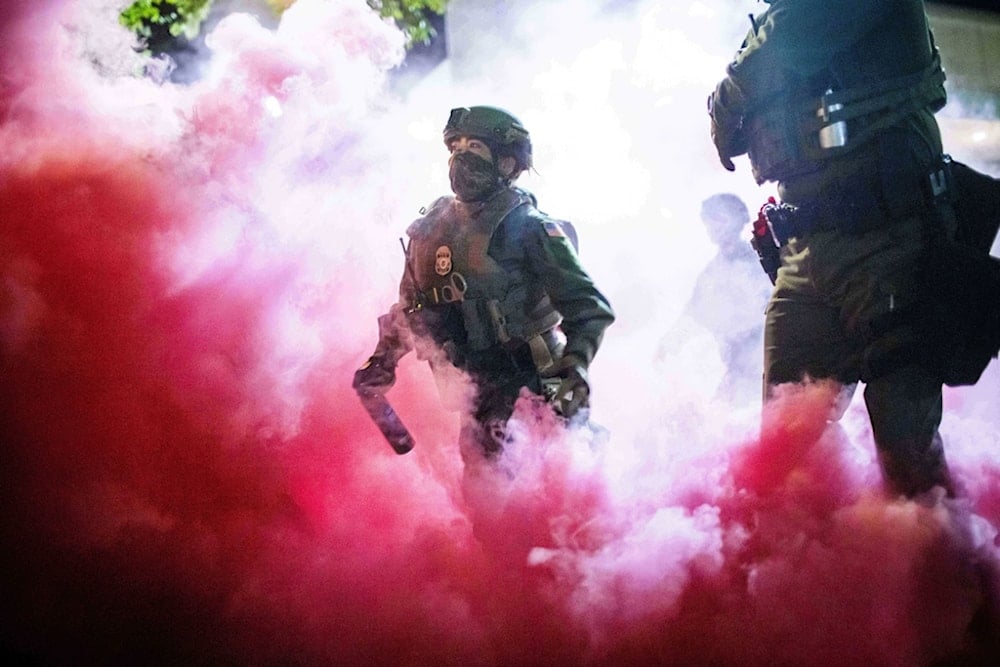
Police and federal officers throw gas canisters to disperse protesters near a US Immigration and Customs Enforcement facility in Portland, Ore., Oct. 5, 2025. (AP)
As the United States approaches the 2026 midterm elections, concerns about US democracy decline are intensifying among political scientists, some of whom argue that the country has shifted toward a form of competitive authoritarianism.
Staffan I. Lindberg, director of Sweden’s V-Dem Institute, says the United States has already crossed a critical threshold and now qualifies as an “electoral autocracy” which is a system in which elections are held but democratic standards are significantly weakened.
Steven Levitsky, professor of government at Harvard University and co-author of How Democracies Die, offered a similar assessment.
"I would argue that the United States in 2025-26 has slid into a mild form of competitive authoritarianism," Levitsky said. "I think it's reversible, but this is authoritarianism."
Under competitive authoritarianism, elections continue to take place, but the ruling party uses various tools, including but not limited to attacks on the press, voter disenfranchisement, the weaponization of the justice system, and threats against critics, to tilt the electoral playing field in its favor.
Trump’s executive power expansion under scrutiny
Debate over Trump authoritarianism has centered on what critics describe as a steady executive power expansion during his second term. Levitsky pointed to two developments in September that he considers particularly troubling.
First, the Trump administration threatened ABC’s parent company, Disney, following remarks by Jimmy Kimmel concerning the killing of Charlie Kirk.
"We can do this the easy way or the hard way," Brendan Carr, chairman of the Federal Communications Commission, warned. A week later, President Trump proposed that US generals use American cities as training grounds for troops.
"We're under invasion from within," Trump said at a gathering of military officials in Quantico, Virginia. "No different than a foreign enemy, but more difficult in many ways because they don't wear uniforms."
Levitsky compared the rhetoric to language used by South American dictators in the 1970s, including Chile’s Augusto Pinochet.
Divided academic opinion on autocracy in America
Not all scholars agree that the US has entered an era of autocracy in America.
Jonathan Turley, a professor at George Washington University Law School, argues that the president’s actions reflect efforts to counter what he views as institutional bias.
"There are legitimate objections that have been raised by the Trump administration," Turley said, author of Rage and the Republic. "That does not justify some of the means, but there is a long-standing need for a debate within these institutions."
Other researchers contend that while democratic institutions have been strained, they remain intact.
Kurt Weyland, who studies democracy and authoritarianism at the University of Texas at Austin, believes the US system has demonstrated resilience. He said that during the early months of Trump’s second term, the president operated like a “steamroller” with little resistance. However, Weyland argues that institutional pushback has since increased.
For example, Jimmy Kimmel was briefly removed from the air but later returned and continues to criticize the president. Weyland also noted that efforts to reshape congressional districts through mass redistricting did not significantly alter the electoral balance.
"If the guy had succeeded in seriously skewing [future] elections in the House, that would've gone to the core of democracy," Weyland said, "but he didn't. He got barely anything."
Immigration enforcement and political backlash
Immigration enforcement has emerged as another flashpoint in debates over executive authority.
Last month, federal agents shot and killed two US citizens in Minneapolis during enforcement operations, triggering public outrage. Border czar Tom Homan later announced that the immigration enforcement surge in Minnesota was ending.
Weyland argued that the backlash could limit the administration’s ability to deploy similarly aggressive tactics in the future.
Public demonstrations, including large-scale protests in Minneapolis and Los Angeles, have reflected mounting tension over federal immigration actions.
Public opinion reflects growing political strain
Recent national surveys suggest that concerns over US democracy decline are unfolding alongside measurable shifts in voter sentiment.
A Harvard CAPS/Harris poll conducted in late January found that 51% of registered voters said Trump is doing a worse job than former President Joe Biden, compared with 49% who believe he is doing better.
Rasmussen Reports similarly found that 48% of likely voters said Biden performed better in office, compared with 40% who chose Trump.
A YouGov/Economist poll conducted in early February showed 46% of US adults saying Trump is doing a worse job than Biden, while 40% said he is doing better. On immigration, traditionally considered a core strength for the president, an NBC News survey found that 49% of adults “strongly disapprove” of how Trump has handled border security.
On the economy, Trump’s net approval rating stands at -18, according to CNN polling analysis, significantly lower than at the same point in his first term.
The YouGov/Economist data also show Trump at -42 net approval among voters aged 18–29, marking a dramatic reversal from early in his presidency. Analysts have also pointed to erosion among non-college voters, a demographic that formed a central pillar of Trump’s prior electoral coalitions.
US midterm elections 2026 as a democratic test
The upcoming US midterm elections 2026 may serve as a crucial test for the country’s democratic institutions. The Trump administration is currently suing states to obtain voter data, a move that has raised concerns among election scholars.
Kim Scheppele, a sociologist at Princeton University who has studied Hungarian Prime Minister Viktor Orbán’s governing style, warned that manipulation of election administration can have far-reaching consequences.
In 2014, Orbán’s government redirected Hungarian voters living in the United Kingdom to different polling locations on Election Day. "They disenfranchised almost all the Hungarians in the UK, most of whom were oppositional to Orbán," Scheppele said.
Earlier this month, Steve Bannon proposed deploying Immigration and Customs Enforcement (ICE) officers to polling stations to identify undocumented migrants attempting to vote, an occurrence widely regarded as statistically rare.
White House press secretary Karoline Leavitt said she was unaware of any such plan, noting that federal law prohibits the deployment of ICE personnel to polling places.
Brendan Nyhan, professor of government at Dartmouth College, warned that even discussing such measures could deter participation among communities concerned about harassment. "But even contemplating that kind of interference is, I think, a really substantial threat," Nyhan said. "The way Election Day works in this country, there are no do-overs."
Read More: ICE detaining hundreds of children in dire conditions amid crackdown


