
DPRK vows to strengthen military deterrence in response to US threats
 4 Min Read
Pyongyang pledges to accelerate military development as it steps up missile tests and advances its naval and strategic deterrence capabilities.
-
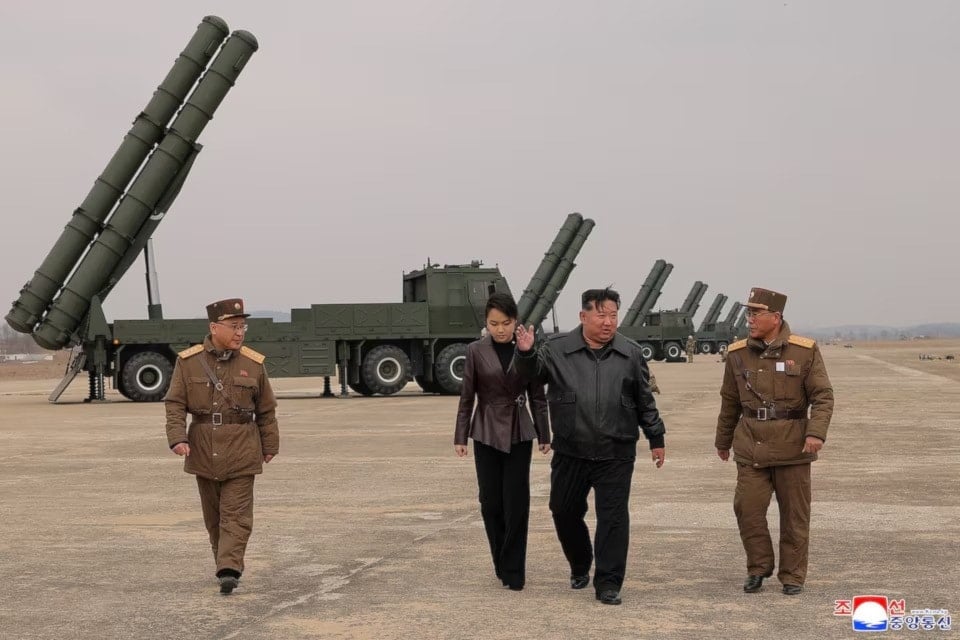
DPRK leader Kim Jong Un, accompanied by his daughter Kim Ju Ae, oversees the test-launch of 600 mm-calibre multiple rocket launchers, DPRK, March 14, 2026. (KCNA)
The Democratic People’s Republic of Korea (DPRK) has vowed to accelerate the development of its military capabilities, citing growing maritime threats from the US and its allies.
Pyongyang announced on Thursday that it would continue strengthening its war deterrence capabilities, stressing its readiness to take responsive measures in the face of escalating maritime threats and moves by Washington and its partners.
According to the Korean Central News Agency (KCNA), the development of the country's military deterrence capabilities will continue without interruption to counter threats posed by the US and its allies at sea.
The announcement comes as Pyongyang steps up its military testing activities. Last week, the DPRK announced that it had tested a new air defense system.
On October 15, it also announced two tests of strategic cruise missiles launched from submarines, following the launch of tactical ballistic missiles earlier that month.
The DPRK has been seeking to advance its naval capabilities and strategic deterrence systems, including underwater missile-launch capabilities.
DPRK warns US-South Korean drills fuel nuclear tensions
Pyongyang has also condemned joint US-South Korean military exercises earlier this month, stating them as preparations for a nuclear war against its territory and arguing that they further demonstrate the need to strengthen its nuclear deterrence.
The latest exercises, known as Freedom Flag, began on October 26 at Kunsan Air Base in Gunsan, around 180 kilometers southwest of Seoul, and are scheduled to run for two weeks. They involve a broad deployment of military aircraft and strategic assets from both allies.
According to South Korea's Yonhap News Agency, the participating aircraft include South Korean F-15K, KF-16, and F-35A fighter jets, alongside KC-330 transport and aerial refueling aircraft and E-737 Peace Eye airborne early warning and control aircraft.
The US has deployed F-16 Fighting Falcon fighter jets and RC-135 reconnaissance aircraft, as well as US Navy MH-60S Seahawk helicopters. The US Marine Corps is also participating with F-35B stealth fighter jets and MQ-9 Reaper surveillance drones.
Seoul says the exercises are intended to assess its ability to command combined forces as it seeks to regain wartime operational control from Washington by 2030 or earlier. The drills follow a series of joint military exercises conducted by the two allies in recent months, including the annual Honguk exercise, held from October 19 to 30 and involving ground, naval, and air operations alongside US forces stationed in South Korea.
Kim Yo Jong warns of instability along southern border
Beyond the joint exercises, tensions between Pyongyang and Seoul have also been mounting along their shared border. Kim Yo Jong, department director of the Central Committee of the Workers' Party of Korea, had warned since last month that the situation had become increasingly unstable, accusing the South Korean military of threatening DPRK troops stationed in the area.
"The situation of the southern border is very unstable," she said, saying that the situation was the result of the "reckless behavior of the ROK military gangsters."
Kim said South Korean forces had fired warning shots at DPRK troops using automatic rifles and large-calibre machine guns, accusing Seoul of invoking alleged border crossings to justify the incidents.
She added that South Korean forces had carried out 2,870 rounds of provocative loudspeaker warnings and 201 warning-shot provocations between August 1 and October 17.
Kim said these actions had crossed a red line, particularly following the "mine explosion farce," further underscoring Pyongyang's concerns over the security situation along the border.


