
Erdogan reaffirms Turkey’s rejection of foreign intervention in Iran
 3 Min Read
Turkey’s President Erdogan tells Iran's President Pezeshkian that Ankara rejects any foreign intervention, as regional tensions and US-Israeli pressure escalate.
-
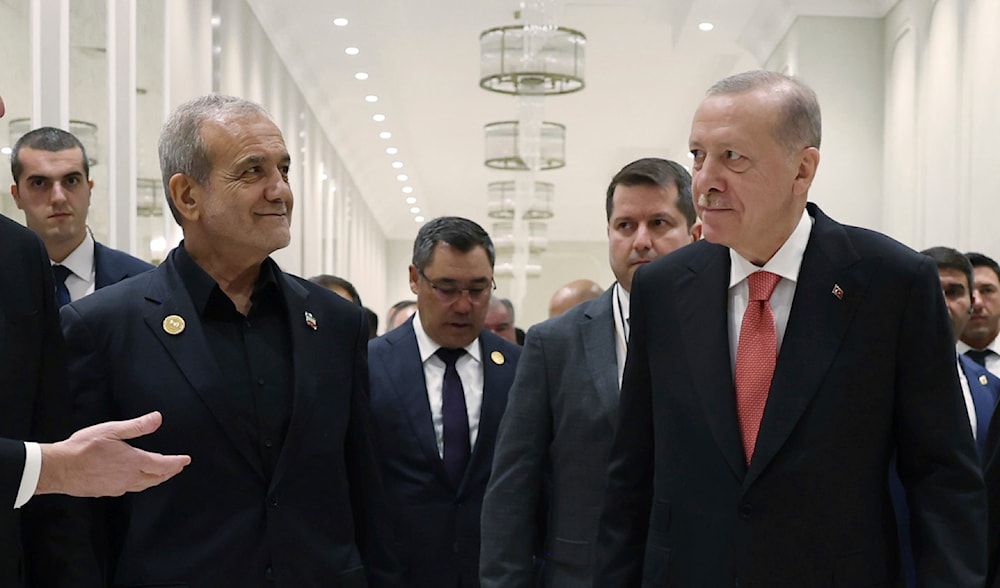
Iranian President Masoud Pezeshkian and Turkish President Recep Tayyip Erdogan arrive to the 17th Summit of the Economic Cooperation Organization (ECO), in the city of Khankendi, Azerbaijan, Friday, July 4, 2025. (Turkish Presidency via AP)
Turkish President Recep Tayyip Erdogan discussed the latest developments in Iran in a phone call with his Iranian counterpart, Masoud Pezeshkian, reaffirming Ankara's firm opposition to any foreign intervention in the country.
According to a statement from the Turkish presidency, Erdogan reviewed the situation in Iran with Pezeshkian and stressed that Turkey rejects all forms of external interference, warning that foreign involvement could further destabilize both Iran and the wider region.
Pezeshkian, for his part, said the mass turnout of millions of Iranians in public squares had thwarted plots aimed at provoking unrest. He warned that "the enemies of Muslim nations seek to expand terrorism and undermine regional security by manufacturing internal crises."
Turkey has previously cautioned that any foreign intervention in Iran would exacerbate regional instability and has repeatedly called for political solutions and direct dialogue rather than coercion or escalation.
Escalating Israeli rhetoric
The phone call comes amid heightened regional tensions and increasingly explicit threats against Iran. Speaking at the World Economic Forum in Davos, Israeli President Isaac Herzog openly endorsed regime change in Iran, calling it "the only viable future" for the country; remarks Iranian officials cite as evidence of a coordinated external pressure campaign.
On Thursday, the commander-in-chief of the Islamic Revolutionary Guard Corps, Major General Mohammad Pakpour, warned that Iran's armed forces are "fully prepared" and on full alert, cautioning the United States and "Israel" against any miscalculation that could trigger a "more painful and regret-inducing" response.
The warnings follow violent unrest that erupted in late December, after initially peaceful economic protests were hijacked by armed groups linked to foreign intelligence networks. The Supreme National Security Council has put the death toll from the unrest and related violence at 3,117 people, including civilians and security personnel.
Border alerts, regional diplomacy
In the heat of the riots, Reuters reported that Turkey's intelligence service warned Iran roughly two weeks ago about Kurdish separatist fighters attempting to cross into Iranian territory from neighboring states, a move Tehran says was aimed at exploiting internal instability.
Regional opposition to military escalation has also surfaced publicly. In Istanbul, demonstrators gathered outside Iran's consulate on Sunday to condemn US-Israeli threats and voice solidarity with Tehran, with analysts citing sustained diplomatic pressure from Turkey and other regional states as a key factor in restraining further escalation.


