
Erdogan says return to F-35 program would boost US-Turkiye ties
 4 Min Read
Turkish President Erdogan says Turkiye’s return to the F-35 program would strengthen ties with Washington and support NATO security.
-
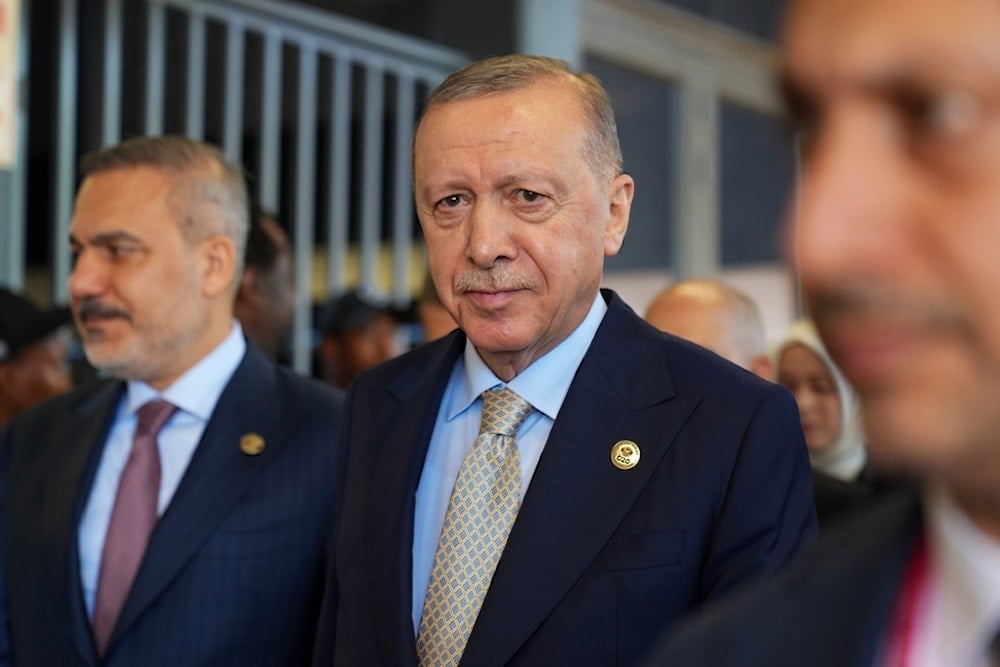
Turkish President Recep Tayyip Erdogan attends a press conference at the G20 leaders' summit, in Johannesburg, South Africa, Sunday, November 23, 2025 (AP)
Turkish President Recep Tayyip Erdogan said that Turkiye’s return to the F-35 fighter jet program would help strengthen relations between Ankara and Washington and bolster the security of the North Atlantic Treaty Organization (NATO).
Erdogan made the remarks in written responses to questions from Bloomberg, describing Turkiye’s removal from the F-35 program following its purchase of Russian military equipment as an “unfair decision.” He said that reinstating Turkiye in the program would be both important and necessary.
The Turkish president said he personally conveyed this position to US President Donald Trump during their meeting at the White House in September 2025. Erdogan added that Ankara’s receipt of the F-35 jets it has already paid for, along with its re-entry into the manufacturing program, would represent a significant step forward.
Trump return created opportunity for expanded ties
Erdogan also said Trump’s return to the US presidency had created an opportunity to advance relations between Turkiye and the United States on what he described as more rational and constructive foundations.
Earlier on Monday, Erdogan held a phone call with Trump during which he stressed the need to avoid pushing Venezuela toward further instability. He reaffirmed Turkiye’s support for the “friendly Republic of Venezuela,” saying that President Nicolas Maduro and the Venezuelan people have repeatedly demonstrated friendship toward Turkiye.
Addressing the ongoing aggression against Venezuela, Erdogan said Turkiye is working to pursue what is best and most appropriate for both the Turkish and Venezuelan peoples, emphasizing that Ankara does not agree with any actions that violate international law.
A long-running dispute
Turkey's move to acquire the S-400 in 2017 triggered a major rupture with the US. Deliveries in 2019 prompted Washington to remove Turkish companies from the F-35 supply chain, cancel Turkey's aircraft order, and impose CAATSA sanctions targeting senior defense figures.
The US later reissued the F-35 consortium memorandum without Turkey, signing it alongside the UK, Italy, the Netherlands, Australia, Denmark, Canada, and Norway.
Despite these challenges, Ankara continues to signal that restoring the F-35 partnership remains a priority, even as regional rivals intensify pressure to keep the door closed.
Turkiye accuses 'Israel', Greece of pressure to block deal
Turkey's Defense Minister Yasar Gueler said in late December that "Israel" and Greece were pressing Washington to prevent Ankara from rejoining the F-35 fighter jet program, a move he describes as part of a broader political effort to limit Turkey's strategic capabilities in the region.
Speaking to the Turkish newspaper Star, Gueler said Ankara remains focused on restoring access to the US-made aircraft, despite opposition from regional rivals and ongoing disputes with Washington. "We see no problems with the delivery of the F-16. Of course, our priority will be the F-35. We know that Israel and Greece are lobbying to prevent these aircraft from being delivered to us," he said.
Gueler added that Turkey is working with the United States to address restrictions imposed under CAATSA. "We continue to work toward lifting the CAATSA… sanctions. We have separate working groups on these issues. When the matter is resolved, we will, of course, share the information with you. Turkey and the US will resolve these issues."
The minister's comments come as the US maintains its long-standing demand that Ankara remove the Russian-made S-400 air defense system purchased in 2017. Washington argues that the system compromises the security of the F-35 platform, and the dispute led to Turkey's expulsion from the multinational program in 2019.


