
EU Commission chief eyes European Article 4 mechanism
 4 Min Read
Ursula von der Leyen calls for new EU security mechanisms and stronger defense coordination as Brussels warns of rising geopolitical and energy pressures linked to global conflicts.
-
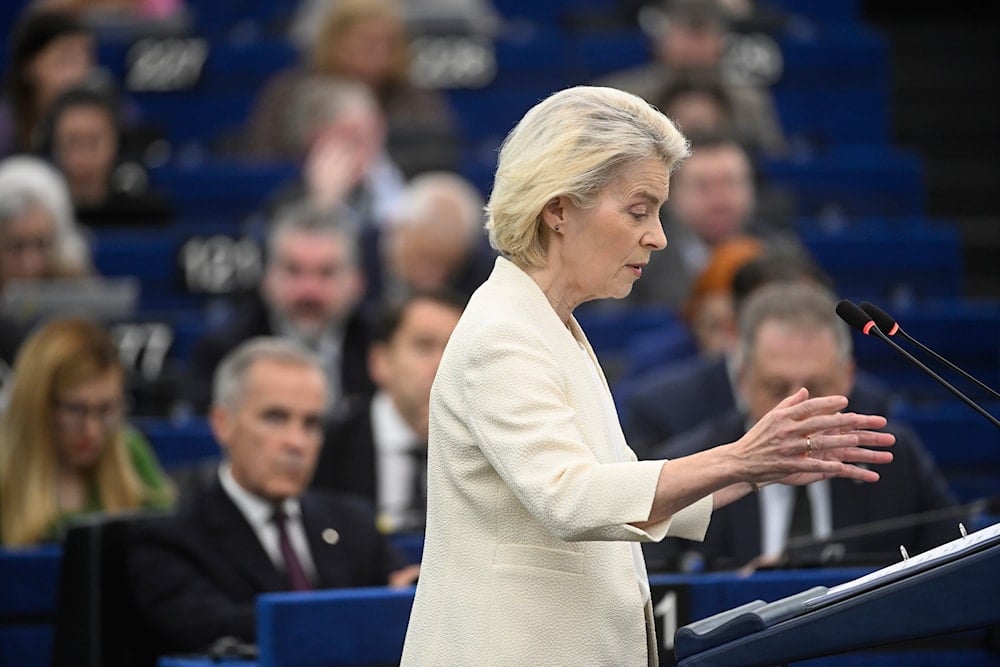
Canada's Prime Minister Mark Carney, left, listens to European Commission President Ursula von der Leyen during the annual State of the European Union at the European Parliament in Strasbourg, eastern France, Wednesday, Sept. 16, 2026 (AP)
European Commission President Ursula von der Leyen has called for a new European security framework that would allow EU members to coordinate responses to emerging threats, arguing that the bloc’s current institutions were designed for a different geopolitical environment, The Washington Post reported.
Speaking during her State of the European Union address, von der Leyen proposed creating a mechanism modeled on NATO’s Article 4, which allows alliance members to hold consultations when one member considers its security, independence, or territorial integrity to be under threat.
“We need a mechanism analogous to Article 4 of the NATO Treaty,” von der Leyen said, arguing that EU countries should be able to come together when one member faces a serious security challenge.
Under the proposal, an EU state could request consultations, with member countries working jointly on measures aimed at preventing escalation and addressing the consequences of security incidents.
EU seeks faster response to hybrid threats
Von der Leyen said Europe must adapt its security structures to address threats that fall below the level of a conventional armed attack but still pose risks to national security.
“Our systems were designed for a different world. They were shaped by well-intentioned attempts at consensus and compromise,” she said, calling for changes to improve the bloc’s ability to respond to new challenges.
She pointed to incidents involving cyberattacks, sabotage, arson, and drone activity as examples of threats facing European countries.
Referring to the discovery of an explosive-laden drone near Leipzig/Halle Airport, von der Leyen said, “We must be clear about what happened there. An attack using military equipment, carried out by Russian agents on European soil.”
“Cyberattacks, sabotage, arson, drone attacks: these things happen every day now. So as the threat situation becomes more serious, Europe’s defense readiness must also increase,” she added.
Proposal comes amid energy concerns linked to war on Iran
Von der Leyen also highlighted the economic consequences of rising geopolitical tensions, saying the war on Iran has contributed to an additional €90 billion in fossil fuel import costs for the European Union.
The increase comes as European energy markets have faced renewed pressure, with concerns over supply disruptions and instability in major energy-producing regions.
The European Commission previously estimated that the EU’s fossil fuel import bill reached €340 billion in 2025, with fossil fuels still accounting for more than half of the bloc’s energy consumption.
Rising oil and gas prices linked to geopolitical uncertainty have intensified discussions in Europe over energy security and dependence on external suppliers.
Calls for European Security Council
Alongside the proposed consultation mechanism, von der Leyen announced plans to advance the creation of a European Security Council, a concept previously discussed by European leaders, including former German Chancellor Angela Merkel.
The proposed body would bring together European and partner countries to address security challenges more rapidly, with von der Leyen saying discussions had already taken place with countries including Canada, Norway, Ukraine, and the United Kingdom.
The idea has gained renewed attention amid the war in Ukraine, uncertainty over Washington’s future role in European security, and growing interest in smaller decision-making formats.
Von der Leyen also outlined plans for greater joint development of strategic military capabilities, including air defense, strategic airlift, aerial refueling, and capabilities in space and cyberspace.
She stressed that any new European defense initiatives would remain aligned with NATO structures.
Read more: Germany's secret Ukraine unit fast-tracked arms worth billions


