
Five cities to rally against US-Israeli aggression Wednesday
 3 Min Read
Simultaneous rallies are set for Gaza, Beirut, Baghdad, Sanaa, and Tehran on Wednesday evening under the slogan "One Front, One Enemy."
-
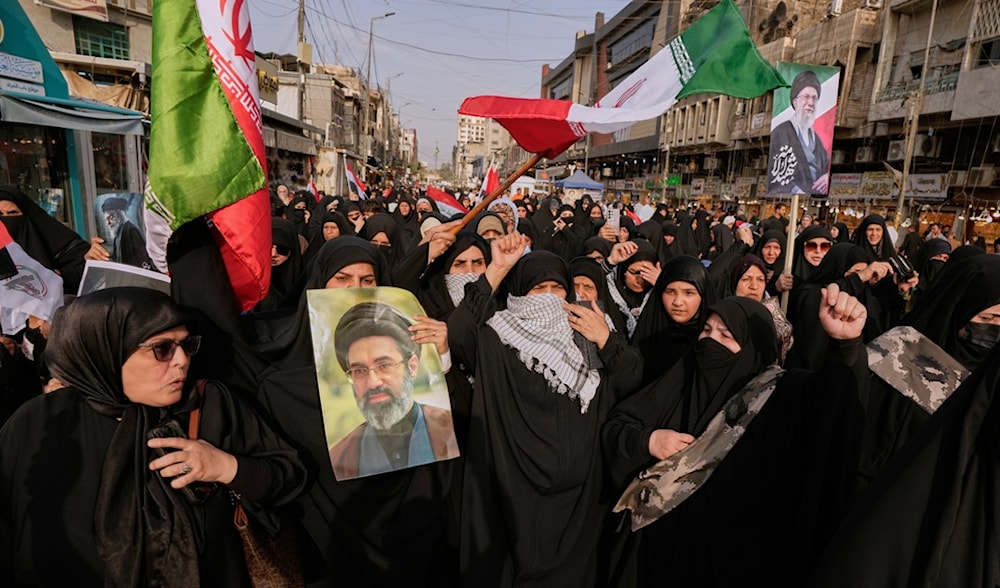
Iraqi women hold portraits of Iran's Martyred Leader Sayyed Ali Khamenei and his son Sayyed Mojtaba Khamenei, during a protest against the US-Israeli aggression on Iran, in Baghdad, Iraq, Saturday, April 25, 2026. (AP Photo/Hadi Mizban)
The International Popular Committees Against Aggression have called for simultaneous public rallies across five cities on Wednesday under the slogan "One Front, One Enemy," in a show of unified popular opposition to US-Israeli aggression across the region.
The rallies will take place at 9:00 pm simultaneously in Gaza, Beirut, Baghdad, Sanaa, and Tehran, broadcast live from Martyrs' Square in Beirut's southern suburbs, outside the International Committee of the Red Cross headquarters in Gaza, Tahrir Square in Baghdad, al-Sabeen Square in Sanaa, and Enghelab Square in Tehran.
In a statement, the committees said the initiative honors the martyrs, affirms the choice of steadfastness and resilience, and expresses rejection of domination and occupation, calling on the public to gather in the designated squares in affirmation of a unified popular stance against ongoing US-Israeli aggression.
The call comes as Israeli aggression continues against Lebanon and Gaza, and as the US carries out intermittent attacks on Iran and its territorial waters.
A unified front
The rallies reflect a broader convergence of political and military messaging from the Resistance front.
Iran has repeatedly affirmed that any ceasefire deal with the US must encompass all fronts across the region, a position confirmed by Hamas on Monday, which revealed that Tehran had directly communicated its intent to bring the war to an end in Gaza as well.
Lebanon remains central to this calculus, with a halt to hostilities there considered integral to any comprehensive regional settlement. Iranian government spokesperson Fatemeh Mohajerani reinforced this framing on Tuesday, pushing back against characterisations of Iran-Lebanon ties as a proxy relationship and arguing that both countries face a common enemy pursuing the simultaneous destruction of Lebanon and fragmentation of Iran.
IRGC Quds Force Commander Esmail Qaani went further, declaring on Tuesday the formation of a unified Resistance security belt stretching from the Strait of Hormuz to the Bab al-Mandab, and warning that continued aggression would draw a coordinated response across the front.
Meanwhile, Khatam al-Anbiya Central Headquarters Commander Major General Ali Abdollahi on Wednesday framed mass public participation itself as a strategic asset, arguing that popular mobilisation has become a component of Iran's deterrence posture, one that signals to adversaries that the country's security rests on more than military force alone.


