
Gaza agreement phase 2 expected to begin early 2026: Turkish FM
 3 Min Read
Turkish FM Hakan Fidan says the second phase of the Gaza agreement will begin in early 2026, focusing on a Palestinian-led administration in Gaza.
-
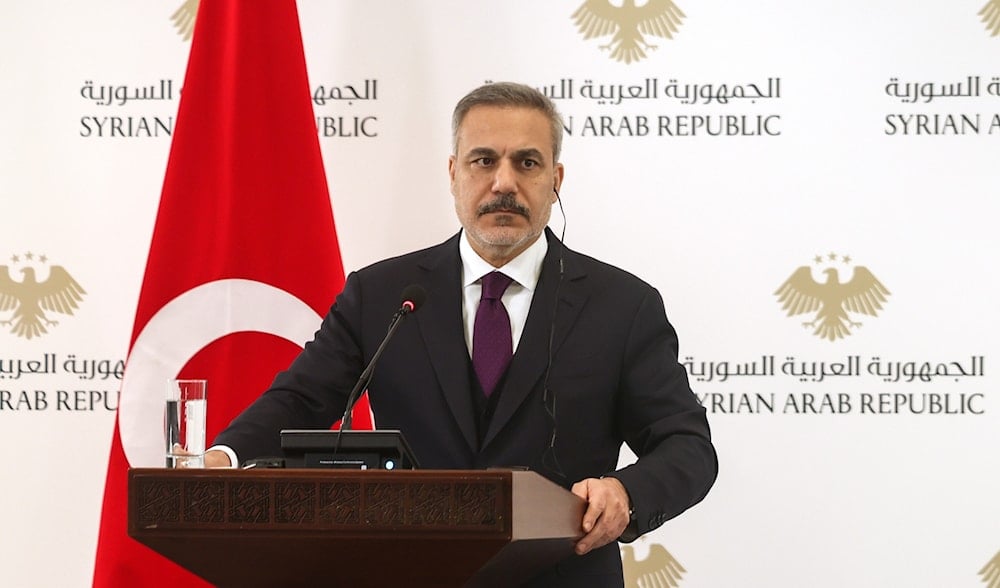
Turkish Foreign Minister Hakan Fidan, during a joint press conference with his Syrian counterpart Asaad al-Shibani after their meeting in Damascus, Syria, Monday, Dec. 22, 2025 (AP)
Turkish Foreign Minister Hakan Fidan has anticipated that the second phase of the Gaza agreement will commence in the first weeks of the new year, 2026, emphasizing that the upcoming stage will prioritize transferring Gaza’s administration to a Palestinian-led mechanism.
Speaking on Monday, Fidan said that the developments and progress of the Gaza agreement since its signing were discussed during a meeting in Miami with officials from the United States, Egypt, and Qatar.
In a joint press conference with his Syrian counterpart, Asaad al-Shibani, in Damascus, Fidan noted that the Miami meeting also addressed the obstacles the Gaza agreement has faced and whether solutions had been reached to resolve these challenges.
Fidan added that the US side had presented preliminary studies regarding Gaza’s reconstruction, and participants exchanged their opinions and feedback on these proposals. He further stated that discussions included how to implement the bodies stipulated in the “Peace Plan” for Gaza on the ground.
Egypt, US, Qatar, Turkey hold closed-door meeting on Gaza ceasefire
The closed-door meeting in Miami, Florida, on December 19, brought together officials from the US, Egypt, Qatar, and Turkey to discuss preparations for the second phase of the Gaza agreement.
Participants assessed achievements of the first phase, such as expanded humanitarian aid deliveries, return of captive bodies, and partial force withdrawals, while identifying challenges that have slowed the shift to the next stage. They emphasized the need to enable interim civic bodies and strengthen coordination with local actors as part of the transition process.
The gathering also produced a joint call for restraint, urging all parties to uphold their obligations under the ceasefire and maintain momentum toward implementing the 20‑point peace plan framework. Officials indicated that further consultations would continue in the coming weeks to tackle outstanding issues and support movement into the second phase in early 2026.
The first phase of the ceasefire agreement in Gaza took effect on October 11, 2025, amid ongoing Israeli violations.
'Israel' dodges second phase of ceasefire in Gaza
"Israel" has delayed moving to the second phase, citing the presence of an Israeli captive's body in the Gaza Strip, even though Palestinian Resistance factions continue searching, clearing rubble, and delivering bodies as soon as they are recovered. Additionally, the occupation failed to meet many of its obligations under the ceasefire agreement.
During the first phase of the Gaza ceasefire that began in October 2025, "Israel" was obligated to permit a significant increase in humanitarian aid into the Gaza Strip, including allowing up to 600 aid trucks per day and reopening key border crossings such as Rafah to facilitate the flow of essential supplies.
However, these commitments were not fully realized, with actual aid deliveries falling well below agreed levels and crossings remaining largely restricted, contributing to continued shortages of food, medical supplies, and basic services for civilians.
In addition, while the ceasefire terms called for Israeli troop withdrawals to agreed lines and a substantial reduction in military operations, reports documented ongoing strikes and movements that violated these conditions, slowing the shift toward broader stability and reconstruction.
These unmet obligations have compounded humanitarian hardships in Gaza and frustrated efforts to advance to the second phase of the peace plan, which hinges on sustained compliance with the initial ceasefire terms.


