
Germany, UK push defense cooperation with $72mn RCH 155 artillery deal
 3 Min Read
Germany and the United Kingdom's deal enhances their mobile strike capabilities and deep precision strike programs.
-
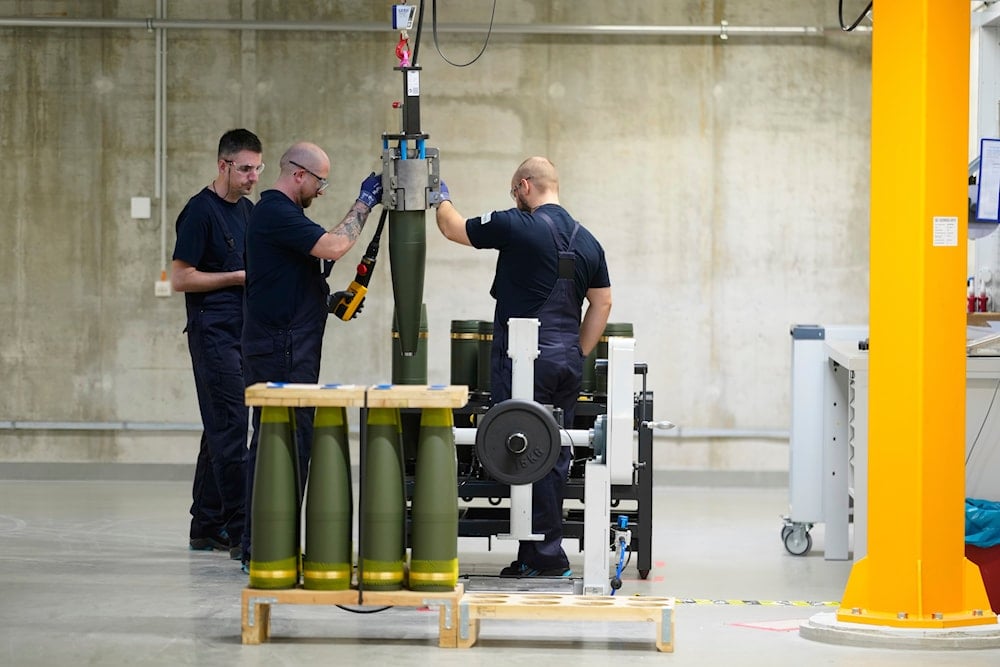
Employees work during a test production run at a newly built artillery ammunition plant by German arms manufacturer Rheinmetall in Unterluess, Germany, Wednesday, Aug. 27, 2025 (AP)
Germany and the United Kingdom have agreed to a joint procurement deal worth $72 million (approximately 61 million euros) to acquire modern, mobile artillery systems capable of firing while on the move and striking targets over 70 kilometres away, media reports confirmed on Sunday.
The British Ministry of Defense stated that the contract will initially provide the British Army with a demonstrator of the RCH 155 artillery system. Germany is set to receive two units for testing purposes. Manufactured by the Franco-German defense company KNDS in collaboration with Rheinmetall, the RCH 155:
- can fire up to eight rounds per minute,
- is operated by a crew of two,
- can travel up to 700 kilometres without refuelling.
This agreement builds on a previous joint armaments project announced in May, when Berlin and London committed to developing a long-range precision weapon. The initiative is aimed at enhancing capabilities for deep precision strikes, allowing the two countries to reach targets far behind enemy lines.
Beyond artillery cooperation, Germany and the UK have agreed to intensify collaboration in submarine hunting under the so-called Trinity House Agreement, a framework for bilateral military cooperation.
At a meeting in Berlin, German Defense Minister Boris Pistorius described the project as a strategic response to evolving security challenges. His British counterpart, John Healey, highlighted that the partnership not only strengthens defence capabilities but also boosts economic activity, investment, and job creation in both countries.
Europe bolsters its defenses
Across Europe in 2025, governments and institutions intensified defense cooperation and joint procurement as part of a broader effort to strengthen military readiness amid evolving security challenges. These initiatives reflect a growing emphasis on collective capability development, industrial coordination, and long-term strategic deterrence across the continent.
On May 12, EU and Ukrainian defense officials met in Brussels for the EU-Ukraine Defense Industry Forum, where they agreed to expand industrial cooperation, advance joint production initiatives, and integrate Ukraine more closely into Europe’s defense supply chains.
On May 27, the EU Council formally adopted the Security Action for Europe (SAFE) instrument, a €150 billion framework designed to facilitate joint procurement of key defense systems such as artillery, missiles, and mobility platforms among member states.
On June 25, NATO leaders concluded their summit in The Hague with commitments to increased defense spending and deeper multinational cooperation, including coordinated procurement and stockpiling of critical military capabilities across Europe.


