
Germany will not join military action against Iran, FM says
 3 Min Read
Germany has ruled out joining military operations against Iran, but says its troops stationed in Iraq and Jordan will defend themselves if attacked.
-
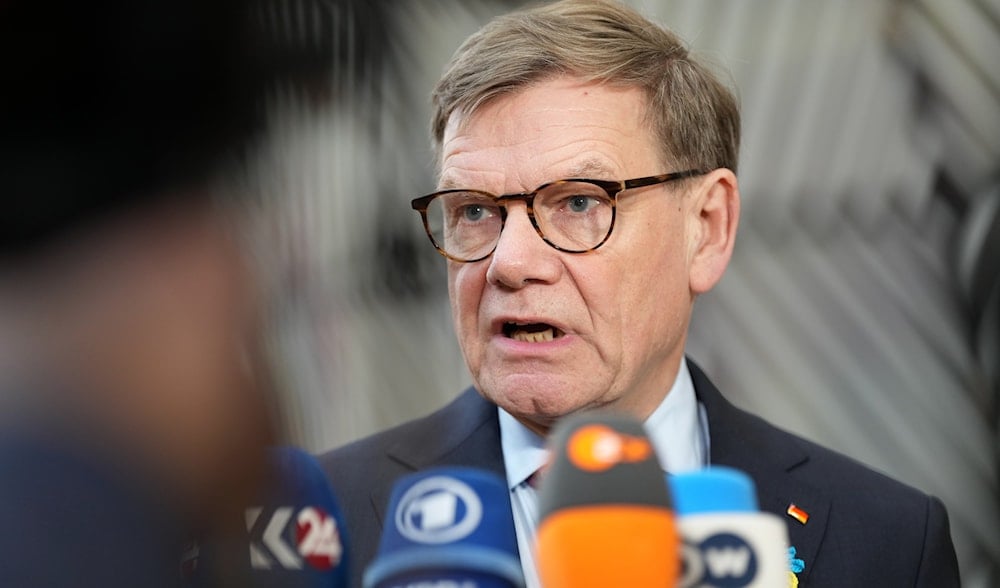
Germany's Foreign Minister Johann Wadephul speaks with the media as he arrives for a meeting of EU foreign ministers at the European Council building in Brussels on February 23, 2026. (AP Photo/Virginia Mayo)
Germany has made clear that it will not take part in military operations against Iran, even as some Western governments edge closer to supporting US and Israeli actions targeting the Islamic Republic.
German Foreign Minister Johann Wadephul told Deutschlandfunk on Monday that "The federal government has no intention of participating," noting that "we also do not have the necessary military resources" to engage in offensive action. At the same time, he stressed that German forces abroad would not be left without protection, adding that “our Bundeswehr soldiers would defend themselves if they were attacked.”
Berlin’s position comes amid rising tensions following a US-Israeli military campaign against Iran, which has drawn international criticism for destabilizing the region and causing civilian harm inside the country. Iran’s Foreign Ministry has defended its response as lawful resistance to unlawful aggression, insisting it “will respond firmly to the aggressors,” while asserting it had done “everything necessary to avoid war.”
Tehran has also maintained that its missile and drone strikes in the Gulf were directed at US military assets and installations, not at the host countries themselves. Iranian officials have argued that bases used to launch or facilitate attacks on Iran become legitimate targets under the right to self-defense, stressing that neighboring states are not the intended targets.
Allied alignment
Some US allies have taken steps that stop short of formal combat roles but still align with Washington’s military posture. The United Kingdom has agreed to allow US forces to use British bases for strikes on Iranian missile sites, described by London as a "defensive measure", and says it will protect regional allies from further attack, while maintaining it is not directly participating in offensive operations.
France has also indicated it is "ready… to take part in [the] defense" of Gulf states and Jordan against Iranian actions, framing this as collective "self-defense" under international law. French officials, however, have voiced regret that the US-Israeli assault was not debated through multilateral institutions such as the United Nations.
Meanwhile, the European Union’s 27 member states have issued a joint appeal for "maximum restraint" and full respect for international law, avoiding endorsement of any offensive mission and underscoring the risks of further escalation.
Global calls mount
Several global actors have condemned the US-Israeli strikes outright. Russia and China have condemned the campaign, calling it a dangerous breach of international norms and urging an immediate halt to hostilities.
Across the Gulf, governments with historically complicated ties to Iran have stopped short of joining any military campaign. Saudi Arabia, Qatar, Kuwait, and the United Arab Emirates have condemned strikes carried out on sites within their territory, but none have pledged forces against Iran. Instead, they have focused on defending their sovereignty while calling for restraint and de-escalation.
Rather than forming a broad coalition against Tehran, many countries are emphasizing defensive readiness, diplomacy, and avoidance of a wider regional war; positions that reflect Iran’s insistence on sovereignty and opposition to unilateral military aggression.
Read more: Iranian drone targets UK airbase in Cyprus


