
Global defense spending hits $2.63tn as US slows, Europe surges
 3 Min Read
Global defence spending hit $2.63tn in 2025 as US cuts slowed growth while Europe accelerated rearmament, according to the Military Balance 2026 report.
-
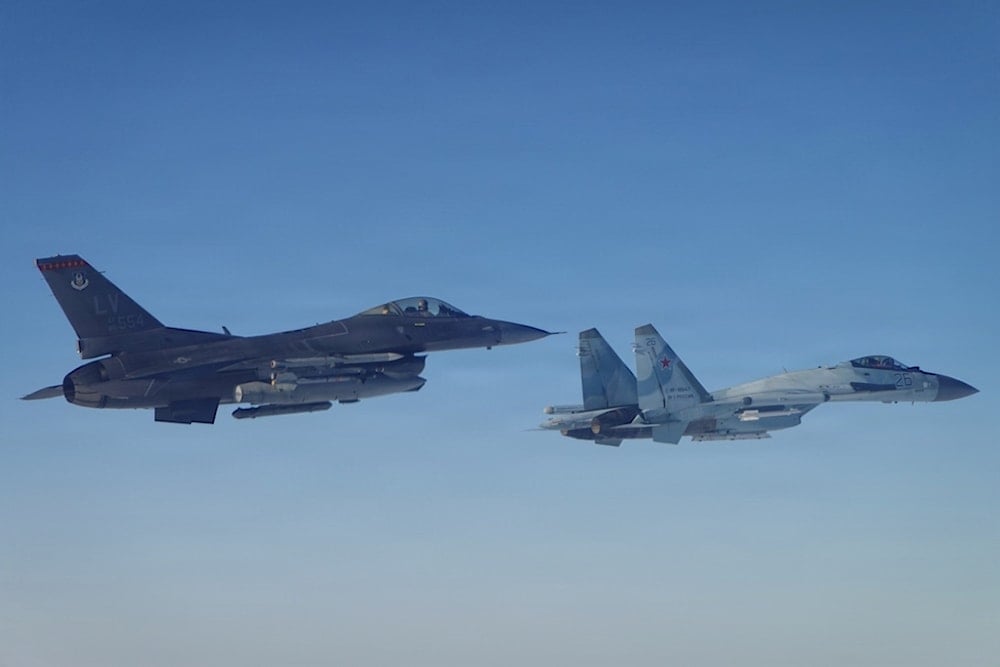
A North American Aerospace Defense Command F-16 fighter aircraft intercepting a Russian Su-35 military aircraft near the Bering Strait, west of Alaska, on Thursday, February 19, 2026 (US Department of Defense)
Global defense spending reached a record $2.63 trillion in 2025, but growth has sharply decelerated as the United States trims military outlays while European states accelerate rearmament, according to the latest Military Balance 2026 report published by the International Institute for Strategic Studies.
Data released Tuesday by the London-based institute shows worldwide defense spending rose just 2.5% in real terms last year, a marked slowdown from the near 10% annual increases recorded following Russia’s full-scale invasion of Ukraine in 2022.
The US remains the world’s largest military spender, accounting for 36% of total global defense outlays in 2025. However, a 7.1% reduction in US spending in real terms significantly dampened overall global growth.
The slowdown reflects a strategic recalibration under President Donald Trump, whose administration has prioritized homeland defense and the western hemisphere while urging allies to shoulder greater responsibility for regional security.
Europe accelerates rearmament
US Defense Secretary Pete Hegseth told allies at a NATO meeting last year that while Washington remains committed to the alliance, Europe must “take ownership of conventional security on the continent.” Since then, Washington has scaled back certain overseas defense commitments and intensified calls for burden-sharing across Europe and the Asia-Pacific.
In contrast, European defense budgets continued to expand, now accounting for more than 21% of global spending, up from 17% in 2022. Germany has driven much of this increase, according to the IISS report.
Under pressure from Trump, most NATO members pledged in June 2025 to raise defense and defense-related spending to 5% of GDP by 2035, including at least 3.5% allocated to core military expenditure, a significant jump from the previous 2% benchmark.
Russia’s surge moderates
The European Union has also adjusted fiscal rules, allowing member states to exceed deficit limits if additional borrowing is directed toward defense investment, further facilitating the continent’s military expansion.
Russia’s wartime spending spike has also cooled. Military expenditure rose 3% in real terms in 2025, following a dramatic 57% surge the previous year. Nonetheless, defense still consumes more than 7.3% of Russia’s GDP, ranking third globally behind Ukraine at 21.2% and Algeria at 8.8%.
The IISS report notes that Washington has “doubled down on the defense of the homeland and placed an emphasis on the western hemisphere,” while gradually rolling back long-standing overseas commitments.


