
Hamas submits response to mediators' roadmap amid Gaza ceasefire talks
 5 Min Read
Hamas has submitted its response to a 15-point roadmap presented by mediators in Cairo, as a new round of ceasefire talks aims to revive the stalled Gaza agreement despite continued Israeli bombardment of the Strip.
-
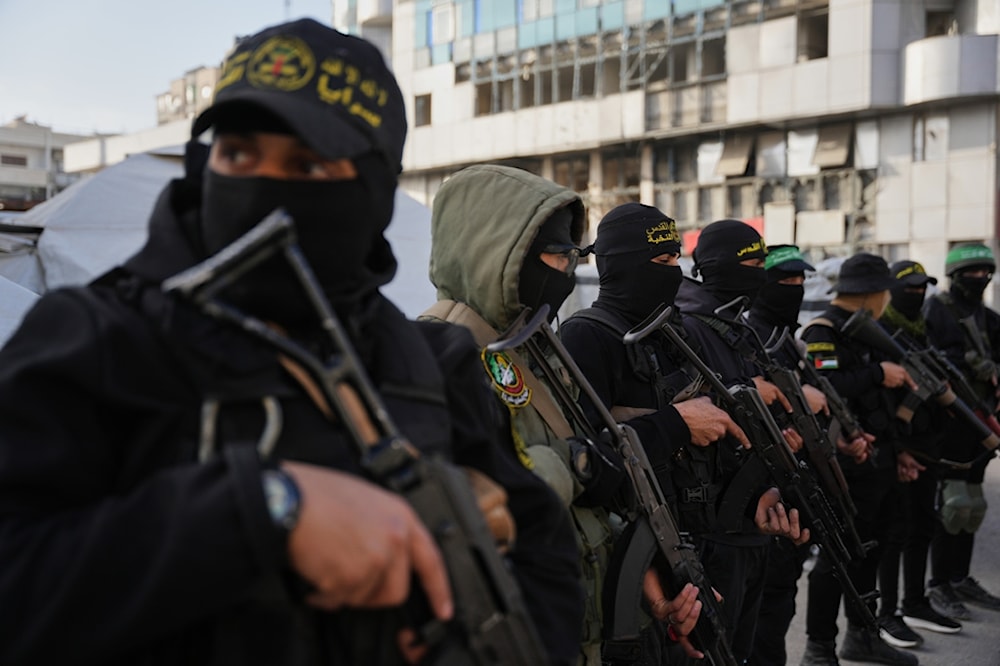
Armed Palestinian resistance fighters from Hamas and Islamic Jihad gather next to Eid al-Fitr prayers in Gaza City, March 20, 2026. (AP)
Senior sources in the Palestinian Resistance have informed Al Mayadeen that Hamas has submitted its formal response to the 15-point roadmap presented by international mediators, as a new round of ceasefire talks kicked off in Cairo aimed at reviving the stalled agreement for the Gaza Strip.
The negotiations began on Sunday, June 7, in the Egyptian capital, with Egyptian, Qatari and Turkish mediators taking part alongside representatives from Hamas and other Palestinian Resistance factions. The talks come as part of broader efforts to move toward the second phase of the US-backed ceasefire agreement that was officially declared on October 10.
Sources detail the Resistance's response
Expert on Palestinian Resistance affairs, Hadi al-Dali, revealed to Al Mayadeen exclusive information detailing that the Palestinian factions and Resistance's response to the mediators’ 15-point roadmap stressed the need to "pressure the Israeli occupation to end its aggression during negotiations and to stop assassinations," alongside verifying "Israel’s compliance with its obligations" before moving to any subsequent phase.
He added that "Hamas agreed to transfer governance in Gaza to a Gaza administration committee, with the committee assuming all legal responsibilities."
Al-Dali highlighted that the response stipulated "no weapons will be handed over to 'Israel'."
"The agreement must lead to a political track guaranteeing the right to establish a Palestinian state," the response emphasized.
The response further linked a phased disarmament of heavy weapons to an Israeli withdrawal and insisted the process must lead to a political track guaranteeing Palestinian statehood, with responsibility now lying in the hands of the mediators and the US.
Resistance demands implementation of existing commitments
The Israeli occupation has repeatedly violated the ceasefire agreement, continuing its airstrikes on residential areas, targeting civilians and infrastructure across the Strip.
Palestinian factions have consistently called for the full implementation of the agreed terms, including the reopening of crossings, the entry of humanitarian aid, and a complete halt to Israeli aggression.
Hamas's submission of its response to the 15-point roadmap signals the movement's continued commitment to diplomatic efforts, while also making clear that any agreement must guarantee an end to Israeli aggression and the lifting of the crippling siege on Gaza.
Ongoing Israeli violations despite ceasefire
Despite the official ceasefire, Israeli forces have continued to carry out bombardment across Gaza. Palestinian factions have warned that continued aggression could derail the negotiations and push the situation toward further escalation.
The Cairo talks are seen as a critical test of whether the international community can pressure the Israeli occupation to abide by its commitments.
Mediators are reportedly working to bridge remaining gaps between the parties, with an emphasis on moving to the second phase of the agreement, which would include further prisoner exchanges and a longer-term truce.
Background: Cairo talks resume as mediators push US-backed plan
The latest round of negotiations follows an earlier meeting on June 8, when international mediators and representatives of Palestinian Resistance factions, including Hamas, launched a new round of talks in Cairo aimed at breathing life into the stalled Gaza ceasefire agreement. Egyptian, Qatari and Turkish mediators took part alongside Hamas and other Palestinian factions, according to an Al Mayadeen report.
At that time, Egypt's Al Qahera News channel reported that discussions focused on a "proposed roadmap to complete implementation of the agreement," describing the atmosphere as "positive" with consensus on the need to continue carrying out the US-backed plan. However, the first phase of the plan -- which included a prisoner exchange, a halt to combat operations, the withdrawal of Israeli forces from residential areas of Gaza, and the large‑scale entry of humanitarian aid -- has not been fully implemented by "Israel," which continues to launch daily attacks on Gaza.
The second phase of the plan, which envisions a Palestinian national committee assuming administration of the Gaza Strip under the oversight of a so‑called "Board of Peace" chaired by Trump, along with the disarmament of Hamas and reconstruction efforts, remains obstructed by numerous hurdles. The talks also come amid continued Israeli aggression, which has killed at least 970 Palestinians since the truce was announced, according to Gaza's Health Ministry.
Senior Palestinian Resistance sources told Al Mayadeen that Hamas has now submitted its formal response to the 15‑point roadmap presented by mediators, marking a critical step in the diplomatic process. However, Palestinian factions have repeatedly stressed that any agreement must guarantee an end to Israeli aggression and the complete lifting of the crippling siege on Gaza.


