
Hamas warns 'Israel' using Gaza 'Orange Line' to entrench control
 5 Min Read
Hamas warns that the expansion of Israeli-controlled buffer zones constitutes a dangerous violation of the ceasefire agreement.
-
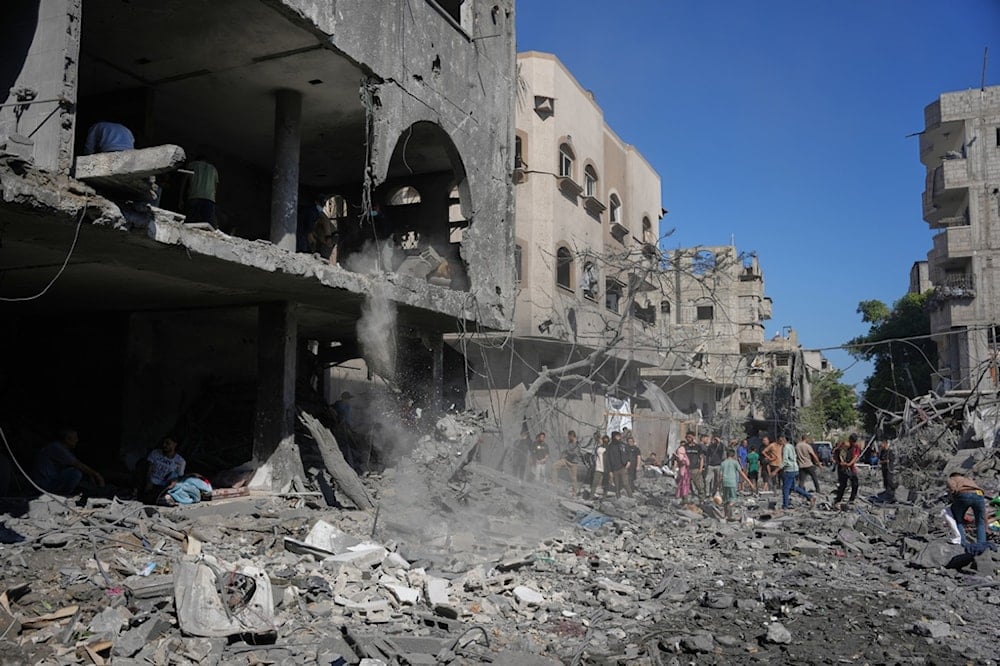
Palestinians inspect the rubble of a building destroyed in an Israeli airstrike in Nuseirat, central Gaza Strip, Tuesday, May 26, 2026 (AP)
The Israeli occupation’s continued enforcement of the so-called "Orange Line" in the Gaza Strip constitutes a serious violation of the ceasefire agreement and an attempt to impose new realities on the ground through military force, Hamas warned on Tuesday.
In a statement, Hamas said the move reflects an ongoing effort to consolidate Israeli military control over Gaza and undermine any genuine opportunity for stability or the success of de-escalation efforts.
Hamas accuses occupation of systematically undermining ceasefire
The movement described the policy as an explicit and continuous breach of the ceasefire terms, accusing the occupation government of deliberately sabotaging mediation efforts while escalating policies of killing, starvation, and siege.
Hamas said Israeli authorities were simultaneously imposing field measures aimed at altering the existing situation in open defiance of understandings and guarantees previously agreed upon under the ceasefire framework.
The group also called on mediators to provide an urgent official clarification regarding the "Orange Line" and publicly condemn the dangerous escalation by the occupation.
The "orange line" marks the new boundary of the area under Israeli occupation control in Gaza.
— Government Communication Center (@pal_gcc_en) May 19, 2026
By shifting the border from the "yellow line" to the "orange line", Israel now controls more than 65% of the Gaza Strip. pic.twitter.com/ZjdcKQkAht
The warning comes amid mounting reports that the ceasefire has been repeatedly violated since it entered into force in October 2025. Palestinian authorities in Gaza have documented hundreds of Israeli violations, including deadly strikes, shootings, restrictions on humanitarian aid, forced displacement measures, and the continued expansion of military control zones across the Strip.
According to Gaza’s Government Media Office, Israeli violations surpassed 1,400 during the first months of the truce, while UN-linked humanitarian reports documented the continued killing of Palestinian civilians despite the ceasefire remaining formally in place.
Read more: Gaza Health Ministry reports 6 martyred, toll exceeds 900 since truce
Hamas argued that the latest expansion of control zones demonstrates that the occupation is using the ceasefire as cover to gradually reshape Gaza’s geography and impose military facts on the ground rather than move toward a genuine end to the war.
The movement warned that the issue extends beyond a temporary security arrangement, arguing that the expanding military lines risk transforming the ceasefire itself into a mechanism for entrenching long-term Israeli control over large parts of Gaza.
The movement also expressed concern that the continued westward expansion of military control zones could confine Palestinians into increasingly crowded enclaves while allowing the occupation to exert greater control over movement, aid access, reconstruction efforts, and civilian life across Gaza.
Calls for pressure on 'Israel'
Hamas urged mediators to reject the measure publicly and compel the occupation to reverse it immediately, warning that unilateral actions threaten the de-escalation process and deepen Palestinian suffering in Gaza.
The movement also called on media organizations, writers, political figures, and supporters of the Palestinian cause worldwide to intensify political and media efforts aimed at exposing Israeli attempts to tighten military control over the Strip and impose new equations by force.
Hamas further warned against continued international silence regarding Israeli policies in Gaza, saying the absence of serious pressure on the occupation encourages further escalation and weakens the credibility of the ceasefire framework itself.
The movement suggested that continued expansion of restricted military zones risks transforming a temporary truce arrangement into a process of long-term territorial fragmentation and indirect reoccupation rather than a pathway toward withdrawal and reconstruction.
Expansion of 'Yellow Line', emergence of 'Orange Line'
The statement comes amid growing reports regarding the expansion of what is known as the "Yellow Line", a temporary separation arrangement included in the ceasefire agreement that entered into force on October 11, 2025.
The line separates areas under Israeli military control in eastern Gaza from western areas where Palestinians are permitted to remain, initially covering around 53% of the territory.
According to the Israeli public broadcaster Kan, Israeli forces have gradually pushed the line further west over recent months, increasing the area under Israeli control from 53% at the beginning of the ceasefire to nearly 59% currently.
International reports and UN-linked organizations have also revealed that "Israel" established an additional zone known as the "Orange Line", expanding a broader military control system that now surrounds approximately 64% of the Gaza Strip.
Reports indicate the "Orange Line" exists primarily as a shifting military coordination and restricted-access zone extending beyond the original "Yellow Line". Humanitarian organizations and Palestinian residents have warned that the boundaries frequently change without clear notification, creating dangerous uncertainty for civilians and aid operations.
Read more: Israeli officials decry Ben-Gvir, invoke 'values' amid daily massacres


