
Hezbollah: US sanctions to protect occupation, resistance unwavering
 4 Min Read
Hezbollah rejects the US claim that it is acting on behalf of Iran's Quds Force, denouncing renewed sanctions and defending its ties with Tehran.
-
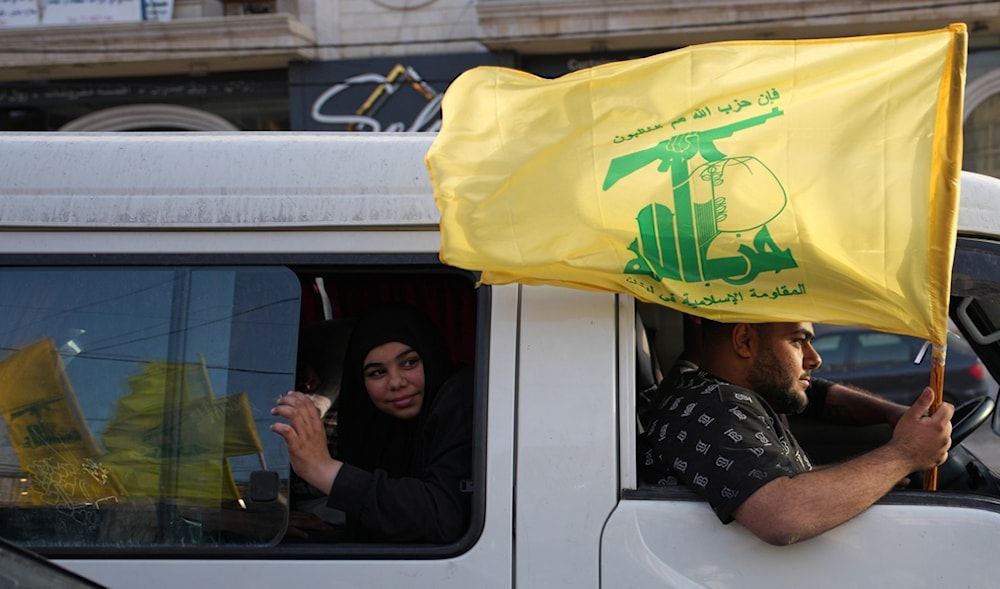
Displaced residents hold a Hezbollah flag as they celebrate while returning to their villages in Zefta, southern Lebanon, Friday, April 17, 2026. (AP)
The Islamic Resistance in Lebanon - Hezbollah has rejected the US designation that it is under the control of Iran’s Islamic Revolution Guard Corps (IRGC) Quds Force, denouncing Washington’s decision to reimpose sanctions on the group as part of a broader policy targeting the Resistance and its popular support base.
In a statement responding to the US Treasury and State Department, Hezbollah said the decision was being used to justify renewed sanctions, blasting it as part of successive US efforts to exert political, financial, and security pressure on the resistance, its social base, and its supporters.
The measure, according to the statement, seeks to protect the security of the Israeli occupation, entrench its occupation of southern Lebanon, and facilitate its expansionist projects and ambitions across the region. Washington’s approach toward Lebanon was also slammed as one of political tutelage rather than an effort to compel the Israeli occupation to withdraw from southern Lebanon and halt its attacks.
“Instead of compelling the Israeli enemy to withdraw from southern Lebanon, halt its attacks, stop blowing up homes, bulldozing fields, and killing Lebanese people, it chooses to besiege the Lebanese and works to strip Lebanon of all its sources of strength,” the statement said.
The Resistance group warned that the renewed sanctions could contribute to internal instability by diverting the course of confrontation with the Israeli occupation toward another arena inside Lebanon. At the same time, Hezbollah maintained that Washington was seeking to weaken Lebanon’s sources of strength.
Hezbollah defends ties with Iran
Hezbollah also rejected any suggestion that its relationship with Tehran undermines its Lebanese identity, pointing instead to Iran’s support for Lebanon during aggressions and crises and its contribution to reconstruction following the July 2006 war.
“Our close and fraternal relationship with the Islamic Republic of Iran is one of which we are proud,” the statement said, stressing that Tehran had supported Lebanon to liberate its territory, restore its sovereignty and rights, and confront the consequences of Israeli aggression.
The group further argued that its Lebanese identity was established by its history of resistance, its confrontation with occupation, and the sacrifices of those who were killed while defending Lebanon and its people.
Challenge to Washington’s authority
The statement also rejected Washington’s authority to assess the group’s patriotism or legitimacy, citing US military interventions and foreign policy across several decades, as well as its support for the Israeli occupation amid the war on Gaza.
“The US administration has neither the moral nor legal standing to classify others or distribute certificates of patriotism,” the statement said, accusing Washington of violating international law and disregarding humanitarian and moral principles.
Hezbollah cited the US record in Vietnam, Afghanistan, and Iraq, alongside Washington’s support for the Israeli occupation and its actions against Lebanon, Yemen, Syria, and the Islamic Republic of Iran.
Sanctions will not alter resistance policy
Despite the renewed sanctions, Hezbollah maintained that Washington’s measures would not alter its position on resistance or what it considers Lebanon’s right to defend its territory, sovereignty, and resources.
“All these unjust sanctions and designations will not deter us from adhering to the choice of resistance and to Lebanon and the Lebanese people’s right to defend their land, sovereignty, and resources,” the statement concluded, reaffirming that resistance remains, in Hezbollah’s view, an integral part of Lebanon’s history, present, and future.
Read more: 'We will not withdraw': Katz on Israeli forces in Lebanon, Syria, Gaza


