
Hormuz disruption exposes hidden strain on US military supply chains
 4 Min Read
Disruptions in the Strait of Hormuz are constraining sulphur supplies, triggering a chain reaction that threatens access to critical minerals and could slow US military production and repair capacity.
-
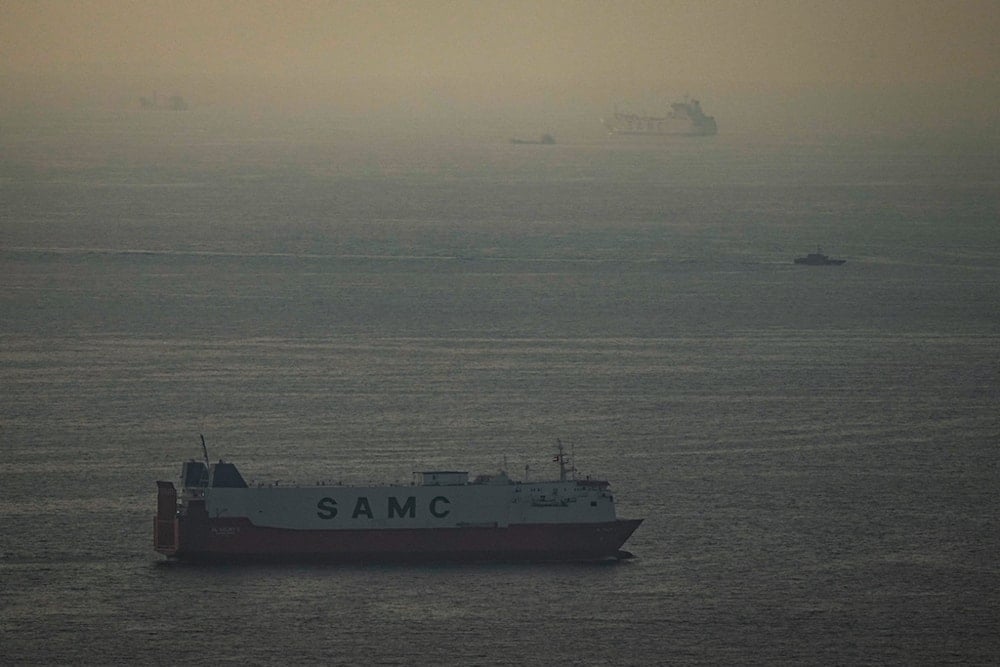
Cargo ships sail in the Gulf toward the Strait of Hormuz, Thursday, March 19, 2026 (AP)
The disruption of maritime traffic through the Strait of Hormuz is beginning to reverberate far beyond energy markets, with new analysis warning that the effects could directly constrain the United States’ ability to sustain and replenish its military operations.
A report by the Modern War Institute, cited by The Guardian, describes the situation as a “paralyzing, real-time problem” for any attempt to expand US defense manufacturing, as well as for repairing equipment damaged in recent Iranian retaliations.
At the center of the concern is sulphur, a largely overlooked commodity that plays a foundational role in industrial production. According to the analysis, seaborne trade in sulphur passing through Hormuz, which accounts for roughly half of global shipments, has been nearly halted. Prices have already surged by around 25 percent since the start of the war, with year-on-year increases reaching 165 percent.
Sulphur’s hidden war role
While sulphur is widely associated with fertilizer production, its strategic importance lies deeper in the industrial chain. It is used to produce sulphuric acid, a critical component in extracting key minerals such as copper and cobalt from lower-grade ores.
These materials are indispensable to modern military systems. From microprocessors and communications hardware to jet engines and drone batteries, copper and cobalt underpin the infrastructure that enables both weapons production and operational capability.
The report argues that these inputs “dictate how fast things can be built and scaled under the pressure of an ongoing war,” warning that the consequences of a sudden disruption in supply have not previously been factored into military planning.
Jahara “Franky” Matisek, a US Air Force lieutenant colonel and nonresident fellow at the US Naval War College, described the situation as a compounding crisis. “It’s a cascading issue,” he told The Guardian, noting that replacement costs for damaged systems could rise sharply. “A knock-on effect of this war is that it may cost double or more than double to replace all these weapons because all the mineral demand is going to go way up.”
He added that supply constraints may go beyond pricing pressures. “Markets are not going to be able to provide the amount of minerals that are needed to replace all these radars that have been destroyed and all these munitions that have to be replaced. It’s a really precarious spot to be in right now.”
The Middle East accounts for roughly a quarter of global sulphur production, much of it generated as a byproduct of oil refining. With shipping routes now disrupted, the supply shock is already feeding into downstream sectors.
Sulphur shock, war strain
Beyond defense, the report notes that reduced sulphur availability could also affect agriculture, as farmers worldwide compete for fertilizer inputs. This raises the possibility of broader food supply pressures, particularly in lower-income countries.
However, the military implications remain the primary concern. The authors estimate that replacing just two major US radar systems destroyed in the early phase of the war would require more than 30,000 kilograms of copper, with additional thousands needed to restore other damaged communications and sensor systems across multiple regional bases.
“The current sulfur shock is becoming a copper problem, and that copper problem risks quickly becoming a readiness and resilience problem,” the report states.
The analysis frames the situation as a “prelogistical crisis", arguing that conventional planning has largely ignored vulnerabilities in the upstream supply of raw materials. Rather than transportation or distribution bottlenecks, the issue lies in the availability of the inputs required to manufacture critical systems in the first place.
A separate study published in February, also co-authored by Matisek, found that only 6 percent of US defense contractors maintain fully transparent supply chains. The latest report suggests that this lack of visibility is now constraining operational capacity.
Industrial dependence
According to the authors, the US military is increasingly dependent on industrial systems it does not fully control, leaving it exposed to disruptions originating far beyond the battlefield.
What is emerging, they argue, is a structural limitation on combat endurance, where the pace of war is determined not only by strategy or firepower, but by access to the underlying materials needed to sustain it.
Read more: US loses over dozen US Reapers valued at $330mln in war on Iran


