
How big tech became embedded in 'Israel’s' war, surveillance machine
 7 Min Read
Investigations reveal how cloud computing, AI, and mass surveillance tools supplied by major tech firms have become deeply embedded in Israeli assaults against Palestinians.
-
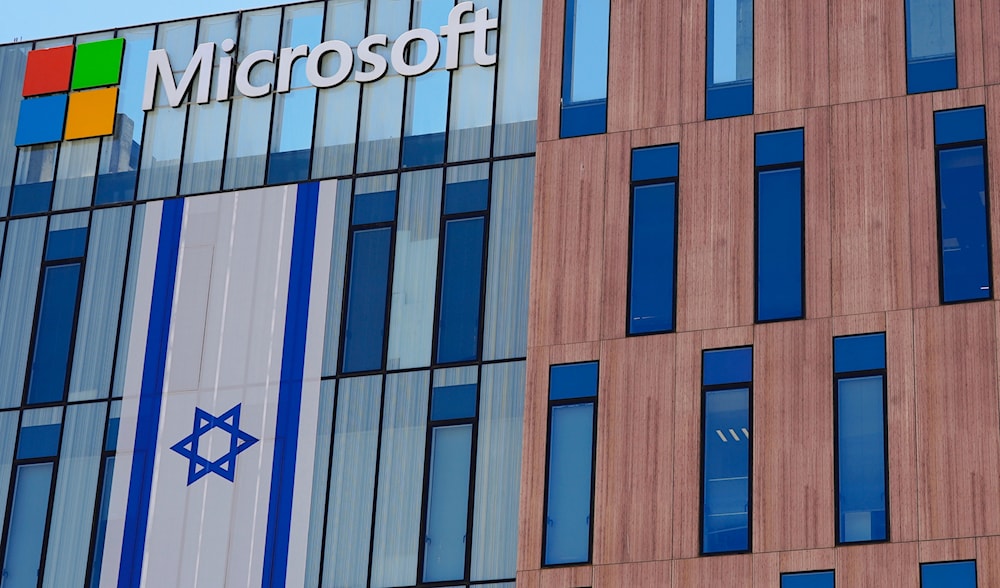
An Israeli flag is draped over the Microsoft offices in a building in occupied Palestine, on Thursday, May 30, 2024. (AP)
An investigations correspondent at The Guardian, Harry Davies, and +972 Magazine journalist, Yuval Abraham, revealed in January that Microsoft had significantly expanded its relationship with "Israel", alongside other major technology firms.
Since then, The Guardian has published a chilling investigative series, produced in collaboration with the Israeli outlet +972 Magazine and the Israeli publication Local Call, detailing what reporters describe as a mutually reinforcing relationship between Silicon Valley and the Israeli occupation forces.
The investigations uncovered how Israeli military operations have increasingly relied on commercial technologies developed by some of the world’s largest tech companies.
One investigation showed that an Israeli mass surveillance system collected nearly all Palestinian phone calls and stored them on Microsoft’s cloud infrastructure. The reporting triggered an internal inquiry that ultimately led Microsoft to cut "Israel" off from certain technologies.
Another report revealed that the Israeli occupation forces had developed a ChatGPT-like system to analyze data obtained through surveillance of Palestinians. A separate investigation found that Google and Amazon had accepted unusually expansive terms in order to secure a major cloud-computing contract with "Israel".
Questions about genocide, technology, and the future
Davies and Abraham were asked to reflect on what they learned over the past year, including how these technologies have been used in "Israel’s" war on Gaza, whether such corporate-military partnerships are sustainable, and what the findings suggest about the future of warfare.
Yuval Abraham told The Guardian that "Israel’s" military had long emphasized artificial intelligence and big data, a trend closely linked to the occupation of Palestinian territories, which generates vast amounts of information. What changed after October 7, he said, was the scale.
The military sought to strike hundreds of it claimed were "targets" per day in Gaza while mobilizing tens of thousands of reservists. This surge dramatically increased demand for technological systems, creating an opening for major tech companies to play a larger role.
Harry Davies added that demand rose not only for data storage, but also for analytical tools used to process intelligence in wartime. He highlighted the importance of “blob storage”, which allows for the storage and processing of enormous volumes of raw intelligence data.
Why 'Israel' became key market for cloud providers
Abraham explained that "Israel’s" long-running collection of Palestinian phone calls required vast storage and processing capacity, particularly when retaining audio, images, and video over extended periods.
Unlike metadata exposed in the Edward Snowden disclosures, these files were data-heavy and required external infrastructure. In the West Bank, sources told reporters the information was sometimes used to coerce Palestinians. In Gaza, intercepted communications were also used in airstrikes that killed civilians.
“So data is power and data is control,” Abraham said, explaining that US cloud providers enable the Israeli military to store and analyze massive datasets, with direct consequences for Palestinians on the ground.
Military thinking nurtured by Silicon Valley
Davies pointed to Yossi Sariel, the former head of "Israel’s" elite Unit 8200, who published a book under a pseudonym later linked to him. In it, Sariel argued that militaries should cultivate relationships with tech companies similar to those they maintain with traditional defense contractors such as Boeing or Lockheed Martin.
Sariel envisioned Google, Amazon, and Microsoft as essential to warfare and surveillance in much the same way as firms that manufacture jets, bombs, or missiles. Davies said subsequent reporting showed how elements of this vision were implemented both before and after October 7, in Gaza and the West Bank.
AI as a tool of war
Abraham said artificial intelligence allowed "Israel" to replicate the effects of carpet bombing while maintaining the appearance of a data-driven campaign with defined targets.
In Gaza, AI systems assigned scores to nearly every individual with a phone number, estimating the likelihood that they were members of Hamas or Islamic Jihad without evidence. One such system, Lavender, was trained on alleged Hamas members and enabled the military to generate tens of thousands of targets at a scale that would otherwise have been impossible.
According to sources, many of those targeted were not Hamas members and were struck inside family homes rather than during combat. Abraham emphasized that while the military was aware of the system’s error rate, the central issue was not mistakes but scale.
“It’s the scale of destruction that it allows militaries to unleash, and it’s a discourse of legitimacy that it enables – a discourse of targets and collateral damage,” he stressed.
AI and the expansion of mass surveillance
Abraham argued that AI incentivizes mass surveillance by making it possible to analyze ever-larger datasets.
Davies noted that intelligence agencies have long collected more information than humans could process, which once acted as a limiting factor. AI, he said, is now removing that constraint, allowing agencies like Unit 8200 to extract meaning from previously unmanageable volumes of data.
Davies said Microsoft explicitly credited the reporting with influencing changes to its policies. He also pointed to growing discomfort within the tech industry, including protests by employees who objected to how their work was being used.
This internal pressure, he suggested, played a role in Microsoft’s decision to restrict certain services to "Israel".
Legal and political risks ahead
Abraham said companies are also weighing potential legal consequences. If the International Court of Justice ultimately rules that "Israel" committed genocide, he said, questions may follow about corporate responsibility.
Microsoft’s move was limited, he noted, but significant. It marked the first known instance of a major tech company withdrawing services from the Israeli military, prompting concern within Israeli institutions about dependence on foreign providers.
"Israel’s" reliance on companies involved in the Nimbus project, a major cloud contract with Google and Amazon signed in 2021, has shifted large volumes of government and defense data onto US-based servers.
“These are US companies,” Abraham said, adding that they are effectively betting that Washington will continue backing "Israel" and will not impose restrictions or sanctions.
He said Microsoft’s decision raised broader concerns about how much leverage foreign corporations might hold, especially amid uncertainty about future US administrations and shifting public opinion.
Looking beyond 2025
Abraham said the reporting had only uncovered “the tip of the iceberg."
Davies added that their investigations revealed only partial insights into a much larger system and that work would continue to examine how these technologies have been and are still being used in Gaza and the West Bank.
He stressed that other militaries are closely watching "Israel’s experience", particularly how it integrated commercial technologies into warfare.
Referring to the US military, Davies said large cloud contracts with Silicon Valley firms raise urgent questions.
“Post-Gaza, we have to look at these relationships and ask: what is the involvement of these companies and their technology in military decisions, in military operations, and in warfare more broadly?”
Read more: Gaza and the logic of necropolitics: Sovereignty measured by killing


