
Illegal US trial of Venezuela’s Maduro: Power trumps law
 11 Min Read
Can Trump’s US strikes on Caracas, the kidnapping of Venezuela’s Maduro, and an illegal trial ever be justified under international law?
-
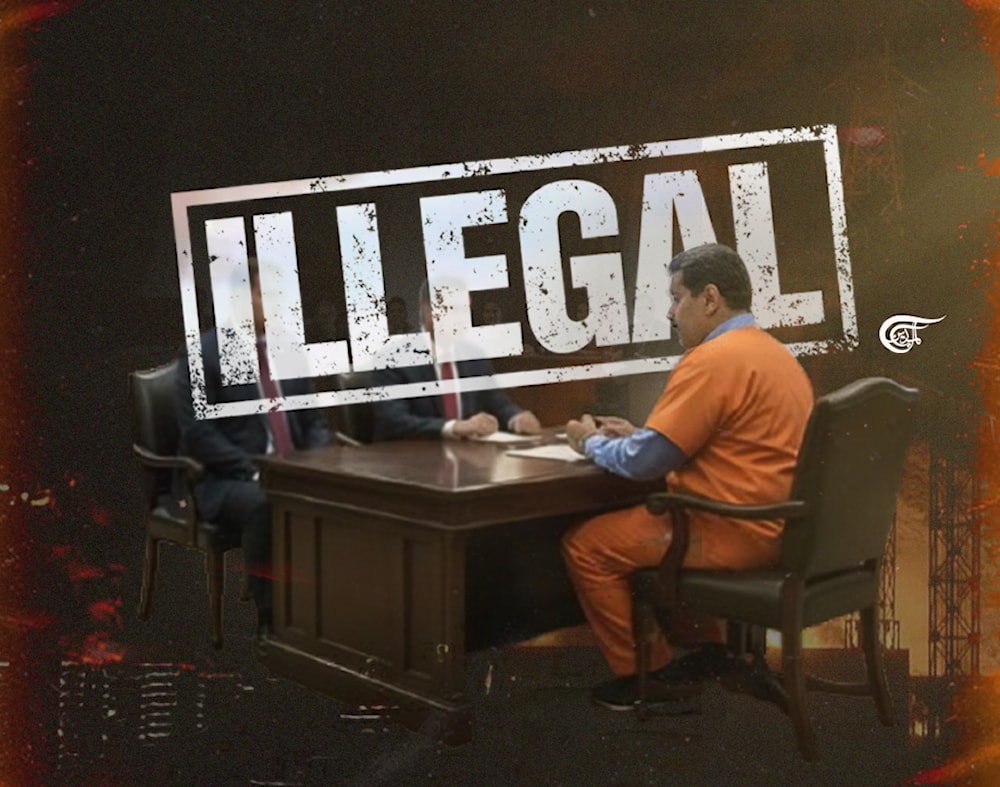
Strikes, kidnapping, Venezuela's oil seizure: a single chain of US illegality. (Al Mayadeen English; Illustrated by Zeinab al-Hajj)
On January 3, 2026, US forces struck Caracas and kidnapped Venezuela’s President Nicolas Maduro and First Lady Cilia Flores from their home country to face illegal prosecution in a US federal court, making one of the most audacious and blatant disregard and assaults on international law. Far from a legitimate law-enforcement action, the United States disregard for state sovereignty, head-of-state immunity, and the United Nations Charter poses a fundamental question about whether Washington recognizes any legal limits on its imperial power.
Case in point, US President Donald Trump did not justify the operation in legal terms. Instead, he framed it as an expression of dominance. In an interview with The New York Times, Trump said the kidnapping of Maduro and Flores was the product of “the iron laws that have always determined global power,” not international law. Asked whether any limits constrained his authority, Trump replied, “My own morality. My own mind. It’s the only thing that can stop me,” adding that he “doesn’t need international law.”
During the interview, Trump was also asked about whether his administration was bound by international law, to which he replied, “It depends what your definition of international law is.”
Those statements are not rhetorical excess, for they describe precisely how the United States has approached the kidnapping of President Nicolas Maduro and his wife, their illegal prosecution, and the economic theft of Venezuela’s oil wealth through force first, legality later, if at all.
President Maduro and Flores appear in US court
Two days after the US aggression on Caracas, on January 5, President Maduro appeared in a Manhattan courtroom and pleaded not guilty to US allegations of narco-terrorism, conspiracy to import cocaine, and weapons offenses.
“I’m not guilty. I’m a decent man, and I remain the President of my country,” Maduro told the court, describing himself as a “prisoner of war.” He said he had not seen the indictment before his appearance and was unaware of his legal rights; statements which alone raise questions about due process. After being reminded of his rights by the judge, Maduro requested a consular visit, which was approved. Likewise, First Lady Flores also rejected all US allegations.
Maduro’s lawyer, Barry Joel Pollack, highlighted “issues with the legality of the military abduction” and said both require medical care. Similarly, Flores’ lawyer confirmed that she had fractured or severely bruised ribs with visible facial bruises that were hard to miss in court.
Kidnapped from Caracas and brought before a US federal court, Venezuela's President Nicolas Maduro and his wife made their first appearance in New York, rejecting the charges, challenging the legitimacy of the trial, and making declarations that immediately reverberated beyond… pic.twitter.com/rLSXYX9dSm
— Al Mayadeen English (@MayadeenEnglish) January 5, 2026
No legal bases under the UN Charter
At the core of this case lies one simple question: Does the United States have any legal right to use military force to kidnap an elected sitting president from his own country? The answer under international law is also simple: No.
The use of force against Venezuela is governed by the United Nations Charter, to which the United States is a party.
Article 2(4) of the UN Charter explicitly prohibits “the threat or use of force against the territorial integrity or political independence of any state.” This principle is the cornerstone of the post-World War II international order. The US airstrikes on Caracas and the forcible kidnapping of Venezuela’s head of state, Nicolas Maduro, and his wife constitute a textbook violation of this provision.
However, the only recognized exception is found in Article 51, which permits the use of force solely in response to an armed attack until the UN Security Council acts.
“Nothing in the present Charter shall impair the inherent right of individual or collective self-defense if an armed attack occurs against a Member of the United Nations, until the Security Council has taken measures necessary to maintain international peace and security,” Article 51 stipulates.
Drug trafficking, even if alleged, even if transnational, even if proven, does not meet the legal definition of an armed attack under international law. Article 51 does not authorize airstrikes, military invasions, or kidnappings in response to criminal allegations or enforce criminal indictments.
Last but not least, there was no Security Council authorization, no Venezuelan consent, and no armed attack by Venezuela against the United States. Under the Charter, the US operation is unlawful, and the case ends here.
Sovereign immunity: A rule the US chooses to ignore
International law grants sitting heads of state personal immunity (immunity ratione personae) from foreign criminal jurisdiction. This rule exists to prevent powerful states from weaponizing domestic courts against foreign leaders they oppose.
Maduro is not a former official, a private citizen, or a deposed leader recognized by the United Nations as removed from office. Venezuela remains a UN member state, and Maduro remains its internationally recognized president. Therefore, trying him in a US court while in office, after being kidnapped by force, violates a settled rule of customary international law, which also renders the US “proceedings” legally tainted.
Venezuela’s Attorney General Tarek Saab slammed the United States for its "terrorist military attack" on #Caracas on January 3, emphasizing that the kidnapping of President #NicolasMaduro and his wife #CiliaFlores is an attack on national sovereignty itself.
— Al Mayadeen English (@MayadeenEnglish) January 7, 2026
Saab warned that the… pic.twitter.com/OS2ztsH6ri
A US trial built on an illegal act
Even under US domestic law, the prosecution rests on a deeply compromised foundation. Courts may assert jurisdiction over foreign nationals accused of transnational crimes, but international law does not permit enforcing that jurisdiction through military force on foreign soil.
Extradition treaties, mutual legal assistance, and diplomatic requests exist for a reason. The United States bypassed all of them. Instead, it chose aggression, airstrikes, and kidnapping.
Moreover, the legality of a trial cannot be separated from the legality of how the accused, that is, Maduro and Flores, were brought before the US court. While US courts have sometimes allowed trials to proceed even when defendants were brought to the US by unlawful means, as in Ker v. Illinois (1886), where a defendant was kidnapped from Peru, and Frisbie v. Collins (1952), where a defendant was forcibly transferred across state lines, international law treats coercion, abduction, and use of force as invalid. Meaning, no procedural step taken afterward can legitimize the underlying act.
ICC, ICJ, and the US contempt for international justice
Venezuelan President Nicolas Maduro’s case fits into a long-standing pattern of the United States accepting international law selectively and outright rejecting it when it becomes inconvenient.
Washington is not a party to the Rome Statute of the International Criminal Court and has actively worked to undermine its authority for daring to do its job, i,e. assert jurisdiction over crimes. In late 2025, the US government imposed sanctions on multiple ICC judges and officials after the court upheld arrest warrants for Israeli Prime Minister Benjamin Netanyahu and former Security Minister Yoav Gallant. It also froze their assets and barred travel for those involved in the investigations. Simply put, the US punished judges and prosecutors for applying international law to a US ally.
Meanwhile, the International Court of Justice (ICJ) offers Venezuela a theoretical avenue to challenge the United States’ use of force and violations of sovereignty; however, enforcement would be mainly symbolic. In past cases, such as the 1986 ICJ judgement in Nicaragua v. United States, the Court found that the US support for armed groups and cross-border operations violated the UN Charter’s prohibition on the use of force. However, Washington refused to comply with the ruling, and the UN Security Council could not enforce it due to the US veto power.
Bearing the above in mind, it’s become quite clear that the United States takes the ICC’s authority lightly and resists ICJ rulings it disfavors, showing that international legal constraints rarely restrain US power in practice.
Seizing and selling Venezuela’s oil: Another legal breach
When it comes to Venezuela, the US legal violations extend far beyond kidnapping President Nicolas Maduro and his wife, Cilia Flores.
The US Department of Energy announced that seized Venezuelan crude oil and petroleum products will be sold, with proceeds placed in US-controlled accounts at “globally recognized banks” to ensure the “legitimacy and integrity” of distribution.
However, under international law, state assets enjoy sovereign protection, particularly when they belong to a government still in power. Customary international law and the UN Convention on Jurisdictional Immunities of States and Their Property prohibit the seizure or monetization of another state’s property without the absent express consent or a Security Council mandate. Moreover, the principle of permanent sovereignty over natural resources, affirmed by UN General Assembly Resolution 1803 and recognized by the International Court of Justice, bars the confiscation and sale of a state’s oil by another state.
There is no legal doctrine allowing one state to sell another state’s oil simply because it has kidnapped its president. Therefore, confiscating and monetizing another country’s natural resources without consent or a UN mandate amounts to unlawful appropriation.
While Delcy Rodriguez has been formally sworn in as Venezuela’s interim president under the country’s constitutional procedures, international law demands more than a domestic title when it comes to sovereign consent over state assets. Under the UN Charter and customary international law, state-owned resources are protected from foreign seizure or disposal unless the state itself gives genuine, voluntary consent through a lawful authority, or unless an authoritative United Nations Security Council mandate exists.
Rodriguez’s constitutional authority provides domestic legitimacy, and Venezuela’s state oil company PDVSA has stated that it is negotiating crude oil sales with the United States on commercial terms, framing them as transparent, mutually beneficial, and similar to prior deals with international companies like Chevron.
However, these negotiations occur in the context of Maduro’s kidnapping and US control over Venezuelan oil flows and proceeds. International law recognizes that consent obtained under the shadow of unlawful force, including military strikes and the abduction of a sitting president, is not automatically free or voluntary. This principle is codified in Article 52 of the Vienna Convention on the Law of Treaties and affirmed by the International Court of Justice, which has consistently held that consent given under coercion, including military pressure, cannot confer legal validity. For example, in Armed Activities on the Territory of the Congo (Democratic Republic of the Congo v. Uganda), the ICJ found that "from August 1998, the DRC had not consented to the presence of Ugandan troops," and "rejected Uganda's claim that its use of force, where not covered by consent, was an exercise of self-defense, finding that the preconditions for self-defense did not exist." The Court held that Uganda’s military intervention constituted a "grave violation of the prohibition on the use of force under Article 2, paragraph 4, of the United Nations Charter." Accordingly, any agreements reached under such conditions do not automatically cure the underlying illegality of the seizure or monetization of Venezuelan resources.
The case of Nicolas Maduro: An illegal US atrocity that demands accountability
The US strikes on Caracas, the kidnapping of President Nicolas Maduro and First Lady Cilia Flores, their illegal prosecution in a US domestic court without Venezuelan consent or international mandate, and the seizure and sale of Venezuela’s oil form a single chain of illegality.
US President Donald Trump’s statement that “the iron laws that have always determined global power” is not incidental. It asserts that some states are bound by law, while mainly one, the US, is not and will never be at this rate.
While the UN Charter was designed precisely to prevent this logic from governing international relations and to replace conquest with rules, force with restraint, and power with law, the US exposed how fragile it is and how easily it shatters when enforcement depends on who holds military and financial dominance.
If the US escapes accountability and its conduct is treated as lawful, then international law ceases to be law at all. It becomes optional, one that is enforced against the weak and stepped on by the strong.


