
India's silence on US sinking of Iran's vessel 'an embarrassment': Op.
 5 Min Read
A.J. Prabal argues India’s lack of response to the reported United States Navy strike on an Iranian vessel near its waters risks diplomatic embarrassment, weakens regional authority, and undermines trust built through naval cooperation.
-
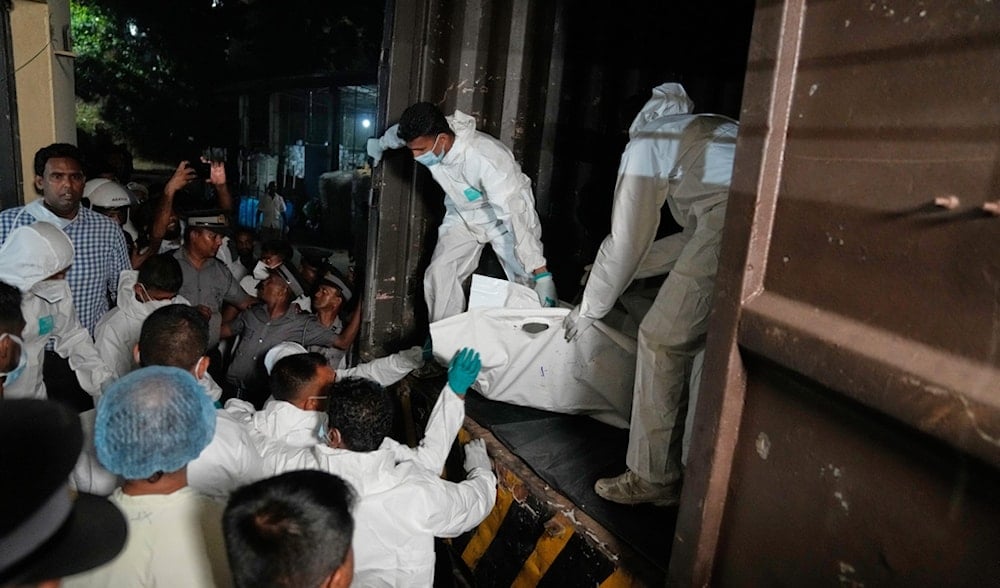
Healthcare workers unload from a vehicle, the bodies of Iranian sailors who were killed when their IRIS Dena warship was sunk outside Sri Lanka's territorial waters, in Galle, Sri Lanka, Wednesday, March 4, 2026 (AP)
India's silence over the sinking of the Iranian naval vessel IRIS Dena by the United states has discredited New Delhi and its claim to neutrality, instead contributing to its growing diplomatic isolation, author A.J Prabal wrote in the National Herald.
In a piece titled "US Navy embarrasses India by sinking ‘unarmed’ Iranian warship," Prabal writes that the absence of either condolence or condemnation following the attack in the Indian Ocean has caused “embarrassment” for India and set a dangerous precedent for maritime security.
He characterizes the strike as unprovoked and conducted without warning, highlighting that torpedoes were fired without giving sailors a chance to evacuate. Based on this event, “No ship is now safe anywhere,” he notes.
India must reject warfare imposed by US, experts say
Former Indian Navy chief Arun Prakash called the sinking a reckless move that could destabilize regional waters and disrupt global shipping. In a televised interview, he slammed it as “a senseless and inflammatory act,” adding, “India must convey our displeasure to the US… you have brought maritime warfare to our borders without informing us,” expressing concern that a nuclear submarine was operating close to India’s coastline without coordination.
Strategic affairs analyst Sushant Singh said the incident dealt a blow to New Delhi’s regional credibility, noting the Iranian vessel had just departed Indian waters after participating in MILAN, a naval exercise hosted by India at Visakhapatnam. “In all likelihood, the Trump administration bypassed the Modi government entirely, launching a lethal submarine strike to expand the war zone without prior notice,” he said.
Similarly, former foreign secretary Kanwal Sibal, generally seen as supportive of the government, stressed that MILAN is meant to build trust and promote “a free, open, inclusive and rules-based maritime order.” He said the Iranian frigate had been hosted by the Indian Navy and added that “the spirit of the MILAN exercise has been violated by this US action… all this is not helpful.”
Security analyst Brahma Chellaney argued that striking a ship returning from an Indian-hosted event effectively turned the country’s maritime neighborhood into a conflict zone. He said the move “violated the unwritten code of naval hospitality,” warning it could deter other navies from participating in Indian exercises.
Meanwhile, Praveen Swami, contributing editor at ThePrint, said prior notification to India and Iran “would have been the decent thing,” allowing the ship to seek shelter. Both he and Chellaney noted that while international waters permit freedom of navigation, wartime conduct is still governed by humanitarian obligations under the Geneva Conventions, including efforts to rescue survivors. According to the opinion, the US submarine left the area, with rescue operations reportedly handled by Sri Lanka Navy.
Read more: India, 'Israel' expand defense, trade cooperation
Has India any maritime authority?
Prabal also references critics who dismiss the argument that India bears no responsibility because the strike occurred outside its territorial waters. One widely shared comment said, “The Iranian ship was a guest of the Indian Navy and it should not matter if it is attacked just beyond your boundary.”
The piece further recalls past tensions, including a 2021 US naval exercise near Lakshadweep, and notes that while India has ratified the United Nations Convention on the Law of the Sea, the United States has not. Critics argue this has allowed Washington to conduct operations in India’s exclusive economic zone without consent.
Overall, Prabal contends that the episode raises difficult questions about India’s maritime authority and diplomatic posture in its immediate neighborhood.
Iran vows: US will 'bitterly regret' its crime
Meanwhile, Iranian Foreign Minister Abbas Araghchi warned Thursday that Washington will pay a heavy price for its "atrocity at sea," after the US submarine torpedoed and sank the Iranian frigate IRIS Dena in international waters near Sri Lanka, killing at least 87 sailors with dozens more still missing.
"The US has perpetrated an atrocity at sea, 2,000 miles away from Iran's shores," Araghchi wrote on X. "Frigate Dena, a guest of India's Navy carrying almost 130 sailors, was struck in international waters without warning. Mark my words: The US will come to bitterly regret the precedent it has set."
The U.S. has perpetrated an atrocity at sea, 2,000 miles away from Iran's shores.
— Seyed Abbas Araghchi (@araghchi) March 5, 2026
Frigate Dena, a guest of India's Navy carrying almost 130 sailors, was struck in international waters without warning.
Mark my words: The U.S. will come to bitterly regret precedent it has set. pic.twitter.com/cxYiI9BLUk
The IRIS Dena had spent February as an invited guest of the Indian Navy at the International Fleet Review 2026 in Visakhapatnam, a ceremonial multinational gathering attended by naval forces from 74 countries, including the United States and Russia, and inspected by Indian President Droupadi Murmu.
Iran's Navy chief met India's Chief of Naval Staff during the visit, and the Indian Eastern Naval Command welcomed the Dena on social media, noting the "long-standing cultural links" between the two nations.
Welcome! | خوش آمدید!
— Eastern Naval Command 🇮🇳 (@IN_HQENC) February 17, 2026
🇮🇳🤝🇮🇷 Indian Navy welcomes IRIS Dena, of the Iranian Navy, on her arrival at #Visakhapatnam to participate in #IFR2026_India and #MILAN2026, reflecting long-standing cultural links between the two nations.@India_in_Iran #BridgesOfFriendship… pic.twitter.com/O77v2qNJHJ
The ship was sailing home when, at approximately 5:08 am on March 4, a US Mark 48 torpedo detonated beneath its stern, lifting the vessel out of the water and breaking its keel.
The Dena sank before any rescue vessel could reach it, and when Sri Lanka's navy arrived at the coordinates of the distress call, what remained was “only some oil patches and life rafts,” navy spokesman Commander Buddhika Sampath said. “We found people floating on the water.”
Read more: IRGC Navy commander challenges Trump: 'Come escort the ships'


