
Inside Gaza's water crisis: 'Israel' kills engineers, blocks supplies
 4 Min Read
Israeli strikes have killed 19 water workers in Gaza as shortages deepen, leaving millions with no clean water, no sanitation, and no path to repair.
-
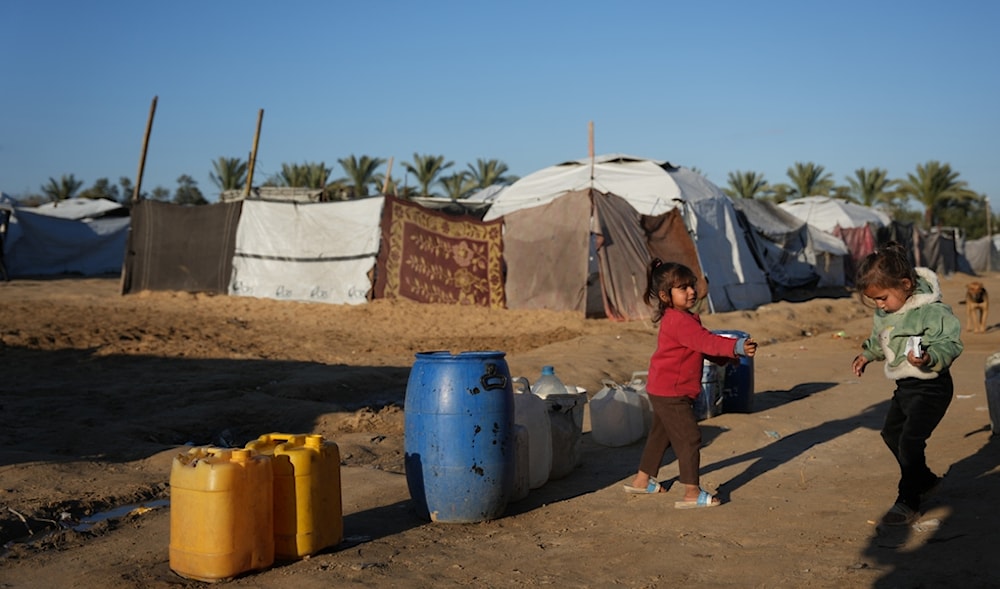
Displaced Palestinians stand by empty water barrels as residents wait for a drinking water delivery in Deir al-Balah, Gaza Strip, Saturday, Jan. 17, 2026. (AP Photo/Abdel Kareem Hana)
Attacks by Israeli forces have killed at least 19 Palestinian water facility workers since the beginning of the war on Gaza, with the most recent incidents occurring within days of each other in mid-April.
An attack on the al-Zein well in northern Gaza left one engineer martyred and four wounded, causing severe structural damage to a facility serving thousands of residents, according to a The Guardian report published on Monday.
Days before that attack, Israeli forces shot and killed two drivers contracted by UNICEF at the primary water collection point for northern Gaza, wounding two others. The UN children's agency warned the killings threatened humanitarian networks supplying clean water to hundreds of thousands of people across the territory.
READ MORE: Killings and destruction continue in Gaza despite ceasefire
Severe shortages, worsening by the day
Following "Israel's" genocidal war on Gaza, the water supply has collapsed to a fraction of what basic human survival requires.
Average daily access stands at just 7 litres of drinking water per person and 16 litres for domestic use, well below the UN's emergency minimum of 6 litres for drinking alone, and a fraction of its standard benchmark of 50 to 100 litres per person per day.
Residents describe daily races to reach water trucks before supplies run out. Omar Saada, a displaced father of four in Khan Younis, told The Guardian that a single truck serves over 50 families in his area, with distribution windows shrinking from several hours to just two.
His children have developed skin infections from reduced bathing, while the water itself causes intestinal problems. "We are forced to drink it because it is the only water available," Saada said.
READ MORE: Civilian toll rises: 3 Palestinians killed in Israeli strikes on Gaza
A manufactured crisis
Médecins Sans Frontières emergency humanitarian affairs manager Laureline Lasserre said the conditions her teams treat daily are a direct product of deliberate policy. "No clean water, no soap, overcrowded living conditions; this is the root cause of a huge proportion of what we treat every day," she told The Guardian.
MSF has documented women developing infections due to the inability to wash during menstruation and after childbirth, infants repeatedly falling ill due to a lack of clean water for formula, and wounds becoming larvae-infested.
Lasserre also flagged a rise in psychological conditions, including suicidal ideation, linked directly to water deprivation.
Unjustified Israeli restrictions on importing soap, detergent, and hygiene products have driven prices to double in just one month, placing basic sanitation further out of reach for displaced families already living in overcrowded shelters and tent camps.
No path to repair
Destruction of desalination plants, pumping stations, and water pipes has been compounded by the occupation's blockades on fuel, spare parts, and equipment.
Engineers have been forced to salvage usable components from multiple destroyed facilities to keep a single unit functioning. A recent airstrike damaged the power line to the Deir al-Balah desalination plant, which serves up to 400,000 people, forcing it to operate at 20% capacity for a week.
The sewage crisis is equally dire. Around 1.1 million displaced people live without functional sewage networks. Of the 100 trucks needed to manage septic overflow, only 15 remain.
With summer approaching and no new equipment permitted entry, health authorities warn that conditions are set to deteriorate further.


