
IOF detonate 700 tons of explosives under historic Shaqif Fortress
 4 Min Read
Israeli occupation forces carry out a massive underground detonation beneath the UNESCO-listed Shaqif Fortress in southern Lebanon's Arnoun.
-
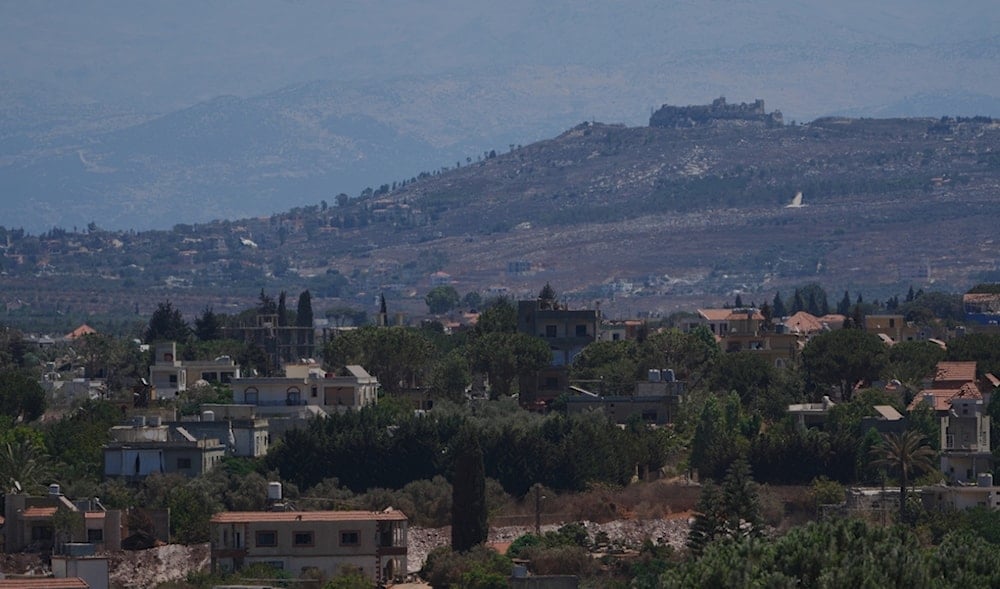
IOF vehicles positioned among homes in Zawtar al-Sharqiyah, occupied by the IOF, with Beaufort Castle atop a hill in the background, as seen from the southern village of Zawtar al-Gharbieh, Lebanon, Tuesday, July 28, 2026. (AP Photo/Hassan Ammar)
Israeli occupation forces set off a massive underground explosion beneath the UNESCO-listed Shaqif Fortress (Beaufort Castle) in the Arnoun area of southern Lebanon overnight Thursday into Friday, using an estimated 700 tons of explosives, according to a joint statement by the Israeli prime minister's office and the Ministry of War.
The blast was powerful enough to be heard across much of southern Lebanon, with reports of the explosion being heard as far as Saida and Iqlim al-Kharroub in Mount Lebanon's Chouf region. In Nabatieh, residents reported dust raining down over the area in the aftermath of the explosions in Arnoun.
WATCH | Footage captures the moment Israeli occupation forces carried out powerful detonations in southern Lebanon, with massive clouds of dust billowing across nearby villages following the blast. pic.twitter.com/4h4FeJSqQl
— Al Mayadeen English (@MayadeenEnglish) July 30, 2026
Shaqif Fortress is one of South Lebanon's most significant archaeological landmarks, a nearly 900-year-old Crusader-era fortress. "Israel" has bombed the fortress more than once, first in 1982, during the Battle of Beaufort, when the castle was heavily shelled and captured, and second during 1982 through 2000, when Israeli occupation forces used it as a base and later carried out significant demolition before withdrawing in 2000.
Israeli allegations
According to the statement, the operation was ordered by Israeli Prime Minister Benjamin Netanyahu and War Minister Israel Katz, and aimed to destroy what "Israel" alleged was a network of tunnels linked to Hezbollah beneath the castle. "Israel" also claimed the bombing came in response to a Hezbollah "violation" of the ceasefire agreement.
The so-called "violation" the occupation is citing traces back to an incident two days earlier. Hebrew-language Israeli outlets, including Yedioth Ahronoth and Channel 12, reported that an Israeli military engineering vehicle was struck overnight Tuesday into Wednesday in southern Lebanon. Other Israeli media outlets cited an Israeli army assessment that Hezbollah had targeted the engineering vehicle with a booby-trapped drone after it attempted to operate in the Ali Taher hill area.
Hezbollah, however, has not released a statement claiming the operation.
However, a Press TV correspondent in South Lebanon rebuked the Israeli narrative, reporting that Israeli occupation forces had been rigging the tunnel network for detonation for weeks before the incident near Ali Taher hill that "Israel" is citing as justification. He also noted that portions of the tunnel network predate any Hezbollah presence in the area by decades, and in some cases centuries.
Lebanon had already rejected the premise
Lebanon's Directorate General of Antiquities, under the Ministry of Culture, issued a statement in June explicitly rejecting Israeli claims that Beaufort housed Hezbollah military infrastructure, describing the maps and video footage "Israel" had circulated as fabricated and geographically unrelated to the archaeological site itself.
The ministry said management of the fortress has been under its direct authority since the withdrawal of the Israeli occupation in 2000, and that the site has held enhanced protection since November 2024 under the 1954 Hague Convention and its Second Protocol governing cultural property in armed conflict.
Culture Minister Ghassan Salame had separately welcomed UNESCO's decision to place Beaufort and four other Jabal Amel-region fortresses on its List of World Heritage in Danger, while accusing Israeli occupation forces of already having destroyed Chamaa Castle and warning that Beaufort itself remained under threat of demolition.
Lebanese geologists raise concern
Lebanese geologists have separately raised concerns about the seismic risks of large-scale demolitions in southern Lebanon. Dr. Tony Nemer of the American University of Beirut has warned that concentrated explosive detonations near the point where the Levant Fault splits into the Yammouneh and Roum faults can alter fault stress and risk triggering human-induced earthquakes.
He first raised that concern after a 2024 wide-scale Israeli demolition operation in Odaisseh used 400 tons of explosives, an operation strong enough that "Israel's" own Geological Institute issued earthquake alerts to 284 localities in northern occupied Palestine and the occupied West Bank. Friday's operation at Beaufort used significantly more explosive material than Odaisseh.


