
Iran could emerge stronger from the war, more dangerous to US: FT
 3 Min Read
Financial Times columnist Gideon Rachman argues Iran is turning Strait of Hormuz control into a potential billion-dollar revenue stream while Washington scrambles for options.
-
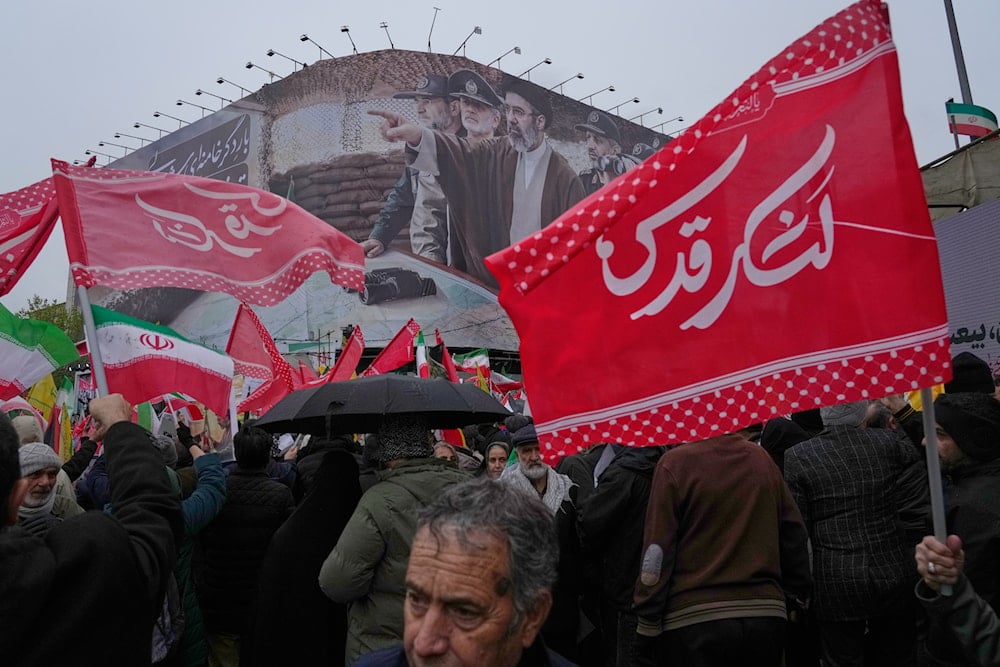
A billboard shows a graphic depicting Iran's Leader Mojtaba Khamenei with military commanders as people attend the annual Quds Day, rally in support of Palestinians, in Tehran, Iran, March 13, 2026 (AP)
Financial Times columnist Gideon Rachman argues that Iran is emerging from the US-Israeli war on it in a position of strategic strength, having demonstrated the capacity to close the Strait of Hormuz and impose a reported transit toll on commercial shipping, in a development that has exposed the limits of US military and diplomatic power in the region.
There is no question that the Islamic Republic has absorbed significant blows since the war began. Senior leadership, including the country's supreme guide, was martyred in the opening hours of the aggression, and missile launchers, ships, and command centres have been reportedly attacked.
Yet Iran has not merely held its ground. By effectively closing the strait and charging vessels a reported $2 million each for passage, Tehran has converted military pressure into economic leverage, and potentially into a permanent revenue stream.
With approximately 140 ships transiting the strait daily under normal conditions, the toll mechanism could generate billions of dollars per month for the Islamic Republic.
A new source of income
Control over the strait also gives Iran direct influence over the Gulf's energy-dependent neighbours. Rachman argues that Saudi Arabia and the United Arab Emirates are now forced to either escalate and risk devastating economic consequences or accept Tehran's de facto authority over one of the world's most critical shipping lanes.
Asian nations, which represent the primary market for Gulf energy exports, may also find themselves quietly accommodating Iranian demands rather than absorbing sustained energy price shocks.
European states, already at odds with the Trump administration, face a similar dilemma.
Washington without a clear path
Rachman explains that the United States has no obvious military solution. Western military planners have assessed that reopening the strait by force alone is unlikely to succeed, given Iran's use of drones that can be operated from well beyond the shoreline and the challenging geography of the area.
Even naval escorts cannot guarantee the safety of commercial traffic. A seizure of Kharg Island, floated by Trump in a recent interview, would not resolve the strait problem, either.
According to Rachman, the only option left is negotiation. But Iran, aware of the leverage it now holds, is in no rush to settle. Trump has publicly acknowledged finding the Iranian negotiating style "strange," and reports suggest the US president floated the idea of jointly managing the strait with Tehran, an overture the Iranians appear to have ignored.
Regional order under pressure
The war has exposed deep fault lines in a regional order long underpinned by US military dominance. Gulf states that once counted on US security guarantees now face the prospect of a reconfigured balance of power in which Iran holds practical control over energy export routes and the ability to grant or deny economic access to countries across the globe.
Iran, for its part, has demonstrated that sustained military assault does not automatically translate into political defeat, and that geography, technology, and strategic patience can be decisive factors even against a far superior military force.


